

More news on this day
As airspace closures and missile strikes linked to the 2026 Iran war continue to disrupt key Gulf aviation hubs, the United Arab Emirates is increasingly turning to its growing national rail network to keep people moving, highlighting how ground transport is becoming a vital back-up when conventional air travel falters.
Get the latest news straight to your inbox!
Regional Airspace Turmoil Leaves Travelers Stranded
Recent escalations involving the United States, Israel and Iran have triggered sweeping airspace restrictions across the Middle East, forcing airlines to cancel or reroute thousands of flights and leaving passengers facing long delays, diversions and unexpected stopovers. Reports indicate that airports in the United Arab Emirates, Qatar, Bahrain, Kuwait and other states have at times faced partial or full suspensions of civilian traffic as authorities weighed the risks of potential missile and drone activity in contested airspace.
Published coverage on the economic impact of the 2026 Iran war notes that airspace closures in multiple Gulf states, including the UAE, have led to several thousand daily flight cancellations and extensive rerouting along longer paths that circumnavigate the region. As a result, journeys between Europe, Asia and Africa that once relied on short transits through Dubai or Abu Dhabi now frequently take hours longer, with airlines absorbing higher fuel costs and passengers dealing with missed connections and disrupted itineraries.
Travel advisories issued in early March describe a fluid situation in which some Gulf airports are operating at reduced capacity while others briefly suspend services altogether, depending on daily threat assessments. Logisticians tracking air cargo movements report that key transit hubs such as Dubai and Abu Dhabi have seen inbound and outbound schedules repeatedly reworked, amplifying uncertainty for travelers seeking a stable route in or out of the region.
For many passengers, especially those undertaking long-haul trips that traditionally depend on the Gulf’s role as a global crossroads, the turbulence in air connectivity is prompting a search for alternative corridors. Within the UAE, that search increasingly points toward the country’s national railway project, which is beginning to demonstrate its value in crisis conditions.
Etihad Rail Demonstrates Crisis Readiness for Passengers
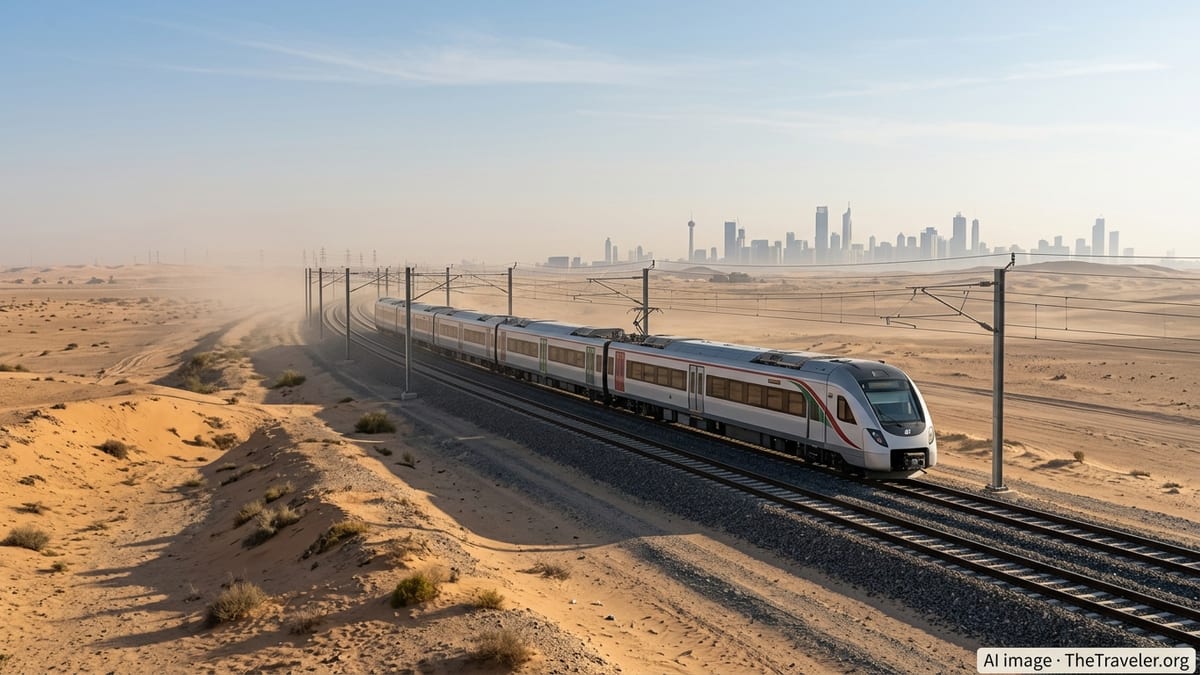
While Etihad Rail has so far been best known for its freight operations, recent developments show how the network can support passenger evacuation and internal mobility when aviation is constrained. According to reports from Emirates 24/7, the operator ran an exceptional passenger service earlier in March between Al Ghuwaifat near the Saudi border and Al Faya in Abu Dhabi, transporting around 350 people affected by the regional travel disruption.
The service, described in local coverage as an emergency measure aligned with broader crisis management efforts, used the national rail line as a secure land bridge for travelers whose onward air journeys had been delayed or diverted. The operation was coordinated with authorities on both the UAE and Saudi sides of the border, underlining how cross-border cooperation can help mitigate the impact of sudden airspace closures on individuals caught mid-journey.
Publicly available information on the run highlights several advantages of deploying rail in such circumstances. Trains were able to move large numbers of passengers in a single operation, avoid contested airspace entirely and operate on dedicated infrastructure less exposed to the knock-on effects of airport damage or congestion. The exercise also offered a real-world test of the network’s emergency response procedures, from scheduling and staffing to security and passenger handling.
Observers of Gulf transport policy note that this kind of ad hoc passenger operation, even at modest scale, signals a shift in how national rail is perceived. What was once framed primarily as a freight corridor and long-term economic enabler is now being positioned as a flexible strategic asset capable of supporting people as well as goods when routine air services are interrupted.
Rail’s Role in Keeping People and Goods Moving
In parallel with its emerging passenger role, the UAE’s rail system has been working to keep critical freight flows steady despite regional instability. A recent report by Gulf News on Etihad Rail’s performance during the current crisis states that the operator has maintained uninterrupted cargo services across the country, allowing industries and retailers to receive supplies even as air routes fluctuate.
The report describes how trains have continued to transport containers, construction materials and other bulk cargo between key industrial zones and ports, reducing reliance on long-haul trucks and relieving some pressure on maritime and air logistics chains. In an environment where many passenger flights, which normally carry substantial bellyhold freight, have been canceled, rail has become an important alternative for domestic distribution within the UAE.
Freight stability directly benefits passengers in less obvious ways. By keeping supermarket shelves stocked and industrial projects supplied, the rail network helps avoid the secondary disruptions that can occur when prolonged aviation outages lead to shortages or bottlenecks. This baseline of reliability supports the wider tourism and hospitality sector, ensuring that hotels, resorts and tour operators can continue to serve guests who do reach the country, even if their journeys have been longer or more complex than planned.
Industry analysts point out that the UAE’s investment in rail offers resilience not only for crises linked to conflict but also for other shocks such as extreme weather or global health emergencies. Because trains operate on fixed, controlled corridors, they can be less vulnerable than air routes to sudden cross-border restrictions, making them a valuable part of a diversified national transport portfolio.
Future Gulf Connectivity and Passenger Prospects
The crisis-driven activation of Etihad Rail for emergency passenger movements comes as the UAE and its neighbors continue to develop long-term plans for integrated Gulf Cooperation Council rail links. Policy papers and regional transport strategies have long envisioned a continuous rail spine running from Kuwait and Saudi Arabia through the UAE to Oman, potentially offering travelers an overland alternative to short-haul flights along some of the Gulf’s busiest corridors.
Although large-scale international passenger rail services in the region are still in their early stages, recent events may accelerate interest in such options. Travel commentators suggest that business travelers and tourists, once accustomed to relying almost exclusively on aircraft for regional mobility, could gradually embrace modern intercity trains for certain routes, especially where station-to-station journey times can compete with disrupted short-haul flights.
For now, the exceptional Abu Dhabi rail operation remains a limited but symbolic example of what might be possible. As airspace over parts of the Middle East remains contested and airlines continue to adjust schedules from one week to the next, the ability of Gulf states to offer safe, reliable movement on the ground will likely become an increasingly important marker of resilience. Investment decisions made today in tracks, stations and rolling stock may determine how effectively the region can protect both residents and visitors from the worst effects of future aviation shocks.
For travelers planning journeys through the UAE in the months ahead, publicly available guidance consistently emphasizes the need for flexibility and up-to-date information on flight status. At the same time, the emergence of rail as a credible support system when skies turn uncertain suggests that, in the Gulf, the next phase of connectivity will rely not only on aircraft, but on trains quietly linking cities and borders below.