

More news on this day
Unseasonably intense rainstorms are once again testing the UAE’s transport network, with Dubai joining Abu Dhabi, Sharjah, Ajman, Ras Al Khaimah and Al Ain in reporting flooded roads, disrupted flights and warnings of more unstable weather that could complicate travel plans over the coming days.
Get the latest news straight to your inbox!
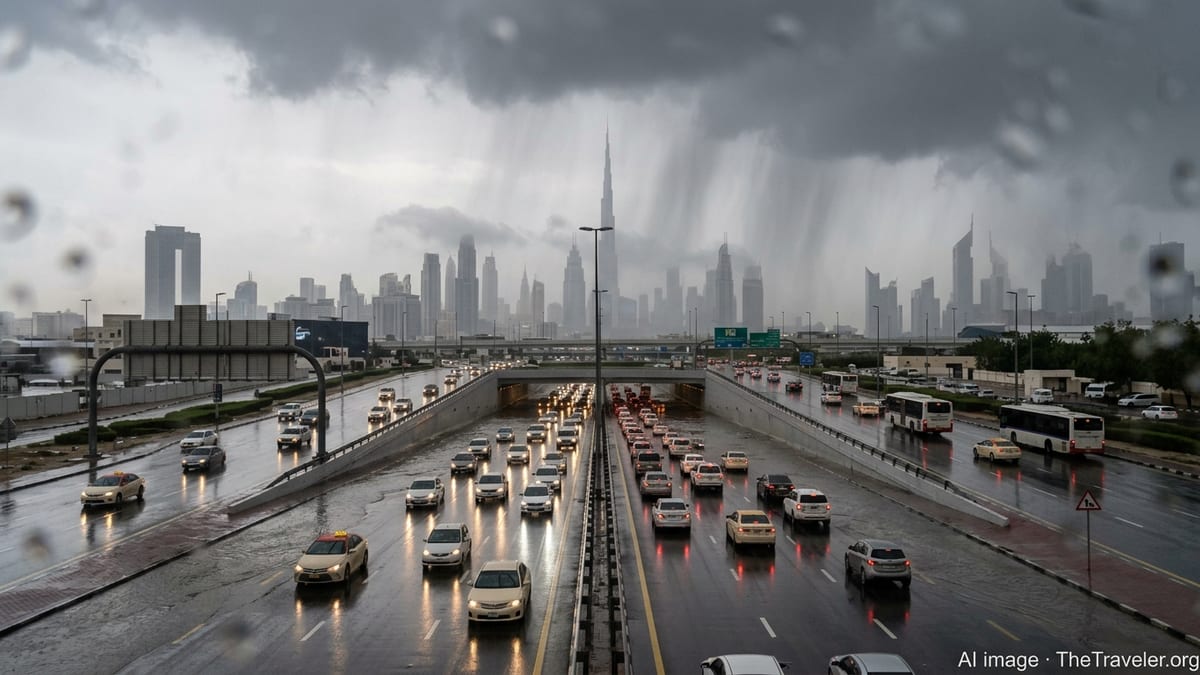
Rain, Flooding and an Unsettled Forecast Across the Emirates
Publicly available weather bulletins and local updates point to a broad swathe of unstable conditions across the UAE this week, with thick cloud, bursts of heavy rain and isolated thunderstorms affecting both coastal and inland cities. Forecasts for the period around March 24 to March 27 indicate continued chances of showers over Dubai and Sharjah, along with cooler temperatures and gusty winds that can reduce visibility and make driving more hazardous.
Rainfall reports shared by local observers describe significant downpours in parts of Abu Dhabi and Ajman, with gauges in inland districts recording tens of millimetres of rain in a short time. These intense bursts have produced standing water on key highways and roundabouts, a familiar pattern during powerful Gulf storms when drainage systems are rapidly overwhelmed.
In Ras Al Khaimah and Al Ain, social media posts and community forums highlight localized flooding on smaller roads and near wadis, particularly where runoff funnels out of surrounding hills. Even when rain is intermittent, the combination of saturated ground and fresh showers can keep surface water in place for hours, forcing detours and slower traffic.
While the current system is not as prolonged as the record event of April 2024, early indications suggest that the spatial footprint is broad, affecting multiple emirates simultaneously. For travelers, that means disruption is not confined to a single city but can ripple across the country’s interconnected air, road and bus networks.
Dubai and Abu Dhabi Airports: Operating, But With Weather and Security Headwinds
Dubai International Airport remains the region’s critical gateway, and recent weeks have already tested its resilience. Published coverage in early March detailed how flights were temporarily suspended after an incident involving the airfield, followed by a cautious, limited restart with a reduced schedule and priority for connecting passengers. Even as operations scaled back up, travelers reported extended queues, rebookings and missed onward connections as airlines worked through accumulated backlogs.
On top of those earlier disruptions, the latest spell of heavy rain is adding a fresh layer of complexity. Thunderstorms, low cloud and standing water on taxiways can all trigger flow restrictions, resulting in minor delays that compound during busy banks of arrivals and departures. Community reports from passengers over the past two weeks reference long holding patterns in the air, diversions to Al Maktoum International Airport and late-night arrivals after weather or operational pauses.
Abu Dhabi’s main airport has faced similar pressure, as regional airspace restrictions linked to wider Gulf security concerns have occasionally intersected with bad weather. Port and aviation advisories circulated in early March referenced airspace closures or limitations across parts of the Gulf, prompting some carriers to thin schedules, reroute flights or consolidate services. When storms then move through the UAE, even a modest reduction in runway capacity can push already stretched timetables into further delay.
For travelers planning imminent trips, the picture is not one of a complete shutdown, but of a fragile operational environment. Flights are operating, but they are more vulnerable than usual to delay, last minute gate changes and rerouting as airlines and airports navigate both meteorological and security variables.
On the Roads: Flooded Underpasses, Slowed Highways and Longer Transfer Times
Within the cities, the most visible impact for visitors is often on the roads. In Dubai, Sharjah and Ajman, stretches of the E11 and E311 as well as major city arterials are prone to surface flooding during intense rain. Posts from commuters describe water pooled in underpasses, lane closures and vehicles inching through bottlenecks where temporary pumps and road crews are trying to keep junctions passable.
Sharjah and Ajman, with dense residential and industrial corridors feeding into Dubai, are particularly sensitive to even modest flooding. Travelers staying in these emirates and relying on road transfers to catch flights from Dubai or Abu Dhabi are reporting markedly longer journey times, especially during the morning and evening peaks. Buses and taxis must detour around inundated sections, and the lack of alternative high-capacity routes can quickly translate into multi-hour delays.
Farther north, Ras Al Khaimah has seen water across some internal roads and areas near wadis, while Al Ain’s proximity to the Hajar Mountains means sudden runoff can affect outskirts and approach roads after downpours. Although primary highways are usually cleared first, access roads to resorts, desert camps and adventure sites can become temporarily impassable, limiting excursions and tour operations.
The practical message for visitors is simple but important: transfer times that feel generous in dry conditions may no longer be sufficient. A drive from Sharjah to Dubai International Airport that might take 45 minutes on a clear night can stretch far beyond that if heavy rain coincides with rush hour or if a key tunnel or underpass is closed due to flooding.
What Travelers Can Expect in the Coming Days
Weather bulletins for the remainder of the week point to a pattern of partly cloudy to cloudy skies with recurring chances of rain, especially along the coast and in northern and eastern areas. Winds are expected to be light to moderate, occasionally fresh over the sea, with the Arabian Gulf at times moderate to rough. That combination means conditions can change quickly from manageable showers to short, intense downpours that briefly disrupt both ground and air operations.
For flight schedules, publicly available airline and airport notices suggest that carriers are continuing to adjust timetables day by day. Some long haul services have been consolidated or retimed to create buffers around the busiest storm periods, while a number of regional flights have shifted departure times or been merged with other services. Travelers are being urged in official advisories and airline updates to monitor flight status right up to the time of leaving for the airport.
Hotel and tour operators across Dubai, Abu Dhabi and the northern emirates are meanwhile revisiting outdoor plans and excursion timings. Desert safaris, dhow cruises and mountain treks are especially exposed to weather shifts and may be postponed, rerouted or shortened at short notice. In several cases, operators are moving guests toward indoor attractions, malls and cultural sites while keeping a flexible rebooking policy for weather-affected activities.
The near term outlook therefore favors a cautious, flexible approach to itineraries. Visitors who build in extra time, stay close to their departure airport before long haul flights and keep alternative activity options in mind are likely to find the experience less stressful, even if the weather remains unsettled.
How to Protect Your UAE Trip Amid Weather Chaos
With rainstorms now affecting not just Dubai but also Abu Dhabi, Sharjah, Ajman, Ras Al Khaimah and Al Ain, planning around disruption is fast becoming an essential part of visiting the UAE. Travel specialists generally recommend treating flight times as provisional during active weather alerts, double checking status through airline channels and considering same day or overnight stays in the city of departure rather than relying on long pre flight transfers from other emirates.
On the ground, simple precautions can make a significant difference. These include allowing generous buffers for road transfers, particularly if crossing emirate borders; avoiding known traffic choke points during peak rain periods where possible; and being prepared for taxi or ride hailing prices to surge temporarily when conditions worsen. Travelers using rental cars should be especially cautious about driving through standing water or attempting to cross flooded underpasses, as vehicles can quickly become stranded.
Insurance and booking flexibility also matter more in the current climate. Policies that include coverage for weather related delays, missed connections and extra accommodation costs can reduce the financial sting of unforeseen changes, while flexible hotel and tour bookings provide room to shift dates without penalty if a key activity day coincides with heavy rain or operational slowdowns.
For now, the UAE remains open and welcoming to visitors, but the pattern of recent weeks underlines how quickly conditions can shift. By anticipating potential snags at airports and on roads across Dubai and its neighboring emirates, travelers can still enjoy the country’s attractions while staying a step ahead of the weather.