

More news on this day
The United Arab Emirates is preparing for a busy Eid Al Fitr period in March 2026, as the country aligns its holiday with the sighting of the Shawwal crescent moon, setting the stage for heightened tourism flows, packed local festivities and closely watched celebration dates across the wider Middle East.
Get the latest news straight to your inbox!
Confirmed Holiday Window and Expected Eid Date
Publicly available federal guidance for 2026 shows that Eid Al Fitr for the Hijri year 1447 will translate into a long weekend for many residents and visitors in the UAE. A recent circular from the Federal Authority for Government Human Resources indicates that the Eid Al Fitr holiday for ministries and federal entities will run from Thursday 19 March to Sunday 22 March 2026, with work resuming on Monday 23 March. This schedule is framed within the country’s unified public holiday calendar, which has been in place since 2024.
Astronomical forecasts published by regional observatories and astronomy groups point to Eid Al Fitr 2026 beginning around Friday 20 March, dependent on the confirmed sighting of the Shawwal crescent on the preceding evening. Forecasts note that Ramadan 1447 is expected to last 29 days, and if the crescent is observed on 19 March, the first day of Shawwal will fall on 20 March, matching the core of the long weekend already built into the UAE’s civil holiday calendar.
While some international holiday trackers still label parts of the 2026 Eid period as tentative, the combination of federal circulars, index-provider market-closure schedules and updated school calendars has effectively locked in the key dates for residents, employers and the tourism sector. Financial market documentation for 2026, for instance, lists the UAE market as closed on Thursday 19 March and Friday 20 March for Eid Al Fitr, aligning with the federal timetable.
As in previous years, the official start of Eid will ultimately be determined on the evening of the 29th day of Ramadan by the UAE’s moon-sighting committee in coordination with religious and astronomical experts. The committee’s confirmation will formally mark the end of Ramadan fasting and the beginning of Eid prayers and celebrations, while the broader holiday framework ensures that long-weekend travel and hospitality plans can be made well in advance.
Tourism Surge and Travel Patterns Around Eid
The alignment of the Eid Al Fitr 2026 holiday with a four-day weekend is already shaping travel expectations within and beyond the UAE. Travel and holiday-planning guides for the Emirates highlight mid to late March 2026 as a prime window for short regional breaks, and tour operators are marketing packages that combine the end of Ramadan with Eid festivities in cities such as Dubai, Abu Dhabi and Sharjah. With residents benefiting from several confirmed long weekends throughout the 2026 calendar, Eid Al Fitr stands out as one of the most attractive periods for both outbound and inbound travel.
Online booking platforms and travel advisories indicate that demand typically spikes for flights between the UAE and key origin markets across the Gulf, Levant, Indian subcontinent and North Africa in the days immediately before and after Eid. For 2026, the configuration of the holiday from Thursday to Sunday is expected to encourage extended trips, particularly for families who can pair religious observance with leisure time abroad, while others take advantage of discounted hotel rates within the Emirates to enjoy "staycation" packages.
Dubai and Abu Dhabi’s hotel sectors usually record some of their strongest spring occupancy levels during Eid Al Fitr, and industry watchers expect 2026 to follow that pattern. Mid-market hotels near family attractions, waterfront districts and large shopping malls often see particularly high demand, while luxury resorts on Saadiyat Island, Palm Jumeirah and the wider Dubai coastline position Eid as a shoulder-season luxury escape ahead of the hotter summer months.
Airports in Dubai, Abu Dhabi and Sharjah also routinely experience peak traffic during Eid periods. With the 2026 holiday falling in March, aviation analysts anticipate a busy but manageable surge, supported by expanded schedules on popular regional routes and additional charter operations focused on religious and family travel. The concentration of public holidays into a clearly defined long weekend gives airlines and ground-handling operators a firmer basis for capacity planning than in earlier years when Eid breaks were sometimes only confirmed at shorter notice.
Local Festivities Across the Emirates
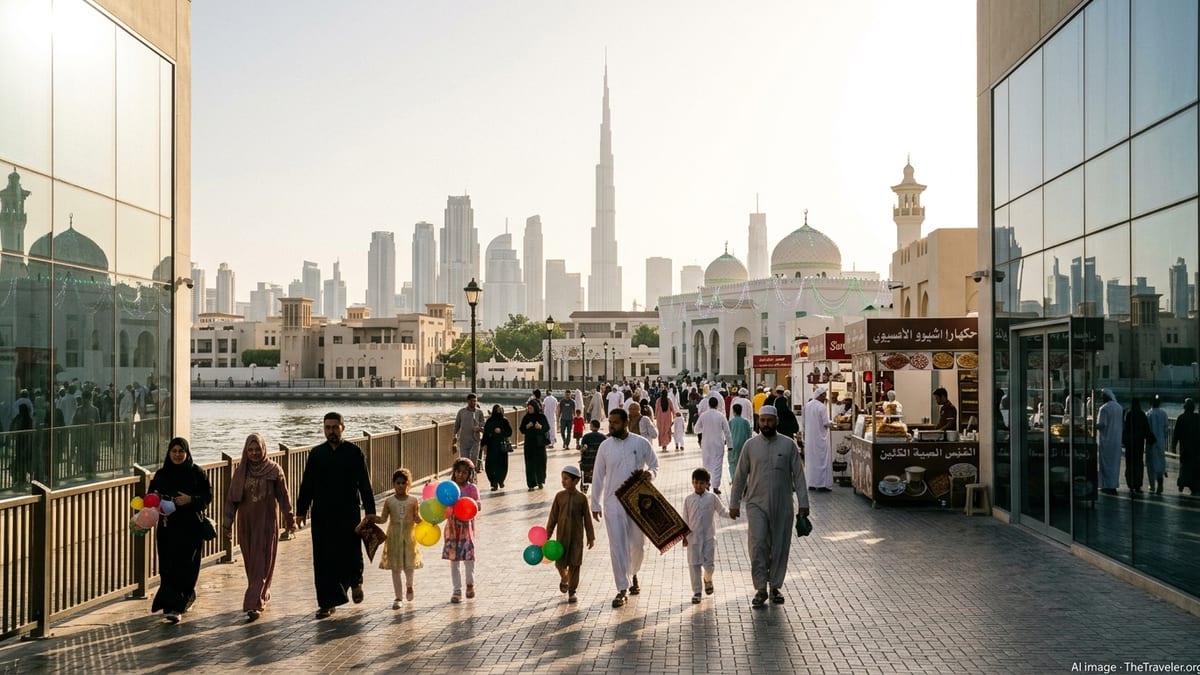
Within the UAE, Eid Al Fitr 2026 is expected to bring a familiar blend of prayer, family gatherings and public celebrations tailored to both residents and international visitors. Municipal event calendars for previous years suggest that major shopping malls, waterfront promenades and heritage districts will again host extended opening hours, themed entertainment and special dining promotions across the four-day holiday period. With school spring breaks overlapping Eid in many emirates, public spaces are likely to be especially busy with family-oriented programming.
Citywide campaigns in Dubai and Abu Dhabi have in recent years linked Eid to broader retail and culinary initiatives, positioning the holiday as a key anchor in the annual events calendar. Analysts expect 2026 to continue this trend, with large malls offering extended sales, raffle promotions and late-night shows, and popular dining destinations highlighting special Eid menus that blend Emirati tradition with international influences. Waterfront destinations such as Dubai Creek, Yas Bay and Al Qana are also expected to serve as focal points for fireworks and evening light shows, depending on local programming decisions closer to the date.
Cultural institutions and heritage sites regularly use Eid periods to spotlight traditional Emirati customs for both residents and tourists. In 2026, museums and heritage villages across Abu Dhabi, Sharjah and the northern emirates are forecast to feature live craft demonstrations, storytelling sessions and performances of traditional music and dance aligned with Eid themes. Such programming supports the UAE’s broader strategy of showcasing intangible cultural heritage alongside its contemporary urban attractions.
The interplay between religious observance and leisure activity is particularly visible during Eid mornings, when mosques across the country host Eid prayers before families disperse to home visits, restaurants, parks and attractions. Analysts note that the 2026 schedule, with Eid likely beginning on a Friday, may add another layer of significance by combining the weekly congregational prayer with the first day of Shawwal, drawing especially large turnouts at major mosques and outdoor prayer grounds.
Regional Eid Timelines and Cross-Border Travel
The UAE’s Eid Al Fitr 2026 timetable is closely watched across the Middle East, where many countries share similar lunar visibility conditions but maintain their own moon-sighting procedures. Regional media coverage and astronomical forecasts suggest that most Gulf Cooperation Council states, including Saudi Arabia, Qatar, Bahrain and Kuwait, are likely to celebrate Eid on or around Friday 20 March, subject to their respective crescent observations. In recent years, close alignment between Gulf states on Eid dates has been common, even as some North African and South Asian countries reported slight variations.
For travelers, this regional clustering of holidays amplifies demand on popular cross-border routes. Airlines serving Jeddah, Riyadh, Doha, Muscat, Cairo and Amman from UAE hubs typically see higher load factors when Eid falls on the same weekend across multiple markets. Travel advisories for 2026 already encourage early booking for these routes, especially in the days immediately before the expected start of Eid and the first working day that follows.
In Europe and parts of Asia, Eid Al Fitr 2026 is forecast to fall on similar Gregorian dates, but local public-holiday designations vary widely. While some countries will mark Eid with official days off, others will see more limited workplace adjustments. This variation influences where Gulf-based travelers choose to spend the break. Destinations that combine relatively short flight times with cultural recognition of Eid, such as Turkey and select cities in the Caucasus and Central Asia, are expected to attract a share of UAE residents seeking cooler climates and familiar festive atmospheres.
At the same time, the UAE continues to position itself as a regional hub for Eid-celebrating travelers from other parts of the Middle East and beyond. With visa facilitation measures, extensive air connectivity and a dense calendar of family attractions, the country is well placed to draw visitors who wish to experience Eid in an environment that blends modern city life with traditional Islamic observance.
School Calendars, Residents’ Plans and Economic Impact
Education authorities in the UAE have aligned the 2025 to 2026 school year so that spring breaks overlap with the Eid Al Fitr period, especially for schools following the Ministry of Education curriculum. Academic calendars published by multiple private schools in Dubai and Abu Dhabi show scheduled breaks that encompass the 19 to 20 March public holiday window, with some institutions extending this into a two-week vacation. This configuration is designed to provide families with flexibility for both religious observance and travel.
For residents, the combination of a long public-holiday weekend and school closures is expected to shape spending patterns across hospitality, retail and entertainment. Economic commentators note that Eid Al Fitr usually delivers a noticeable uplift in consumer activity, as households allocate budgets for new clothing, gifts, home décor and dining out, alongside domestic and international trips. The timing of Eid 2026 in March positions this spending ahead of the summer travel season, potentially smoothing demand for airlines and hotels that might otherwise see a sharper peak later in the year.
Business groups and market analysts also point to the effect of clearly mapped public holidays on corporate planning and productivity. With the Eid Al Fitr 2026 break anchored by federal circulars and mirrored in financial-market closure schedules, companies can better anticipate operational slowdowns, schedule maintenance, and plan inventory and staffing needs. This predictability, they argue, benefits sectors ranging from logistics and retail to financial services, where trading pauses must be coordinated across multiple regional markets.
Looking ahead, observers expect the 2026 Eid Al Fitr period to reinforce the UAE’s position as a focal point for regional celebration, travel and commerce. The combination of a moon-sighting based religious calendar with a long-weekend civil holiday structure exemplifies how the country is balancing tradition with the practical needs of a modern, globally connected economy.