

More news on this day
European travellers from Poland, Italy, Sweden, Ireland, Germany, France, Hungary and more than 30 other states are facing fresh uncertainty over trips to Dubai and the wider United Arab Emirates as the Gulf hub quietly tightens its visa on arrival procedures, aligning with broader e-visa and biometric screening reforms sweeping Europe itself.
New Scrutiny at UAE Borders for European Arrivals
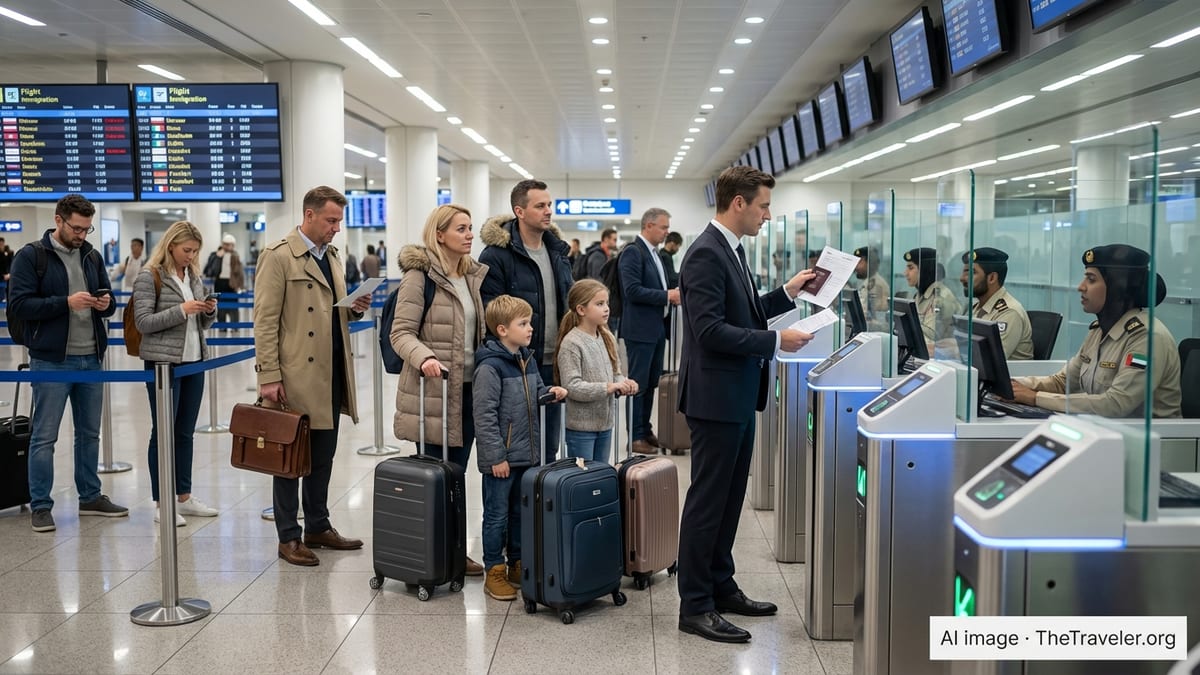
In recent weeks, UAE airports have begun enforcing stricter checks on passport holders from a widening group of European countries that were once synonymous with frictionless travel to Dubai and Abu Dhabi. Travellers from Poland, Italy, Sweden, Ireland, Germany, France, Hungary and other Schengen and non Schengen states report longer queues at immigration, more detailed questioning and selective refusals at the point of entry, even when they believed they were eligible for visa on arrival.
Officials have not announced a formal end to visa on arrival access for most Europeans, but front line implementation has shifted. Airlines and travel agents in the region say passengers are increasingly being asked for proof of accommodation, onward or return tickets, and evidence of sufficient funds before boarding flights to the UAE. The changes are being interpreted as a de facto tightening of visa on arrival privileges, especially for first time visitors and those flagged in new risk assessment systems.
The emerging pattern places European nationals in a similar position to residents of the UAE who have been grappling with tougher Schengen visa procedures. It marks a new phase in what many analysts describe as a cycle of mutual tightening, with Gulf and European authorities each strengthening entry controls in response to migration pressures and security concerns.
Poland Joins Expanding List of Affected States
Poland has become one of the most closely watched cases in this new landscape. Polish travellers and tour operators say they have seen a noticeable increase in secondary screening and document checks on arrival in the UAE, particularly at Dubai International Airport. While most Polish citizens are still able to enter, a growing number are being told at check in or immigration that a pre arranged visa or confirmed hotel booking is required, undermining the once straightforward promise of visa on arrival tourism.
The development comes at a time when Poland itself has reintroduced or extended internal border checks with Germany and Lithuania, part of a patchwork of temporary controls across Europe aimed at curbing irregular migration and tackling security risks. Those internal checks are scheduled to remain in place until at least April 2026 and mean that travellers crossing Europe’s once invisible frontiers must once again plan for potential stops and inspections.
Travel data providers note that Poland’s inclusion alongside Italy, Switzerland, Ireland, Hungary and Germany on a growing roster of countries associated with enhanced screening is symbolically significant. The list now spans much of the European Union, plus several non EU Schengen members, sending a signal that visa privileges can no longer be taken for granted, even by citizens of long standing partner states.
Why the UAE Is Tightening Visa on Arrival Access
Analysts point to a combination of factors driving the UAE’s recalibration of its visa on arrival policy. The country has become one of the world’s busiest aviation hubs, with Dubai International and Abu Dhabi International handling tens of millions of transit and destination passengers each year. As traffic has rebounded and then surpassed pre pandemic levels, authorities have moved to better manage overstays, irregular work and the misuse of short term visit visas.
Security considerations are also part of the picture. Like many destinations, the UAE relies increasingly on risk based border management, using advance passenger information, watchlists and behavioural indicators to single out travellers for more detailed scrutiny. European nationals, once perceived as low risk, are now sometimes swept up in these systems as governments share more data about irregular migration routes, document fraud and transnational crime.
At the same time, there is a growing push for reciprocity. For years, Emirati citizens have enjoyed steadily expanding visa free and visa on arrival access worldwide, ranking their passport among the most powerful globally. As Schengen states and other European countries harden borders and introduce new requirements such as biometric registration and electronic travel authorisations, Gulf policymakers have reacted by signalling that similar standards and pre checks can also apply at their own frontiers.
Europe’s Parallel Shift to E Visas and Biometric Controls
The UAE’s gradual tightening coincides with major structural changes to how Europe manages its own borders. Schengen countries are rolling out the Entry Exit System, a bloc wide database that replaces manual passport stamping with digital records of every crossing by non EU and non Schengen nationals. Under EES, travellers must provide fingerprints and a facial image on first entry, and their movements in and out of the area are logged automatically.
In parallel, governments in Italy, Poland, Switzerland, Ireland, Hungary and Germany are embracing broader e visa platforms and biometric passport controls. Many consulates already require online applications, electronic document uploads and in person biometric collection for visitors who previously could rely on paper forms and shorter processing times. Norway, while outside the EU but inside Schengen, is pressing ahead with its own strengthened checks, aligning itself more closely with these common systems.
Later in 2026, the European Travel Information and Authorisation System is expected to come into force for visa exempt visitors to the Schengen Area and selected associated states. When launched, ETIAS will obligate travellers from countries that currently enjoy short stay visa waivers to obtain electronic pre clearance before departure, supplying biographic data and answering security questions in exchange for a multi year authorisation. Together, EES and ETIAS mark a comprehensive shift from trust based entry to data driven risk assessment.
Schengen Visa Backlogs in the UAE Add to Traveller Frustration
For residents of the UAE hoping to holiday in Europe, the picture has already been complicated by prolonged delays in securing Schengen visas. Throughout 2025 and into 2026, travel agencies in Dubai and Abu Dhabi have reported that appointment slots at consulates for popular destinations such as France, Italy, Germany and the Netherlands are being snapped up months in advance. In some cases, interview dates are unavailable until late summer for those trying to travel in peak season.
Processing times have also stretched well beyond the standard 15 to 30 day window, with consulates like Denmark’s at points facing queues approaching two months. Applicants complain of spending significant sums on service fees and document preparation only to receive short validity visas, sometimes limited to 15 day stays, despite previous multi year approvals. The squeeze has prompted many would be visitors to Europe to abandon or postpone trips, redirecting bookings to destinations in Asia, Africa and the Caucasus that offer faster or simpler entry rules.
In this context, the UAE’s emerging strictness toward European nationals arriving on visa on arrival schemes is being seen as part of a broader reset rather than an isolated development. Whereas Emirati citizens largely retain favourable entry conditions abroad, residents and expatriates in the UAE, along with tourists on both sides of the corridor, are confronting a denser thicket of online forms, biometric kiosks and conditional approvals before they can board a flight.
Impact on Airlines, Tour Operators and Holidaymakers
The immediate impact of the UAE’s stricter stance is most visible at check in counters and immigration queues. Airlines operating dense schedules between Europe and the Gulf, including major carriers from Germany, France and Italy, are under growing pressure to verify that passengers have all required documents before boarding. Carriers that deliver travellers who are refused entry risk fines and the cost of returning passengers to their point of origin, so staff are increasingly cautious.
Travel agents who market winter sun packages and city breaks in Dubai to European customers say they are now advising clients from Poland, Sweden, Ireland, Germany and other states to travel with printed hotel confirmations, full itineraries and evidence of medical insurance, even when these documents are not explicitly listed as mandatory. Some agencies also suggest that first time visitors consider applying for an e visa or pre arranged entry permit rather than relying on visa on arrival, particularly during peak periods such as Christmas and Easter.
For individual travellers, the changes can mean longer planning horizons and reduced spontaneity. Weekend trips booked at short notice, once a hallmark of affordable low cost connections between Europe and the UAE, may become riskier for those who cannot demonstrate strong ties and well documented plans. Families travelling with children, retirees on extended winter stays and digital nomads hopping between hubs are all among the groups paying close attention to the new requirements.
Border Checks Inside Europe Add Another Layer of Complexity
Complicating matters further, several European countries facing outbound scrutiny from the UAE have reintroduced temporary controls inside the Schengen Area itself. France, Germany, Denmark, Norway, Sweden and Poland are among the states that have notified the European Commission of renewed or extended checks at selected land borders, ports and airports. Governments cite threats ranging from terrorism and sabotage to irregular migration and organised crime.
For travellers, this means that even after clearing the more technologically sophisticated external frontier, they may encounter traditional passport inspections while transiting between Schengen states. Rail and road passengers driving from Germany into Poland, or flying from Spain into France, can no longer assume that identity checks are a thing of the past. Wait times at some border crossings may lengthen, especially on weekends and around major holidays, as police conduct spot inspections.
The return of visible border controls within Europe adds a psychological dimension to the sense of tightening mobility. Tour operators that once sold pan European itineraries packaged around high speed trains and open roads are now adjusting timetables and warning clients to factor in potential delays. Combined with stricter UAE entry practices, this layered system of checks risks dampening enthusiasm for long haul multi destination trips that include both Europe and the Gulf.
How Travellers Can Navigate the New Rules
Amid the flux, travel experts recommend that European nationals treat trips to the UAE much as UAE residents now treat Schengen journeys. That means starting preparations early, checking the latest entry guidelines with both airlines and consular authorities, and ensuring that supporting documents are in order even if they are not always requested. Passports with several months of remaining validity, detailed accommodation plans and proof of funds are increasingly part of a well prepared traveller’s toolkit.
Specialists also advise paying close attention to whether an e visa or pre travel authorisation is available and, if so, whether it might offer a more predictable experience than relying solely on visa on arrival. While such systems require more advance effort, they can reduce uncertainty at the border and provide written confirmation that can be useful if questions arise at check in or immigration.
Finally, travellers from Poland, Italy, Sweden, Ireland, Germany, France, Hungary and the wider group of affected states are urged to build flexibility into itineraries. Allowing longer connection times, avoiding last minute bookings, and taking out comprehensive travel insurance can help cushion the impact of changing rules on both sides of the Europe UAE corridor. With EES and future systems such as ETIAS set to harden external borders even further, the era of entirely frictionless international travel for most visitors appears to be giving way to a new normal of pre cleared, biometrically verified movement across continents.