

More news on this day
Air traffic across the United Arab Emirates has been thrown into turmoil as escalating conflict between Iran, the United States and Israel forces the closure of major Gulf airspace, shutting down Dubai, Abu Dhabi and Sharjah airports, grounding hundreds of new flights and leaving tens of thousands of passengers stranded across the region.
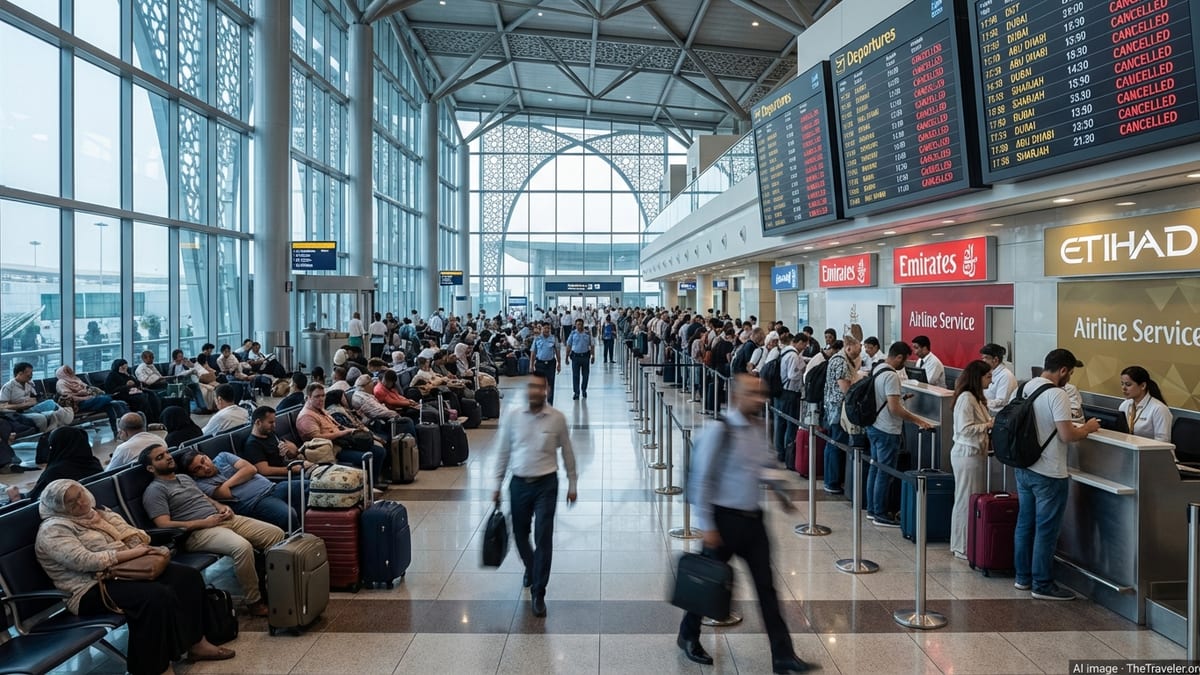
Missile Strikes and Airspace Closures Paralyse UAE Hubs
What began as targeted strikes on Iran has rapidly evolved into a broader aviation crisis, with Iranian drone and missile attacks hitting critical transport infrastructure across the Gulf, including airports serving Dubai and Abu Dhabi. Authorities in the UAE, alongside neighbouring states such as Qatar, Kuwait and Bahrain, have announced at least partial airspace closures, forcing airlines to cancel or divert flights and suspend new services into the region.
Dubai International Airport, consistently ranked the world’s busiest hub for international passengers, and Abu Dhabi’s Zayed International Airport have both seen operations halted following incidents linked to falling debris and near-miss strikes. Sharjah International Airport has also been affected as UAE officials move to contain risk in increasingly crowded skies and prevent civilian aircraft from crossing active conflict zones.
Regional aviation data indicates thousands of flights have been delayed or cancelled since the first waves of attacks, with flight-tracking services reporting more than 3,400 cancellations across seven major Middle Eastern hubs in a single day. Airlines and airport operators warn that the knock-on disruption to global schedules will likely last well beyond the initial closures, as aircraft and crews are left out of position worldwide.
Emirates, Etihad, Flydubai and Air Arabia Extend Suspensions
The UAE’s flagship and low-cost carriers have responded with sweeping flight suspensions that effectively freeze scheduled passenger growth and ground many new flights into the country’s three main hubs. Emirates has halted all flights to and from Dubai International until at least mid-afternoon on Monday, March 2, while Flydubai has suspended its entire Dubai operation over the same period, citing multiple regional airspace closures and the need to prioritise safety.
In Abu Dhabi, Etihad Airways has suspended all flights to and from Zayed International Airport until early Monday, repeatedly extending its operational pause as the regional security picture deteriorates. The airline is allowing travellers with tickets issued before the crisis to rebook without penalty or request full refunds, though it has warned that call centres and airport desks are under severe pressure from the surge in enquiries.
Sharjah-based budget carrier Air Arabia has similarly paused operations, announcing a temporary halt to flights to and from the UAE as it works with aviation regulators to assess the security risk. Across all four carriers, thousands of passengers scheduled on new routes or increased frequencies for the busy late-winter travel period are now facing cancellations, last-minute rebookings or open-ended uncertainty.
UAE aviation authorities have also suspended permits for drones, gliders and recreational aircraft for at least a week, underscoring official concern about the risk of misidentification in congested and militarised airspace. Officials stress that regular operations will resume only when they can guarantee an acceptable level of safety for civilian traffic.
Global Airlines Reroute as Thousands of Passengers Stranded
Far beyond the Gulf, the sudden shutdown of the UAE’s airports is reverberating across global airline networks. Carriers such as Lufthansa, British Airways, Wizz Air and Air Canada have halted services to Dubai and Abu Dhabi for several days, while others are diverting flights to avoid Iranian, Iraqi, Qatari and parts of Gulf airspace entirely. Longer routings are adding hours to journeys between Europe, Asia and Australia, as aircraft are forced onto more southerly tracks over the Arabian Sea and Indian Ocean.
Travel analytics and tracking firms report that tens of thousands of passengers have been stranded or diverted as aircraft are held on the ground or sent to alternate airports in South Asia, Europe and East Africa. At Dubai and Abu Dhabi, images from terminals show crowded departure halls, with passengers sleeping on luggage trolleys and airport floors as they wait for news of rescheduled services.
UAE authorities say they are covering meals, hotel accommodation and rebooking costs for tens of thousands of affected travellers, in an effort to stabilise conditions in the terminals and avoid scenes of chaos. Nonetheless, individual stories of hardship are emerging, from organised tour groups whose funds are running low to business travellers missing critical meetings and migrant workers unable to return to jobs or families.
Industry analysts warn that, even if airspace is partially reopened within days, it could take much longer to untangle the global web of diversions and cancellations. Airlines must not only reposition aircraft and crews but also rebuild trust among passengers wary of travelling through a region that has abruptly become a front line in a widening conflict.
Safety Concerns Rise After Casualties at UAE Airports
Although the physical damage to UAE airport infrastructure remains limited compared with the scale of the attacks, a series of incidents has heightened safety concerns for both travellers and staff. Authorities in Abu Dhabi have confirmed fatalities and multiple injuries linked to an incident at Zayed International Airport, while in Dubai several people were hurt by debris at the airport as missile and drone fragments fell across parts of the city.
Elsewhere in Dubai, minor fires were reported at prominent landmarks, including a luxury hotel and developments on the Palm Jumeirah, before being quickly contained by civil defence teams. The UAE’s General Civil Aviation Authority has reiterated that protecting human life remains the overriding priority and has condemned the targeting of civilian infrastructure as a breach of international law.
For airlines, these events are sharpening an already intense focus on risk management. Carriers and insurers must weigh the probability of further strikes against the commercial imperative to restore services through some of the world’s most important hubs. Civil aviation regulators, meanwhile, are coordinating closely to align no-fly zones and publish updated route guidance to avoid any miscalculations between civilian pilots and military assets operating in the same skies.
The volatility is also testing crisis communication systems. Passengers have reported confusion over shifting departure times, conflicting notifications from airlines and last-minute gate changes. Travel experts advise would-be passengers to avoid heading to the airport without confirmed flight information and to keep contact details updated with their airline or booking agent to receive real-time alerts.
Regional Turmoil Threatens Long-Term Role of Gulf as Transit Nexus
The grounding of new flights into Dubai, Abu Dhabi and Sharjah comes at a sensitive moment for the Gulf’s aviation-driven economic model. Over the past two decades, the UAE and its neighbours have built powerful hub strategies around open skies and geopolitical stability, channelling traffic between Europe, Africa, Asia and Australasia. The closure of multiple Gulf air corridors within days, followed by direct strikes on or near flagship airports, exposes how vulnerable that strategy is to regional escalation.
Economists note that the suspension of services is already rippling through sectors including tourism, hospitality, retail and conferences, which rely heavily on steady flows of international visitors transiting through or staying in the UAE. Hotels near airports are full of stranded passengers on emergency stopovers, but bookings for upcoming events and leisure travel are coming under review as corporate risk managers and individual travellers reconsider itineraries that pass through the Gulf.
At the same time, rival hubs outside the immediate conflict zone, from Istanbul to major European and Asian gateways, are moving quickly to capture rerouted traffic. Airlines that previously depended heavily on Dubai or Abu Dhabi as connecting points are exploring medium-term alternatives, raising questions over whether some of the capacity and route changes triggered in early March will become permanent.
For now, UAE officials and airline executives are focused on crisis response rather than long-range strategy. But as missiles and airspace closures redraw the aviation map of the Middle East in real time, the struggle to restore normal operations at Dubai, Abu Dhabi and Sharjah will also be a test of whether the Gulf can maintain its central role in global travel amid deepening geopolitical turmoil.