

More news on this day
Air travel through the United Arab Emirates remains heavily disrupted as Qatar Airways, Gulf Air and Malaysia Airlines continue to ground and reroute services, with more than 40 flights affecting links to Kuwait, Kuala Lumpur, Amsterdam, Paris, Chennai, Bengaluru and other major cities caught up in a widening web of Middle East airspace closures.
Get the latest news straight to your inbox!
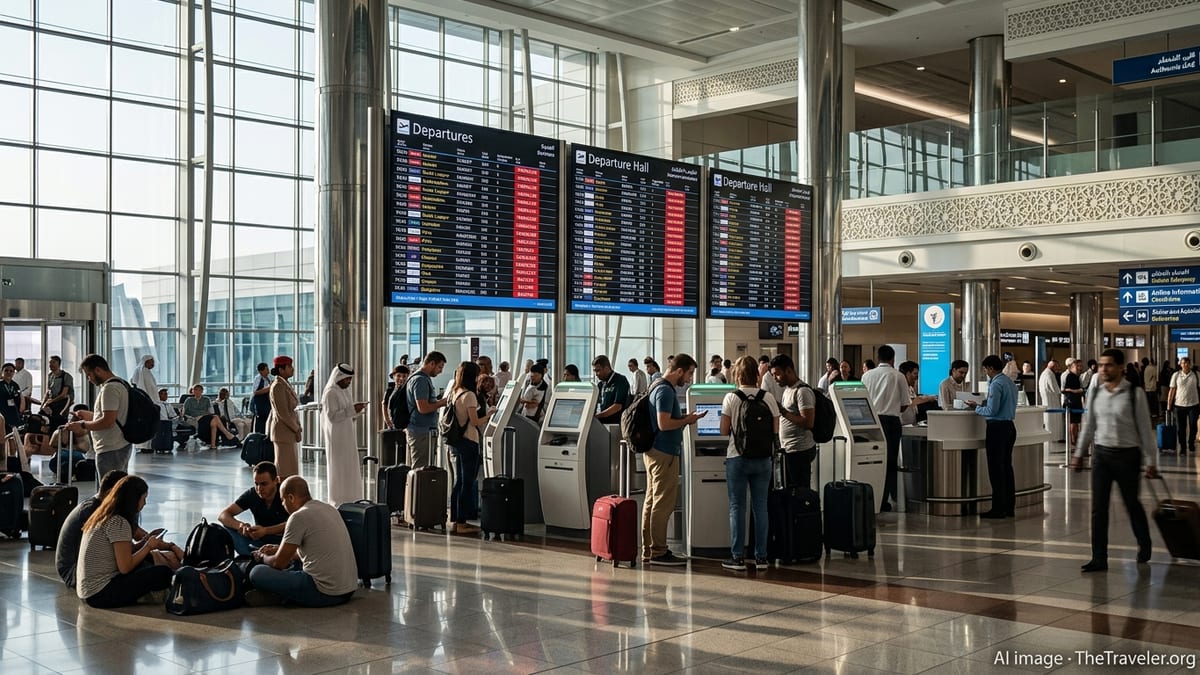
Regional Airspace Closures Keep Pressure on UAE Hubs
Weeks after the sudden closure of key air corridors across the Gulf in late February, published aviation data and travel advisories show that carriers serving the UAE are still operating on sharply reduced schedules. Airspace restrictions linked to the conflict involving Iran and western allies have forced airlines to suspend or reroute traffic over Iran, Iraq and parts of the Gulf, undermining Dubai, Abu Dhabi and Doha’s role as high-volume connecting hubs.
Reports indicate that thousands of flights across the broader region have been cancelled since the crisis began, with Dubai and Abu Dhabi among the hardest-hit airports. Passenger movements through the UAE have been constrained as airlines prioritise limited slots for repatriation, repositioning and essential cargo operations, while standard commercial services remain curtailed on many routes.
Travel industry bulletins describe a patchwork of partial resumptions and rolling suspensions. Some Gulf carriers have restored a fraction of their usual frequencies using longer detours that skirt closed airspace, adding hours to flight times and disrupting aircraft and crew rotations. Others remain largely grounded as regulators and operators weigh safety, insurance and operational constraints.
For travellers, the result is persistent uncertainty. Even when flights appear in booking systems, departure times are subject to late changes as air traffic managers adjust routings day by day. Passengers connecting through UAE hubs to Europe, South Asia and Southeast Asia are being advised to treat itineraries as provisional and to build in additional time for potential disruptions.
Qatar Airways Cuts Deep Into Network While Operating Limited Relief Flights
Qatar Airways, which relies heavily on overflights in the affected airspace, has seen some of the most extensive disruption. Publicly available schedules and airline updates show that the carrier initially suspended regular commercial operations to and from Doha when Qatari airspace was closed, cancelling services across Europe, Asia and Africa and stranding large numbers of passengers who would ordinarily connect via the Gulf.
Subsequent travel alerts outline a phased reopening under emergency conditions, with Qatar Airways operating a limited number of relief and repatriation flights along designated corridors. These flights have focused on major gateways such as London, Paris and other primary European capitals, but the reduced network has left many secondary destinations without direct service. Connections between Doha and UAE cities remain especially constrained, as detours around restricted zones reduce the viability of short-haul links.
According to regional coverage, the airline’s curtailed schedule has translated into dozens of grounded flights touching UAE markets and onward destinations including Amsterdam and Paris, where Qatar Airways typically offers multiple daily frequencies via Doha. Travellers holding tickets between the UAE and these European cities through Qatar Airways have faced repeated rebookings, long wait times on alternative carriers, or extended stays in transit points while they await confirmed seats.
The disruption is also affecting southbound itineraries that would normally route via Doha to the Indian subcontinent and Southeast Asia. With frequencies cut and aircraft redeployed to priority routes, availability on services touching Chennai, Bengaluru and Kuala Lumpur has tightened, pushing more demand onto already stretched UAE-based and Asian carriers.
Gulf Air and Other Regional Carriers Extend Cancellations to Kuwait and Beyond
Gulf Air, the Bahraini flag carrier, has likewise scaled back operations across its network as Bahrain’s airspace has been drawn into the regional restrictions. Travel alerts shared via booking channels and traveller forums indicate that the airline has extended flexible cancellation and rebooking policies into late March, reflecting an expectation of continued volatility.
Routes linking the UAE to Bahrain and onward to Kuwait, Saudi Arabia and points in Europe have been particularly affected. With Gulf Air acting as a regional connector, the grounding of multiple rotations has severed itineraries that many passengers relied on to reach destinations not directly served from Dubai or Abu Dhabi. Kuwait-bound travellers who would typically connect through Manama are among those facing last-minute changes or outright cancellations.
Other Gulf-based operators have implemented similar measures. Published reports from regional media list widespread suspensions or reduced schedules for carriers using UAE hubs to feed traffic across the Middle East and into Europe. The cumulative effect is a substantial thinning of options for travel between the UAE and nearby countries such as Kuwait, as well as longer-haul connections via Gulf transit points.
These constraints are coinciding with heavy demand from residents and expatriate workers attempting to travel for family, business or onward long-haul journeys. As a result, remaining seats on alternative routings through open airspace, including via Riyadh, Jeddah or non-Gulf hubs in Europe and Asia, are filling quickly and often pricing significantly higher than pre-crisis levels.
Malaysia Airlines and Asian Networks Feel the Ripple Effect
Farther east, Malaysia Airlines and other Asian carriers are grappling with knock-on delays and cancellations as the Middle East corridor remains unstable. Data compiled by aviation analytics firms and regional travel clubs show that Kuala Lumpur International Airport has recorded notable spikes in delays and a smaller number of outright cancellations on services linking Southeast Asia to the Gulf.
Malaysia Airlines, which in recent years has been rebuilding its long-haul network including renewed links between Kuala Lumpur and Paris, now faces added complexity in coordinating European and Middle Eastern connections. Public advisories from Malaysian aviation authorities urge passengers travelling to or through the Gulf region to check directly with airlines for schedule changes and to allow extra time for connections, reflecting continued uncertainty around routings.
While Malaysia Airlines’ direct services between Kuala Lumpur and the UAE represent only part of its network, groundings and schedule reductions by partner and codeshare airlines in the Gulf have disrupted onward journeys to cities such as Amsterdam and Paris. Travellers who previously relied on seamless one-stop itineraries via UAE hubs or Doha now confront multi-stop routings, extended layovers, or the need to rebook altogether on different alliances or carriers.
The situation is particularly challenging for passengers flying between Southeast Asia and Indian cities like Chennai and Bengaluru, where itineraries often depend on Gulf connections. Cancellations by Qatar Airways and Gulf Air, combined with capacity constraints at Emirates, Etihad and low-cost operators, have contributed to a bottleneck that is reverberating across check-in counters from Kuala Lumpur to Singapore and Bangkok.
Travellers Face Uncertain Timelines and Complex Rebooking Choices
For travellers in the UAE and beyond, the central question remains how long the disruption will last. Airlines and regulators have been cautious in projecting timelines, with many notices extending suspensions in short increments of several days at a time. Industry observers note that while limited services are gradually resuming along specially approved corridors, a rapid return to full pre-crisis schedules appears unlikely in the near term.
Passengers affected by the grounding of Qatar Airways, Gulf Air and Malaysia Airlines services are being offered varying combinations of refunds, credit vouchers and free rebooking, depending on fare rules and the specific carrier. Travel insurance coverage is proving uneven, with some policies recognising airspace closures as a valid disruption trigger and others classifying the events as exclusions, leaving travellers to negotiate directly with airlines and agents.
Advisories from airports and aviation agencies across the region consistently urge passengers not to proceed to terminals without a confirmed, operating flight and explicit instructions from their airline. Travellers are being encouraged to monitor booking portals and flight-status tools frequently, as flight numbers that appear active days in advance may still be cancelled or rerouted closer to departure as airspace conditions evolve.
In the meantime, UAE airports continue to function as constrained but critical connectors, handling a mix of limited commercial services, repatriation flights and freight movements that keep essential trade and travel links open. Until wider airspace access is restored, however, the experience of flying to, from or through the UAE is expected to remain unpredictable, with a significant share of flights grounded and core routes to cities such as Kuwait, Kuala Lumpur, Amsterdam, Paris, Chennai and Bengaluru operating well below normal capacity.