

More news on this day
As missile and drone strikes ripple across the Gulf and beyond, the United Arab Emirates, United Kingdom, France and Poland are racing to evacuate citizens from a Middle East where key airspace remains closed or severely restricted, leaving hundreds of thousands of travelers stranded and forcing governments and airlines into complex rescue operations.
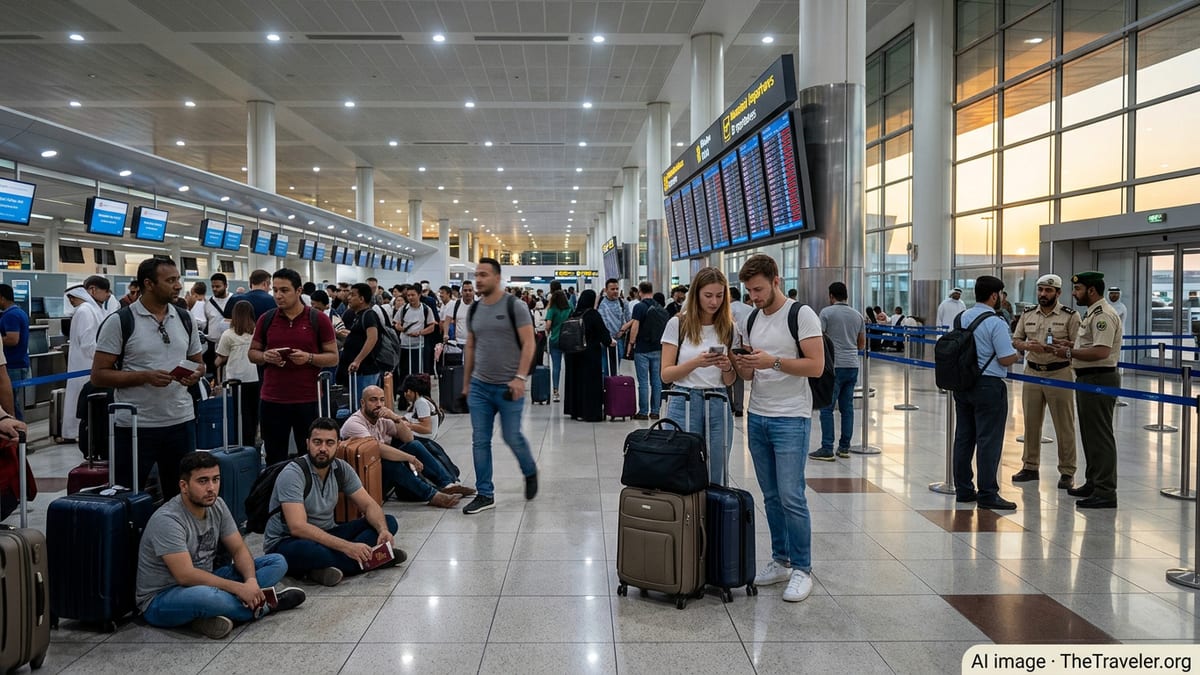
Airspace Closures Turn Key Hubs Into Bottlenecks
The latest round of US and Israeli strikes on Iran, and Iranian retaliation across the Gulf, has triggered sweeping airspace closures that have effectively severed many of the world’s busiest east–west routes. Iran, Israel and Iraq have imposed full or near-total shutdowns, while Gulf states including the UAE, Qatar, Kuwait and Bahrain have restricted their airspace, turning Dubai, Abu Dhabi, Doha and other hubs into bottlenecks rather than gateways.
Dubai International and Abu Dhabi’s Zayed International, normally among the busiest global transit points, were closed for days and are now only gradually resuming limited operations as authorities prioritize emergency, military and evacuation flights over routine commercial services. Airlines are juggling last-minute diversions, extended routings around closed flight information regions and rolling cancellations as risk assessments evolve by the hour.
For travelers, that means that even if their origin and destination are technically open, the traditional connections via Gulf hubs may no longer be viable. Many carriers are opting to route long-haul services north of the conflict zone, adding hours to flight times and straining available aircraft and crew, while others have pulled out of the region entirely until security conditions stabilize.
On the ground, airports that remain open on the fringes of the affected area, particularly in Saudi Arabia and Egypt, are under intense pressure. Travelers are attempting to reach these alternate gateways by road, facing long drives, congested border crossings and no guarantee of a departing flight once they arrive.
UAE Orchestrates Limited Evacuation Flights Amid Ongoing Threats
The United Arab Emirates finds itself both at the geographic center of the disruption and directly in the line of fire. Suspected Iranian strikes have hit near critical infrastructure in Dubai, and the country imposed a partial closure of its airspace, halting most commercial operations while emergency services responded and aviation authorities reassessed risk over key corridors.
In recent days, the UAE has cautiously restarted a small number of outbound services, focused largely on evacuation corridors and essential repatriation routes. Flag carriers are operating with special permits, tight curfews and revised flight paths designed to avoid active conflict zones, and schedules are being adjusted at short notice as the security picture shifts.
UAE officials have emphasized that the priority is the safety of residents, citizens and transit passengers, working in coordination with foreign ministries from Europe, North America and Asia that are seeking to move their nationals out of the region. Travelers currently in the Emirates are being urged to remain in close contact with their airlines and consular services rather than heading directly to airports, where access can be suddenly restricted and terminal crowds pose their own safety concerns.
With much of the wider regional airspace still constrained, even those able to secure a seat on departing flights may face complex routings through secondary hubs in Europe, Africa or South Asia. Flexible ticket policies, including fee waivers and open-dated returns, are being extended on a case-by-case basis, but travelers should expect limited options and premium fares for the most direct escape routes.
UK and France Activate Charter Flights and Tighten Travel Advice
In Europe, the United Kingdom and France have moved swiftly to combine strict travel advisories with targeted evacuation operations. Both governments are warning against non-essential travel to large parts of the Middle East and are urging citizens already in the region to leave as soon as practicable using any remaining commercial options or government-organized flights.
The UK Foreign Office has confirmed the first charter evacuation flight from Oman, prioritizing vulnerable British nationals who managed to reach the sultanate after transiting overland from more heavily affected Gulf states. Officials have asked citizens not to converge on Muscat’s airport without direct instructions, reflecting both the scarcity of seats and the need to manage security and crowding as missiles and drones continue to threaten the wider region.
France, whose flag carrier relies heavily on Middle Eastern overflight rights for links to Asia and the Indian Ocean, has extended a wave of cancellations across the region as key corridors remain closed. French consular teams are working with Air France and partner airlines to rebook stranded travelers onto alternative routings via safer airspace, while also preparing contingency plans for dedicated repatriation flights if commercial capacity proves insufficient.
For UK and French travelers, the message is clear: check government travel advisories several times a day, register your presence with your embassy where possible, and expect last-minute changes even after boarding passes are issued. Insurance coverage may be limited for trips undertaken after advisories are tightened, and travelers should closely review policy wording before attempting to reroute on their own.
Poland Scales Up Military-Assisted Evacuations
Poland, which has several thousand citizens spread across the Gulf, Levant and wider Middle East, has transitioned from a watchful waiting posture to active evacuation. After initially stopping short of a broad airlift, Warsaw has now deployed military transport aircraft to support the extraction of Poles stranded by the closures and disruptions.
The Polish Armed Forces confirm that dedicated aircraft have departed to the region under a newly approved military contingent focused solely on evacuation support. These flights are operating to airports still able to receive traffic on the margins of the conflict zone, including in Oman and Egypt, where Polish diplomats and military personnel are coordinating last-mile movements for citizens arriving by road from more affected countries.
Earlier overland convoys from Israel and Jordan to Egyptian airports had already brought hundreds of Poles to safety, and authorities are now refining medical-priority lists to ensure that critically ill or vulnerable travelers are moved first on limited-capacity flights. A round-the-clock helpline has been set up for Poles in the region to register, receive instructions and coordinate rendezvous points where security conditions allow.
Other European governments are closely watching Poland’s use of military assets and regional staging points as a potential model should conditions deteriorate further. The combination of state-operated aircraft and civilian carriers under charter allows for a degree of flexibility that purely commercial schedules can no longer provide.
What Travelers Must Do Now
For travelers currently in the Middle East or holding near-term bookings through the region, the situation demands rapid but measured action. Those in affected countries are strongly advised to register with their embassy or consulate, monitor official travel advisories and airline updates several times per day, and keep phones, power banks and essential documents ready in case a short-notice evacuation or rerouting opportunity appears.
Anyone with itineraries routed through major Gulf hubs in the coming days and weeks should assume disruption as the default. Contact your airline or travel advisor proactively to explore alternative routings that bypass closed airspace, such as connections through southern Europe, North Africa or South Asia, even if these involve longer flight times or overnight layovers. Many carriers are offering limited flexibility to change dates or destinations, but capacity is tight and options shrink as more travelers seek to rebook.
Travelers considering new trips involving the Middle East are widely being urged to postpone unless travel is essential. Even destinations that remain open can be affected by upstream disruptions to aircraft and crew positioning, while sudden escalations could close currently available corridors with little warning. For those who must travel, fully refundable tickets, robust travel insurance that covers conflict-related disruption, and clear contingency plans are now critical.
Above all, patience and caution are essential. With the UAE, UK, France and Poland all scrambling to move citizens out of a region still under aerial threat, the coming days will be marked by evolving security assessments, rolling schedule changes and high demand for every available seat out of the conflict zone.