

More news on this day
The United Arab Emirates has announced it will waive visa overstay fines for tourists and residents stranded in the country by unprecedented regional airspace closures, ongoing flight suspensions and rising geopolitical tensions, offering crucial relief to thousands caught in a web of disrupted travel plans.
Authorities Move to Protect Stranded Tourists and Residents
The Federal Authority for Identity, Citizenship, Customs and Ports Security confirmed this week that travellers unable to leave the UAE because of recent airspace blockages and widespread flight cancellations will not face visa overstay penalties. The exceptional measure applies to visitors on tourist or visit visas, exit permit holders and residents who cancelled their residency in preparation to depart but were then unable to fly.
Officials said the decision was taken in response to the rapid deterioration of regional security and the resulting impact on commercial aviation across the Gulf. Airspace restrictions and safety notices to airmen have forced carriers to suspend or sharply curtail operations, leaving passengers in Dubai, Abu Dhabi, Sharjah and other hubs with few or no options to exit on their original itineraries.
The waiver covers overstay fines incurred on or after 28 February 2026, the date many airspace closures and large-scale flight suspensions came into effect. Before the new policy, travellers whose visas expired while they remained in the country typically faced daily penalties that could quickly climb into the thousands of dirhams, particularly for families and longer stays.
By removing those penalties for those directly affected by the disruption, the UAE aims to ensure that travellers are not financially punished for circumstances beyond their control, and to prevent an administrative backlog once commercial schedules begin to normalise.
Airspace Closures and Flight Cancellations Ripple Across the Region
The move comes as escalating tensions involving Iran, the United States and Israel have triggered a cascade of airspace restrictions across parts of the Middle East. In recent days, missile and drone exchanges and retaliatory strikes have led several states to close portions of their skies, while aviation authorities across the Gulf have imposed precautionary bans on overflights through sensitive corridors.
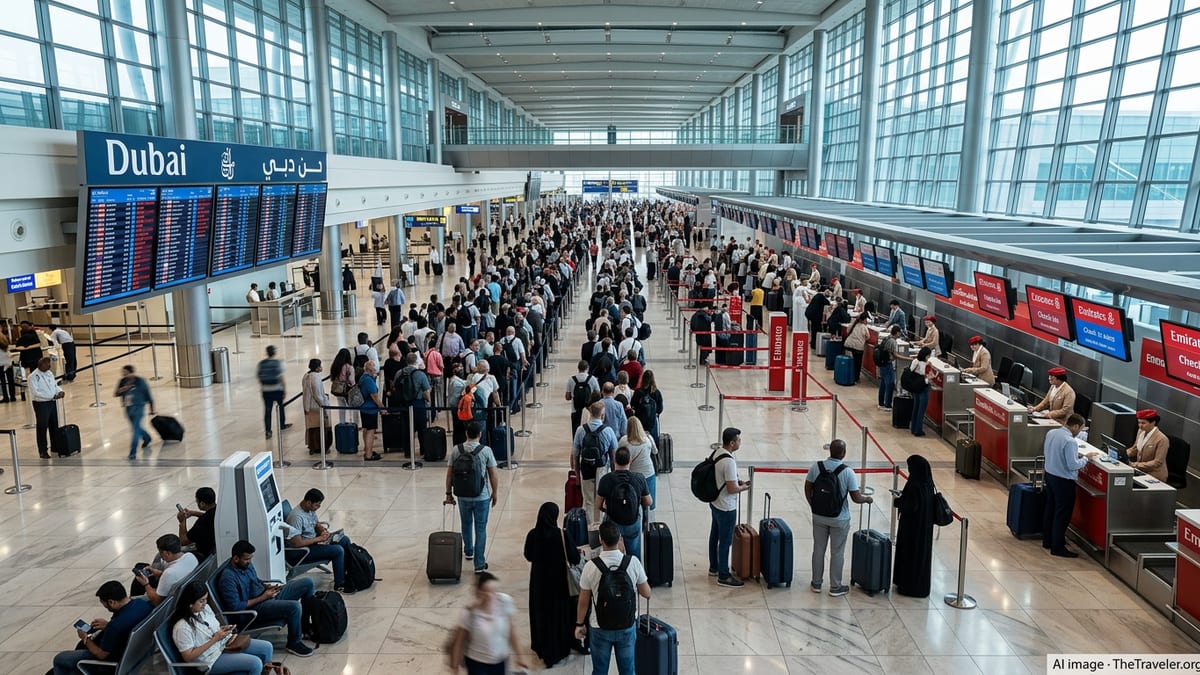
UAE-based airlines including Emirates, Etihad Airways, flydubai and Air Arabia have temporarily suspended most regular services, operating only a limited number of repatriation and “exceptional” flights coordinated with regulators. Dubai and Abu Dhabi airports, normally among the world’s busiest for international transit, have scaled back operations while managing thousands of stranded passengers in terminals and nearby hotels.
Travel advisories issued by multiple governments describe a highly fluid environment, with rerouted long-haul services skirting the region via alternative paths over Africa, Central Asia or the Caucasus. For many point-to-point travellers whose journeys originate or terminate in the Gulf, however, rerouting is not feasible, resulting in multi‑day or open‑ended delays.
Airport authorities and airlines are working with immigration officials to identify passengers whose visas are expiring and to flag them for inclusion under the overstay waiver scheme. Priority is being given to elderly travellers, families with children and those with onward connections that have been repeatedly cancelled.
Scope of the Waiver and Who Qualifies
According to statements carried by local media, the exemption applies to visitors holding valid visit or tourist visas, exit permits issued for those scheduled to leave, and residents who formally cancelled their residency visas before departure. Where these individuals were then unable to exit because of airspace closure or flight suspension, any overstay fines incurred from 28 February 2026 onwards will be fully waived.
The scheme is limited to those whose stay in the UAE was directly impacted by the current disruption. Travellers who accumulated immigration violations or overstay fines before that cut‑off date are still expected to regularise their status and pay outstanding amounts under existing regulations. Authorities have emphasised that the current relief is intended as a targeted response to a defined emergency, not a blanket amnesty.
Officials have urged affected visitors and residents to keep documents that demonstrate their situation, such as flight cancellation notices, airline rebooking messages and formal travel advisories. While the waiver is automatic at exit points for those identified through airline and immigration data, travellers are being advised to arrive early at airports and be prepared to explain their case to border officers if needed.
Travel agents and legal specialists say the measure will be particularly important for travellers on shorter-term visit visas and for expatriates who had already given up accommodation, settled utility bills and shipped belongings in anticipation of leaving the country. Without the waiver, many could have faced substantial unexpected costs through no fault of their own.
Financial Relief Eases Pressure on Travel Industry and Visitors
Visa overstay fines in the UAE, typically charged per day after the permitted stay has ended, have long been a significant deterrent to remaining in the country without status. For tourists and residents stranded by the current crisis, the rapidly mounting costs risked turning a stressful delay into a serious financial hardship, especially for families or lower‑income workers.
By suspending these penalties for those directly affected, the government is easing pressure not only on travellers but also on airlines and tour operators, which might otherwise have faced calls to cover or reimburse overstay charges. Industry sources say the decision provides greater clarity when assisting stranded passengers and allows carriers to focus resources on rebooking, accommodation and essential welfare support.
The waiver also supports the UAE’s wider strategy of maintaining its reputation as a predictable, visitor‑friendly hub, even in times of intense regional volatility. Tourism bodies and hospitality operators have welcomed the announcement, noting that many guests have chosen to remain in their hotels or serviced apartments while waiting for new flights rather than seeking to exit via more complex overland routes.
Some hotels report working closely with airlines and consulates to offer discounted extended stays, flexible check‑out times and shuttle services to airports once new departures are confirmed. The removal of overstay fines, they say, has allowed guests to focus on practical travel arrangements instead of worrying about immigration penalties accruing in the background.
Guidance for Travellers Currently in or Heading to the UAE
Officials are advising tourists and residents already in the UAE to monitor airline updates and official announcements closely, as flight schedules and airspace restrictions can change at short notice. Travellers with visas approaching expiry are encouraged to stay in regular contact with their airlines, travel agents and, where appropriate, their embassies or consulates.
Those whose visas lapse while they remain in the country due to cancelled flights or closed airspace are being reassured that, provided their circumstances fall within the defined timeframe and conditions, overstay fines will not be charged when they eventually depart. Passengers are nonetheless urged not to travel to airports until they have a confirmed reservation, to avoid crowding terminals and adding pressure to ground services.
People planning trips to or through the UAE in the coming days are being reminded that the situation remains highly fluid, with only a limited number of outbound and inbound flights operating. Travel experts recommend flexible bookings, travel insurance that covers disruption in high‑risk regions and readiness for last‑minute itinerary changes, including possible diversions or extended layovers.
For now, the UAE’s decision to waive overstay fines offers a measure of certainty in a period of acute regional instability. As aviation authorities work to gradually reopen airspace and restore normal traffic flows, the policy stands as a signal that travellers will not be left to shoulder the immigration consequences of a crisis far beyond their control.