

More news on this day
Uganda Airlines has secured a Sh422.26 billion capital injection from government, a move expected to fund new Boeing and Airbus jets, ease recent service disruptions and underpin an ambitious revival of long-haul routes from Entebbe.
Get the latest news straight to your inbox!
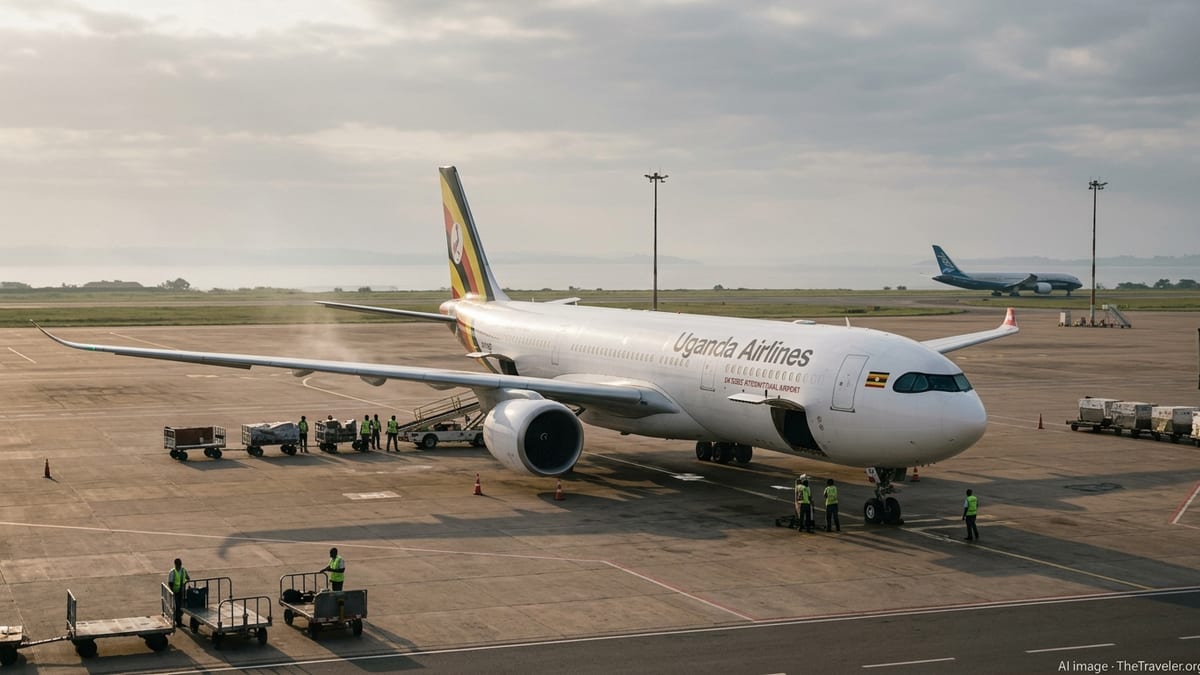
Parliamentary Lifeline Targets Fleet Expansion
Publicly available budget documents and parliamentary coverage show that legislators recently cleared Sh422.26 billion in supplementary funding for Uganda Airlines as part of the 2025/2026 financial year. The allocation is framed as initial payments towards a larger multi‑year plan to acquire up to 10 additional aircraft, giving the national carrier its first significant growth capital since it was revived in 2019.
Reports on the proceedings indicate that the Ministry of Works and Transport requested the funds after arguing that the airline’s current fleet is overstretched, even as it now carries well over a third of passenger traffic through Entebbe International Airport. Aviation industry outlets note that the supplementary funding sits alongside a broader government commitment in the 2025/2026 budget speech to recapitalise the carrier so that it can open more international routes and improve reliability.
According to industry databases tracking fleet plans, the package is expected to support a mix of new regional and long‑haul aircraft. The expansion would build on Uganda Airlines’ existing fleet of Bombardier CRJ900 regional jets and two Airbus A330‑800neo widebodies, which have been used to launch services to destinations such as Dubai, London and Mumbai.
Government budget analysis published by consultancies and policy think‑tanks suggests that the recapitalisation is being justified as part of a wider strategy to boost tourism, trade and investment by turning Entebbe into a more competitive regional hub. The funding comes despite persistent losses at the carrier, signalling that policymakers still view the airline as a long‑term strategic asset rather than a short‑term commercial play.
New Boeing and Airbus Jets on the Horizon
Aviation intelligence platforms that track order negotiations report that Uganda Airlines has been in discussions with Boeing over the acquisition of 787 Dreamliner aircraft, potentially configured for routes to China from 2026. At the same time, analysts expect the carrier to look again to Airbus for additional narrow‑body or small wide‑body jets suited to high‑density African and Middle Eastern markets.
The supplementary funding is described in several business outlets as an “initial payment,” implying that any deals with Boeing or Airbus are likely to be structured over multiple years, combining direct purchases with leasing arrangements. This approach would mirror trends among African peers that are spreading capital outlay over time while still accessing newer, more fuel‑efficient aircraft.
Fleet data shows that Uganda Airlines’ current mix is heavily weighted towards regional flying, with its CRJ900s operating the bulk of short‑haul routes to East, Central and Southern Africa. The Sh422.26 billion envelope therefore represents a pivotal opportunity to rebalance the fleet, adding longer‑range jets that can sustain intercontinental services while also bolstering regional capacity on high‑growth routes.
Aviation analysts point out that introducing new‑generation Boeing and Airbus jets could lower unit operating costs, improve reliability and upgrade the passenger experience through more modern cabins. That combination is regarded as critical if Uganda Airlines is to compete credibly with larger African and Gulf carriers on both price and product.
Addressing Disruptions and A330 Groundings
The capital injection comes at a time when Uganda Airlines has been grappling with operational turbulence on its long‑haul network. Specialist aviation media recently reported that both of the airline’s Airbus A330‑800neo aircraft were temporarily withdrawn from service for what was described as unscheduled maintenance, forcing the carrier to secure a wet‑leased Boeing 787 from Ethiopian Airlines to keep key intercontinental routes running.
These groundings followed a period of rapid international expansion, including the launch of nonstop flights from Entebbe to London Gatwick in 2025 using the A330neo. While the new route bolstered Uganda’s profile in the UK market, it also exposed the limits of operating a long‑haul network with only two widebody aircraft, where any technical or operational issue can cascade into cancellations and extended delays.
Industry commentary suggests that the Sh422.26 billion support package is intended, in part, to ease these vulnerabilities by funding additional aircraft that can provide redundancy and scheduling flexibility. With a more robust long‑haul fleet, Uganda Airlines would be better positioned to maintain consistent service even during maintenance events or unexpected disruptions at Entebbe and overseas airports.
Audit reports and financial reviews have also highlighted governance and cash‑management weaknesses at the airline, including unbanked revenues and recurrent losses in recent financial years. The latest capital injection is therefore likely to be accompanied by closer scrutiny from oversight bodies, as government seeks to ensure that new assets are deployed efficiently and that operational reliability improves in a measurable way.
Reviving Long‑Haul Ambitions from Entebbe
Since its relaunch, Uganda Airlines has articulated a vision of connecting Entebbe to major global gateways in Europe, the Middle East and Asia, with non‑stop services aimed at both the Ugandan diaspora and high‑yield business and leisure travellers. The Sh422.26 billion lifeline is being widely interpreted as a fresh endorsement of that strategy after a mixed record of implementation.
International route‑development studies commissioned by aircraft manufacturers have frequently cited Entebbe as an under‑served market with potential for viable direct links to London, China and key Gulf hubs. Uganda Airlines’ move into long‑haul flying with the A330neo, capped by the London Gatwick launch, aligned with those findings but left the carrier exposed due to limited scale and backup capacity.
By enabling the acquisition of additional long‑range aircraft, the new funding is expected to support the restoration and stabilisation of routes that have faced interruption, particularly in Europe and Asia. Aviation strategists note that more reliable direct connections could boost tourism flows to Uganda’s national parks and strengthen air links for high‑value export sectors such as horticulture, pharmaceuticals and high‑end manufacturing.
Entebbe’s growth as a hub is also likely to be reinforced by the planned opening of new infrastructure such as Kabalega International Airport near the oilfields in western Uganda, which is expected to handle cargo and specialized traffic. A stronger national carrier with an expanded fleet could play a crucial role in channelling passenger and freight flows between such facilities and major global markets.
Balancing Strategic Goals with Fiscal Pressures
The Sh422.26 billion recapitalisation is being approved against a backdrop of tight fiscal conditions. National budget briefs issued by advisory firms show that Uganda’s 2025/2026 resource envelope is already heavily committed to debt service, human capital development and infrastructure, leaving limited space for large discretionary spending.
Economists note that adding Uganda Airlines to the list of entities receiving substantial capital injections raises questions about opportunity costs, particularly given the carrier’s continuing losses. Public commentary in local business media reflects a debate over whether the airline can realistically transition to commercial sustainability, or whether it will remain a permanent call on the public purse.
Supporters of the recapitalisation argue that a functional national airline delivers indirect returns that do not appear immediately on its balance sheet, from tourism receipts to business travel facilitation and national branding. They contend that, if paired with stronger corporate governance and disciplined route planning, the latest lifeline could position Uganda Airlines as a catalyst for broader economic growth.
For now, the Sh422.26 billion approval marks a decisive bet on that optimistic scenario. The coming years, as new Boeing and Airbus aircraft arrive and long‑haul routes are rebuilt, will determine whether Uganda’s flag carrier can turn fresh public money into a more reliable, globally connected air bridge for the country’s travellers and visitors.