

More news on this day
Britain’s aviation sector has reached a new milestone, with UK airports handling a record 302 million passengers in 2025 and a swelling group of regional hubs crossing the symbolic threshold of one million travelers a year.
Get the latest news straight to your inbox!
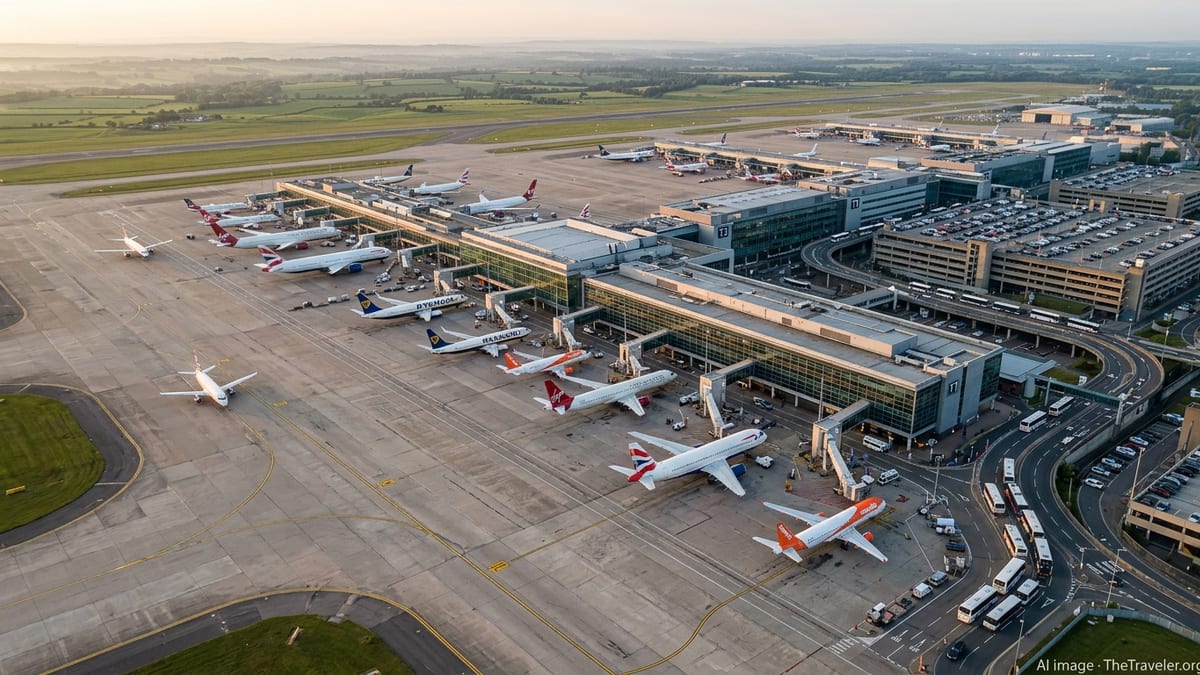
A Record Year for UK Skies
Publicly available data from the UK Civil Aviation Authority indicates that total passenger traffic through UK airports climbed to around 302 million journeys in 2025, surpassing the previous high set before the pandemic and edging above the 295 million to 300 million range seen in earlier recovery years. Industry summaries of the newly released figures describe 2025 as a definitive return to growth, rather than just a rebound from crisis.
The new peak crowns a rapid multi‑year recovery. In 2020, UK airport passenger numbers collapsed as travel restrictions took hold, with subsequent years marked by volatile demand and operational disruption. By 2023, passenger journeys had rebounded into the high 200 million range, and in 2024 volumes moved closer to pre‑Covid levels. The 2025 data now shows not only full recovery but new territory for the country’s air travel market.
The 302 million total reflects both outbound and inbound journeys and covers all commercial UK airports, from major global hubs to small regional fields serving a handful of routes. While London’s airports still account for a large share of overall traffic, growth has increasingly been spread across the wider country, with regional centers and secondary airports recording some of the fastest percentage increases.
Airline scheduling and route data suggest that leisure demand has been a key driver, particularly for Mediterranean and short‑haul European destinations. At the same time, a gradual return of business travel, buoyed by conferences and corporate activity, has reinforced the upward trend, even though corporate travel habits remain more selective than before 2020.
The Emergence of the ‘One Million Club’
Within the headline figure, one of the most striking storylines is the rise of what observers are describing as the UK’s airport “one million club.” Civil Aviation Authority tables for 2024 and 2025 show a growing band of smaller airports edging past or consolidating above one million terminal passengers per year, elevating them into a more influential tier of the network.
This club typically includes regional gateways and secondary city airports that, until recently, handled only a few hundred thousand passengers annually. Recent data suggests that several of these facilities have either crossed the one million mark for the first time or returned to it after slipping below during the pandemic downturn. For local economies, the shift can be significant, often supporting new airline bases, extra seasonal routes and expanded employment.
Published coverage of UK airport statistics points to continued growth at airports such as Teesside International, Exeter, Newquay, Southampton and others that have benefited from domestic connectivity, leisure charters and low‑cost carrier expansion. In some cases, the one million threshold has been reached through a combination of revived routes, targeted tourism campaigns and the addition of niche international services that connect smaller British regions to European hubs.
Analysts note that joining the one million club can be a powerful signal to airlines and investors. Passenger volumes at this level can justify improved terminal facilities, upgraded security and border infrastructure, and more frequent public transport links, which in turn make the airport more attractive as a platform for future growth.
London’s Dominance and the Rise of Regional Hubs
Even as regional airports gain ground, London’s multiairport system remains the beating heart of UK aviation. Data collated from CAA releases and industry reports shows that Heathrow, Gatwick, Stansted, Luton, London City and Southend together handled roughly 177 million passengers in 2024 and an even greater share in 2025. Heathrow alone processed more than 80 million travelers over the past year, consolidating its position among the world’s busiest international hubs.
Gatwick, Stansted and Luton have also reported strong demand, driven by low‑cost carriers and point‑to‑point leisure networks that radiate across Europe and beyond. However, the surge in overall UK passenger numbers is not confined to the capital. Manchester, Birmingham, Edinburgh, Glasgow and Belfast have all seen volumes move closer to or above pre‑pandemic levels, according to airport annual reports and CAA datasets.
Some regional airports are setting their own records. Liverpool John Lennon Airport, for example, has reported annual passenger volumes exceeding five million for the first time, highlighting how sustained low‑cost growth and targeted route development can transform a regional gateway’s role in the national network. Similar patterns are visible at other major regional hubs, which are increasingly competing with London for inbound tourism and short‑haul traffic.
This geographic diffusion of growth has implications for travelers. As more airports reach critical mass, passengers in many parts of the UK gain access to a broader choice of direct flights without transiting through London. That can reduce total journey times, ease congestion at the biggest hubs and spread economic benefits more widely across the country.
Capacity, Service and Sustainability Pressures
Behind the headline of 302 million passengers lies a more complex picture of capacity constraints and service challenges. Previous summers have exposed pinch points in airport staffing, security processing and baggage handling, and although punctuality indicators reportedly improved in 2024 and 2025, consumer groups continue to highlight instances of crowding, delays and disrupted journeys at peak times.
The record traffic is also sharpening focus on accessibility and inclusivity. The UK Civil Aviation Authority’s most recent airport accessibility assessments indicate that more than 5 million passengers requested assistance in 2024, a number that continues to grow faster than total passenger volumes. That trend is pushing airports to upgrade layouts, wayfinding, seating and boarding processes so that surging numbers do not come at the expense of passengers with reduced mobility.
Environmental concerns remain central to the debate over continued growth. Government policy papers and aviation industry submissions to Parliament repeatedly reference the “Jet Zero” strategy and the sector’s goal of delivering net zero aviation by mid‑century, alongside interim milestones such as zero‑emission airport operations by 2040. With passenger numbers now exceeding previous records, campaigners and policymakers are re‑examining how capacity expansion, new runways and regional growth can be reconciled with climate commitments.
In response, airports are increasingly highlighting investments in low‑carbon ground operations, on‑site renewable energy, sustainable aviation fuel infrastructure and public transport links. However, the scale of the challenge means that rising passenger totals will likely remain a focal point in UK climate and transport debates, particularly when major expansion projects are under review.
What the New Milestone Means for UK Travel
The crossing of the 302 million passenger line marks a psychological as well as statistical threshold for Britain’s aviation market. After several years in which the primary narrative was one of recovery and resilience, the conversation is now shifting toward managing success: how to accommodate long‑term demand while protecting service quality, regional connectivity and environmental goals.
For travelers, the immediate impact is greater choice and, in many cases, more convenient access to international routes from local airports. The expansion of the one million club means that more communities can reach key European and holiday destinations without adding an extra domestic leg, while established hubs bring back long‑haul frequencies and open new markets in North America, the Middle East and Asia.
For airports and airlines, the record year underscores the importance of carefully sequencing investment. Terminal refurbishments, new piers, upgraded baggage systems and improved digital services are all being calibrated against passenger forecasts that now assume sustained growth rather than a temporary post‑pandemic surge. The challenge will be to ensure that the UK’s air infrastructure keeps pace, so that the achievement of 302 million journeys becomes a platform for balanced, durable development rather than a ceiling that exposes the limits of the current system.