

More news on this day
The United Kingdom has joined a group of 11 European countries to push a new wave of coordinated travel and tourism reforms, aiming to make cross-border journeys smoother through shared digital systems, aligned entry rules and closer cooperation on visitor flows.
Get the latest news straight to your inbox!
A New Coalition Focused on Seamless European Journeys
The emerging coalition brings together the UK with Austria, Croatia, Denmark, Czech Republic, Finland, France, Lithuania, the Netherlands, Slovenia and Spain, a cluster that sits at the crossroads of Europe’s busiest air, rail and road corridors. Publicly available information shows that these countries are already deeply interconnected through the Schengen Area, the EU’s freedom of movement framework and long-standing air and rail links used by tens of millions of travellers each year.
Reports indicate that the group is now working to align upcoming changes in border management, including new pre-travel authorisation systems and biometric checks, to reduce duplication and confusion for visitors. While each government retains control over its own borders, shared timelines, compatible technology and common communication to passengers are emerging as core themes of this joint effort.
For travellers, the headline ambition is clear: fewer surprise checks, more predictable processes and a single, easy-to-understand rulebook when moving between the UK and key EU destinations. Industry coverage suggests that aviation, rail and ferry operators have been pressing for such coordination to avoid bottlenecks when multiple new systems go live across Europe in the middle of the decade.
Tourism boards in participating countries have also been highlighting the opportunity to pair smoother borders with campaigns that promote multi-country itineraries, encouraging visitors to treat Europe as a continuous, hassle-free travel space rather than a patchwork of separate trips.
Digital Entry Systems at the Heart of the Shift
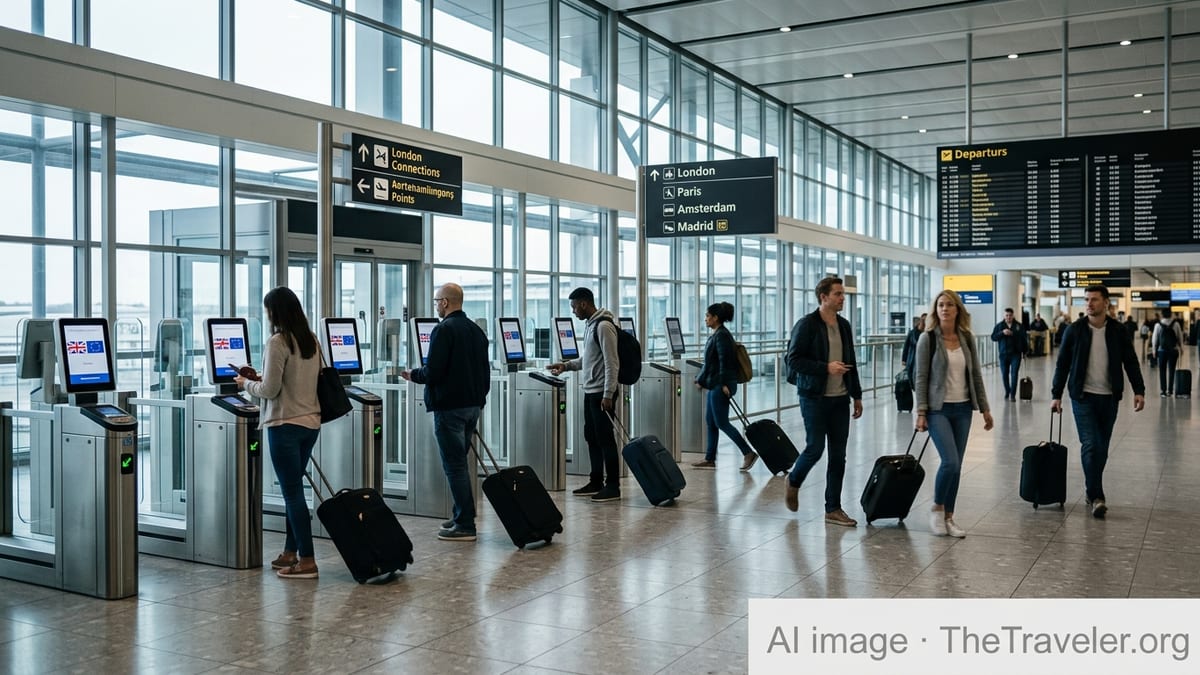
At the core of this policy push is a rapid move toward digital pre-screening and biometric border checks. On the EU side, the Entry/Exit System and the European Travel Information and Authorisation System are being phased in to register non-EU arrivals and require advance travel approval from visa-exempt visitors. In parallel, the UK is expanding its own Electronic Travel Authorisation scheme, which will eventually apply to citizens of many European countries.
According to published coverage, authorities across the UK, France, Spain, the Netherlands and other hub countries are working to ensure that these systems can operate side by side without overwhelming airports and ports. That includes coordinating trial periods, staffing levels and passenger information so that travellers are not faced with multiple, poorly explained checks on the same journey.
For visitors from outside Europe, the shift means that trips which previously required only a passport may soon involve quick online applications, fees and biometric scans at automated gates. Travel industry analysis suggests that, if properly harmonised, these steps can shorten queues by shifting vetting to the pre-travel stage and letting most passengers use self-service lanes on arrival.
Crucially, the participating states are emphasising data protection safeguards and clear opt-outs for those who cannot use automated systems. Ensuring that digitalisation does not create new barriers for older travellers, families or people with reduced mobility remains a central challenge within the broader effort to make journeys more seamless.
Aligning Tourism Strategies Across Key Source Markets
The same group of countries is also closely linked through tourism flows. Recent European tourism statistics show that the UK remains one of the largest outbound markets for Spain, France and Croatia, while travellers from Austria, the Netherlands, Denmark and Finland are significant contributors to city-break and nature tourism across the continent.
National tourism organisations in these states have been stepping up joint campaigns, particularly in long-haul markets such as North America and Asia, presenting multi-country rail routes, coastal road trips and themed cultural circuits as single, integrated products. The new policy coordination on borders is expected to reinforce these campaigns by reassuring visitors that paperwork and entry procedures will be predictable across multiple destinations.
Industry briefings point to an emphasis on sustainable transport, with cross-border rail corridors between France, the Netherlands, Denmark, the Czech Republic and Austria highlighted as alternatives to short-haul flights. The alignment of travel rules is seen as a way to support these shifts by simplifying ticketing, identity checks and baggage rules for passengers making seamless transfers.
For cities and regions heavily dependent on tourism, such as Spain’s Mediterranean coast, Croatia’s Adriatic resorts or France’s major cultural centres, more reliable and user-friendly border processes are being framed as essential tools to maintain competitiveness at a time when destinations worldwide are racing to capture pent-up demand.
What Travellers Can Expect in the Coming Years
For now, many of the changes remain in gradual rollout, and today’s travellers will still encounter a mix of traditional passport stamping and newer automated gates across European gateways. However, published forecasts suggest that by the second half of the decade, the experience of moving between the UK and much of the EU will be markedly more digital and pre-planned.
Passengers can expect wider use of online portals and mobile apps to upload passport data, answer basic security questions and receive electronic travel approvals before departure. At airports in the UK, France, Spain and the Netherlands, as well as major rail and ferry terminals, this should increasingly translate into dedicated lanes for pre-cleared passengers and quicker passage at border kiosks.
Travel experts note that the success of this multi-country effort will hinge on clear, consistent communication. If the UK and its 11 partners can agree on common terminology, shared FAQs and aligned timelines for new requirements, then the promised “seamless and hassle-free” journeys will become a realistic prospect rather than an aspirational slogan.
As the transition unfolds, travellers are being encouraged by public information campaigns to check entry rules well before departure and to treat digital pre-clearance as a standard part of trip planning, similar to booking flights or accommodation. In return, the coalition of countries is betting that a smoother border experience will help anchor Europe’s position as one of the world’s most attractive and accessible travel regions.