

More news on this day
UK holidaymakers and business travellers are scrambling to rewrite their plans after Dubai, Abu Dhabi and Doha were placed on the UK Foreign Office’s list of destinations to avoid amid the escalating Iran conflict, triggering sweeping airspace closures, mass flight cancellations and complex, expensive rerouting across key Europe–Asia corridors.
Get the latest news straight to your inbox!
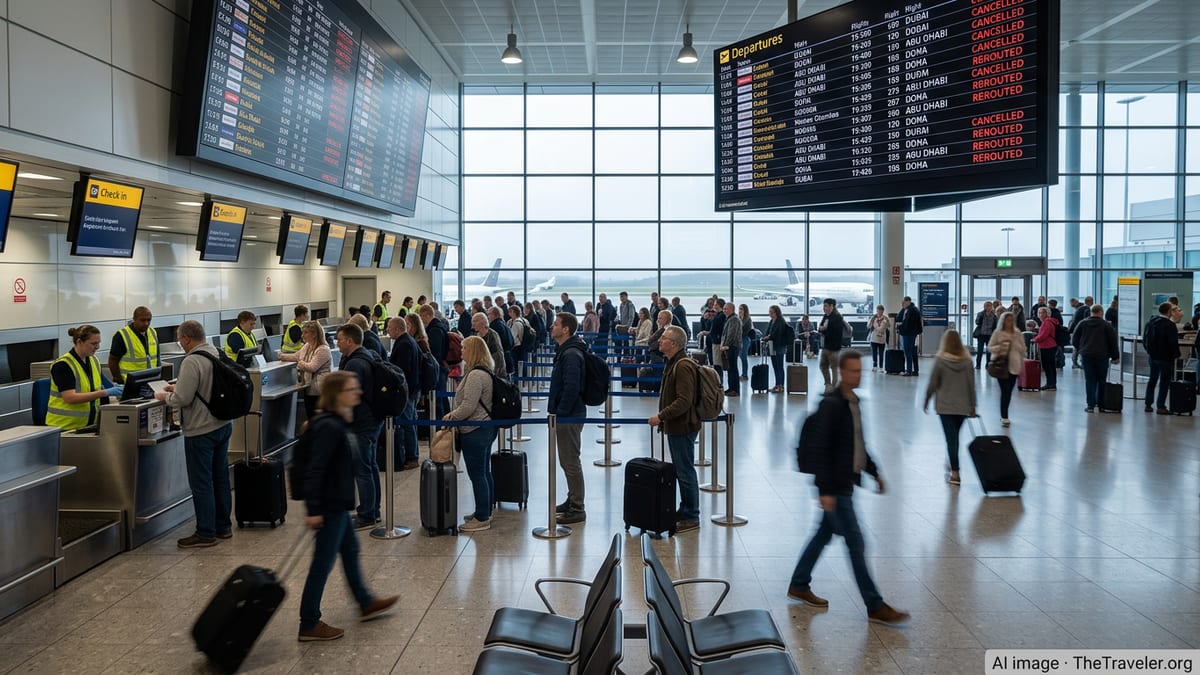
Foreign Office Advice Shifts Overnight For Key Gulf Hubs
The updated travel advisories, issued in early March as the Iran conflict intensified, mark a dramatic shift in the status of three of the world’s busiest transit hubs. Publicly available UK guidance, which already warned strongly against travel to Iran itself, has expanded to advise against non-essential or all travel involving transits through Dubai, Abu Dhabi and Doha, citing heightened regional security risks and ongoing missile and drone activity.
Security analyses released in recent days describe a high-risk operating environment across much of the Gulf, with multiple reports of missile and drone interceptions over or near major cities. Travel risk bulletins note that the United Arab Emirates has faced strikes and air defence activity in the vicinity of Dubai and Abu Dhabi, while Qatar has also been drawn into the confrontation. Airports serving these cities, normally marketed as ultra-reliable global hubs, are now surrounded by restricted airspace, diversions and rolling delays.
Travel advisory firms tracking the situation say the policy shift reflects a combination of direct security concerns and the practical difficulties of guaranteeing safe, predictable passage through the region. Some guidance documents underline that although no formal closure has been declared for key maritime chokepoints, airspace in many Gulf states has been partially or fully shut on a rolling basis, making future connectivity uncertain.
Airspace Closures Spark Global Rerouting And Long-Haul Disruption
The new Foreign Office stance lands on top of extensive airspace closures already in place across Iran, Iraq, Jordan, Qatar, Bahrain, Kuwait and the United Arab Emirates. Industry briefings from aviation and risk consultancies describe full or partial shutdowns that have forced thousands of cancellations and large-scale rerouting of long-haul traffic between Europe, Africa, Asia and Australasia.
Major airports including Dubai International, Abu Dhabi International and Doha’s Hamad International are reported to be operating at sharply reduced capacity, with periods of complete suspension earlier in the crisis. Operational updates compiled by travel management companies show Emirates halting its network out of Dubai for extended periods, Etihad suspending Abu Dhabi departures, and Qatar Airways pausing services while regulators reassessed overflight permissions.
For UK travellers, the knock-on effect is severe. Popular one-stop itineraries from London, Manchester, Edinburgh and regional airports to destinations such as Bangkok, Sydney, Cape Town and Bali, which typically rely on overnight connections in the Gulf, have become uncertain or unviable. Airlines and booking platforms have had to rebuild schedules on short notice, sending flights south over the Red Sea, via Central Asia, or through alternative hubs such as Istanbul, Delhi and various European gateways.
Airlines’ internal estimates, shared in industry-facing briefings, suggest that several thousand flights were affected in the initial disruption window, with continuing instability on many trunk routes. The extra flying time, fuel burn and crew repositioning are feeding directly into higher operating costs, some of which are starting to be passed on to passengers in the form of fare increases and rebooking fees.
British Travellers Face Confusion Over Insurance, Refunds And Rights
The sudden addition of Dubai, Abu Dhabi and Doha to the list of destinations covered by negative UK travel advice is also creating a tangle of contractual and insurance questions for UK residents. Consumer rights discussions and legal commentary highlight that many standard travel insurance policies restrict or exclude cover for trips taken against government advice, especially where conflict or acts of war are involved.
Online forums and advisory sites used by British travellers show growing concern from people holding tickets or holiday packages routed through the Gulf. Some report outbound legs cancelled only hours before departure as airspace closures took effect, while return segments remain technically active but exposed to further disruption. Others are discovering that flying on an itinerary that still passes through a newly designated no-go hub may jeopardise their insurance, even if the airline continues to operate.
Publicly available information on airline policies indicates a patchwork response. Certain European and UK carriers have issued broad “book-away” or waiver policies, allowing passengers to reroute via alternative hubs or claim refunds for itineraries touching Dubai, Abu Dhabi or Doha during the crisis period. By contrast, some Gulf-based and codeshare partners are reported to be slower to cancel or reissue tickets, leaving travellers stuck between airline conditions of carriage, package holiday terms and their insurers’ requirements.
Consumer advocates warn that the interaction between Foreign Office advice and airline obligations under UK and European passenger rights regulations is complex. While carriers generally must offer refunds or re-routing when they cancel a flight, there is less clarity for passengers who wish to proactively abandon a trip solely because of changing government guidance, particularly where parts of the itinerary are still technically operating.
Tourism And Business Travel Hit As Gulf Stopovers Lose Their Appeal
The Gulf hubs have spent decades building reputations as reliable bridges between the UK and the rest of the world, anchored by aggressive expansion from Emirates, Etihad and Qatar Airways. The latest conflict and the associated Foreign Office no-go designation are delivering a rare shock to that model, undermining the allure of Dubai city breaks, Abu Dhabi resort stays and Doha stopover packages for British travellers.
Tour operators and corporate travel managers report significant reprogramming of itineraries away from the region. Publicly available booking data and anecdotal feedback suggest that some UK firms have implemented temporary bans on staff travel via the Gulf, while leisure travellers are pivoting to routings through Europe, South Asia or the Mediterranean to avoid the perceived risk and administrative complexity.
Destinations that once depended heavily on Gulf connections are also feeling the impact. With a large share of UK–Asia and UK–Africa traffic historically funnelled through Dubai, Abu Dhabi and Doha, the current disruption is pushing demand toward alternative hubs in Turkey, India and continental Europe. Analysts note that the longer the Iran conflict and regional airspace restrictions continue, the greater the likelihood of permanent shifts in traveller behaviour and airline network planning.
At the same time, tourism bodies in the Gulf are grappling with an abrupt downturn from key origin markets such as the UK. While local authorities continue to promote events, attractions and winter-sun packages, the combination of Foreign Office warnings, footage of missile interceptions and complex flight schedules is expected to weigh heavily on arrivals from Britain in the short to medium term.
What UK Travellers Can Do As The Situation Evolves
With the conflict still evolving and airspace restrictions subject to change at short notice, travel specialists emphasise the importance of close monitoring. Publicly available guidance consistently advises passengers to check live flight status before leaving for the airport, to keep a close eye on airline travel alerts, and to ensure contact details are up to date in booking systems so that schedule changes are communicated quickly.
For those yet to travel, risk consultants recommend reviewing the latest UK government travel advice before committing to any routing through the Gulf, and considering fully flexible tickets where travel is essential. Prospective travellers are also urged to read their travel insurance documents carefully, paying particular attention to exclusions linked to war, civil unrest and official government advisories.
Industry observers expect further timetable adjustments, extended suspension of certain routes and a prolonged period of higher fares on alternative corridors as airlines work around closed or constrained airspace. Until the regional security picture stabilises and the UK Foreign Office revises its assessments, Dubai, Abu Dhabi and Doha are likely to remain off-limits for many British travellers, transforming what were once seamless connections into a patchwork of unpredictable, and often more expensive, journeys.