

More news on this day
Portugal’s tourism boom is accelerating to new records, with fresh data showing the United Kingdom has surged past the Netherlands, Germany, France, Spain and other European rivals as the country’s most powerful source market for both guest numbers and spending, helping propel Portugal to unprecedented highs in international arrivals and tourism revenue.
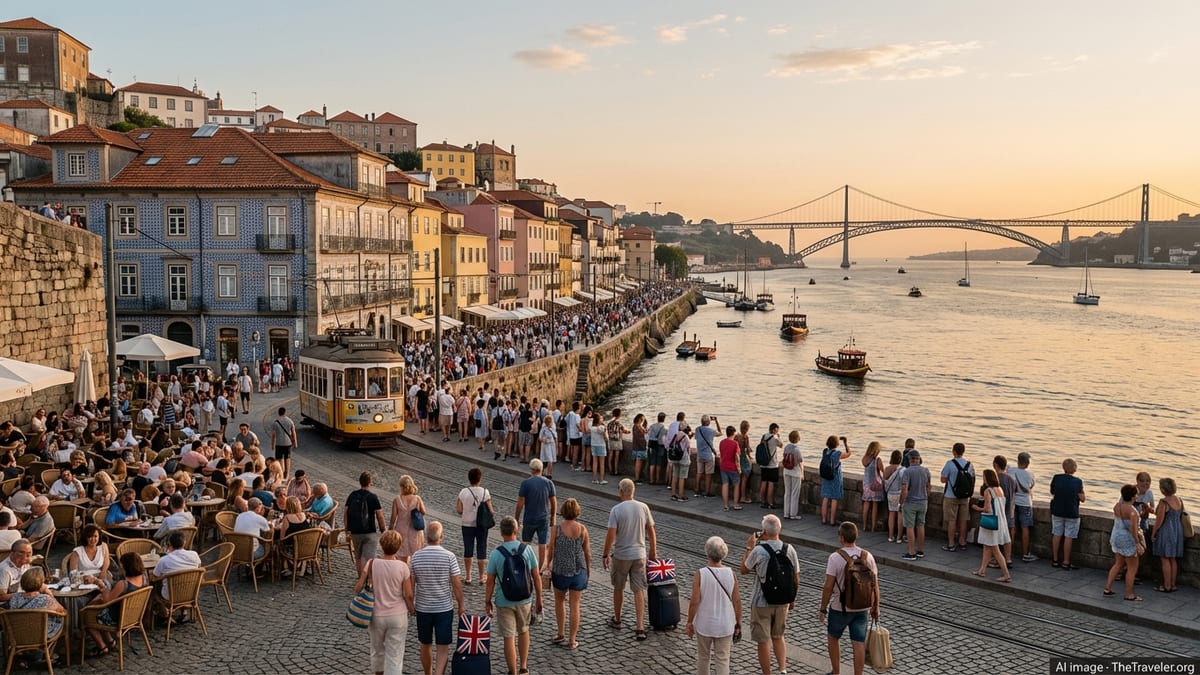
UK Emerges as Portugal’s Undisputed Powerhouse Market
Official figures from Turismo de Portugal and the national statistics office show that in 2024 the United Kingdom firmly established itself as Portugal’s leading source market, measured by both guests and overnight stays. British visitors accounted for 18.1 percent of all non-resident overnight stays in tourist accommodation and 12.7 percent of total foreign guests, cementing their position at the top of the table ahead of Germany, France, Spain, the Netherlands and Italy.
According to the latest market breakdowns, British travelers generated around 2.46 million guests and more than 10.2 million overnight stays in Portugal in 2024, with year-on-year growth in both indicators. That performance outpaced or contrasted with softer trends from several continental competitors, with Spanish overnights, for example, registering declines in some months even as the overall UK contribution edged higher.
By 2025, partial-year data underline that the shift is not a one-off. Between January and July 2025, Portugal welcomed roughly 1.4 million British guests, who generated 5.8 million overnight stays, keeping the UK firmly in first place as an origin market and widening its lead over neighboring European countries. Industry analysts say this consolidation reflects not only pent-up demand after the pandemic but also structural changes in British travel behavior.
“The UK is no longer just one of several big markets; it is the cornerstone of Portugal’s inbound tourism,” one senior tourism official in Lisbon noted in a recent briefing. “It has decisively overtaken traditional European rivals in terms of volumes, and that leadership is now extending to spending.”
Tourism Revenue Surges to Record Levels
Behind the headline numbers on arrivals, the balance sheet tells an even more dramatic story. Bank of Portugal data show that tourism exports – spending by non-resident visitors in the country – climbed to roughly 27.7 to 30 billion euros in 2024, a historic peak that lifted tourism’s contribution to about 9.7 percent of GDP and close to half of all service exports. In the European Union, that performance placed Portugal among the top five for tourism receipts and among the very highest when measured relative to the size of its economy.
Crucially, British visitors now provide the single largest slice of this revenue. Central bank and tourism-board figures indicate that UK travelers generated just over 4.1 billion euros in tourism receipts in 2024, making the United Kingdom Portugal’s number-one market by income. That means British tourists are not only arriving in record numbers but also spending more on accommodation, dining, culture and transport than any other nationality.
The shift becomes even more striking when viewed in regional context. While Spain, France, Italy and Germany continue to dominate Europe’s tourism earnings in absolute terms, Portugal is climbing the rankings, buoyed by robust British spending. UN Tourism-based estimates for 2024 place Portugal with around 30 billion dollars in international tourist receipts, above the Netherlands and approaching the levels of long-established Mediterranean competitors.
Officials point out that revenue growth is now outpacing visitor growth, suggesting that the country is capturing higher-value segments of the British market. Business-class arrivals, long-stay digital nomads from the UK and affluent leisure travelers attracted by wine, golf and gastronomy are all contributing to a rise in average spend per visitor, amplifying the impact of British demand on the Portuguese economy.
Overtaking Continental Rivals Across Key Indicators
The reshuffling of source markets is visible not only in Portugal’s internal rankings but also in how the UK’s role compares with that of other European nations. For years, Spain, France and Germany tussled for the top positions as emitters of tourists to Portugal. Recent data show that, while those markets remain vital, the UK has now pulled clearly ahead in several core metrics, from share of overnight stays to total receipts.
France and Germany continue to account for sizeable portions of foreign overnights in Portugal – 8.0 and 11.3 percent respectively in 2024 – but their growth rates have been more modest than that of the British market. Spain, historically dominant due to geographic proximity and easy cross-border travel, has slipped down the spending league, with American visitors recently surpassing Spaniards in total tourism outlays even as UK travelers retain the top spot.
Beyond the big four, the Netherlands, Switzerland and Italy remain important but secondary contributors in Portugal’s inbound mix. Recent central bank analysis shows that when the revenue generated by each nationality is ranked, British visitors lead, followed by French and German tourists, with Americans now in fourth place and Spaniards relegated to fifth. Dutch travelers, despite recording double-digit growth in some segments, sit firmly behind the UK in both volume and value.
This divergence is particularly notable given ongoing records elsewhere in Europe. Spain, for instance, welcomed nearly 97 million foreign visitors in 2025 and ranks among the world’s top three tourism earners. Yet even in that context, British travelers are increasingly choosing Portugal over other European destinations for their holidays and relocations, shifting the balance of UK outbound tourism toward Lisbon, Porto, the Algarve and the islands.
Record-Breaking Guest Numbers Transform Destinations
On the ground, the UK-led surge is transforming some of Portugal’s most popular destinations. The national statistics office reports that total guest numbers reached about 31.6 million in 2024, with 80.3 million overnight stays in tourist accommodation. Non-residents accounted for more than 70 percent of those nights, underlining the country’s growing dependence on international tourism.
British travelers are at the forefront of that expansion. In December 2024, a traditionally quieter month, tourist accommodation recorded 1.9 million guests and 4.2 million overnight stays, both record highs for the month. The UK topped the international ranking with a 13.7 percent share of all foreign overnights in December, highlighting how British demand is increasingly stretching beyond the summer peak into the shoulder and winter seasons.
Regionally, the map of British tourism in Portugal is highly concentrated but slowly diversifying. The Algarve remains the primary draw, capturing close to 58 percent of all UK overnight stays, followed by Madeira with around 19 percent and Greater Lisbon with roughly 13 percent. Coastal resort towns such as Albufeira, Lagos and Portimão continue to attract sun-and-sea holidaymakers, while Funchal and Caniço in Madeira are seeing strong growth from British hikers, cruise passengers and long-stay retirees.
Urban centers are also stepping into the spotlight. Lisbon and Porto have become weekend-break favorites for British city travelers, attracted by direct low-cost flights, a thriving food scene and cultural festivals. Tourism officials say that British guests are increasingly combining city stays with excursions into lesser-known regions such as Alentejo’s wine country or the Douro Valley, further spreading the economic benefits of tourism.
Spending Power and Revenue Mix Tilt Toward the UK
While the United Kingdom leads on several volume indicators, its real impact is felt in Portugal’s revenue mix. Tourism authorities note that UK visitors accounted for nearly 15 percent of all tourism receipts in 2024, giving them disproportionate influence over the sector’s financial health. That dominance extends across hotels, short-term rentals, restaurants and local experiences, from golf courses to guided tours.
Bank of Portugal analysis indicates that between 2010 and 2024 Portugal recorded the largest increase in tourism exports as a share of GDP among EU countries, with a rise of approximately five percentage points. British demand has been central to that surge, consistently providing stable, high-value inflows even during periods of macroeconomic uncertainty and currency volatility.
The revenue data also highlight the diversification that is under way. While the UK remains the top spender, the sharp increase in American and Canadian tourism is reshaping the hierarchy behind it. In 2024, US tourists overtook Spaniards in total spending, moving into fourth place on the revenue ranking and signaling a broader broadening of Portugal’s international appeal. Yet despite this North American momentum, British travelers continue to generate the largest single contribution.
For local businesses, the spending habits of UK visitors are particularly prized. Hoteliers in the Algarve report robust demand for higher-category rooms and all-inclusive packages, while restaurateurs in Lisbon and Porto say British diners are increasingly seeking out contemporary Portuguese cuisine and wine pairings, rather than sticking solely to budget-friendly options. This mix of volume and value is a key reason why policymakers describe the UK as “strategic” to maintaining Portugal’s tourism-driven growth.
Why Portugal Is Winning Over British Travelers
Several structural factors help explain why the UK has overtaken other European countries as Portugal’s most important feeder market. One of the most significant is air connectivity. In 2024, Portugal ranked fifth in total outbound air flows from the UK, with carriers such as easyJet, Ryanair, Jet2, British Airways and TAP Portugal collectively operating a dense network of flights from British regional airports to Portuguese gateways in Lisbon, Porto, Faro and Funchal.
Cost and quality of life are also critical components. British media and relocation specialists increasingly cite Portugal as a more affordable alternative to Spain, France or Italy, particularly for retirees and remote workers concerned about rising living costs. Reports of declining British residency numbers in Spain, alongside new property taxes and tighter visa regimes there, contrast with Portugal’s relatively flexible residency routes and more accessible property market, helping to redirect some long-stay and expatriate demand westward.
Climate and lifestyle round out the appeal. Portugal offers a mix of Atlantic beaches, historic cities, wine regions and rugged interior landscapes within a manageable geographic area. For British visitors, that means short flight times to a destination that offers winter sun, summer surf and year-round cultural events. Tourism campaigners have also invested heavily in promoting niche interests such as golf, surfing, cycling and gastronomy, all of which resonate strongly in the UK market.
“For many British travelers, Portugal hits the sweet spot between affordability, authenticity and accessibility,” a Lisbon-based travel analyst said. “It has managed to scale up tourism without losing its sense of place, and that is proving a decisive advantage over some of its Mediterranean competitors.”
Managing Growth: Opportunities and Pressures Ahead
The rapid rise in guest numbers and revenue, largely propelled by British and North American demand, brings both opportunities and challenges. On the positive side, record tourism receipts have improved Portugal’s external balance and created jobs in accommodation, food services, transport and culture. Inland regions and secondary cities are starting to benefit from spillover demand as coastal hotspots near capacity in peak periods.
Yet policymakers and local communities are increasingly focused on the pressures that accompany success. Housing affordability in Lisbon, Porto and parts of the Algarve has become a contentious issue, with residents pointing to the expansion of short-term rentals catering to foreign visitors and expatriates. Municipal authorities have responded with tighter licensing rules in some neighborhoods and initiatives to redirect tourism flows toward under-visited areas.
Environmental concerns are also rising up the agenda. Coastal erosion, water stress and the impact of cruise tourism on port cities like Lisbon and Funchal are all under scrutiny as visitor numbers climb. Tourism strategists argue that higher-spending segments, such as British golfers or wine tourists, can help decouple revenue growth from raw visitor volume, enabling Portugal to pursue a model based more on value than sheer numbers.
For now, officials see the UK’s leadership as a strength, but one that needs to be balanced with continued market diversification. The goal, according to recent government statements, is to maintain Portugal’s appeal to British travelers while deepening ties with emerging markets and encouraging off-season and inland tourism. If that balance can be struck, Portugal’s status as a European tourism success story looks set to endure, with the UK continuing to play a starring role in its ongoing ascent.