

More news on this day
Growing airspace restrictions across the Middle East are rippling through global aviation networks, leaving travelers from the United Kingdom and dozens of other countries stranded or severely delayed, while Saudi Arabia moves to ease the burden with visa extensions and temporary relief from overstay fines that can reach SAR 50,000.
Get the latest news straight to your inbox!
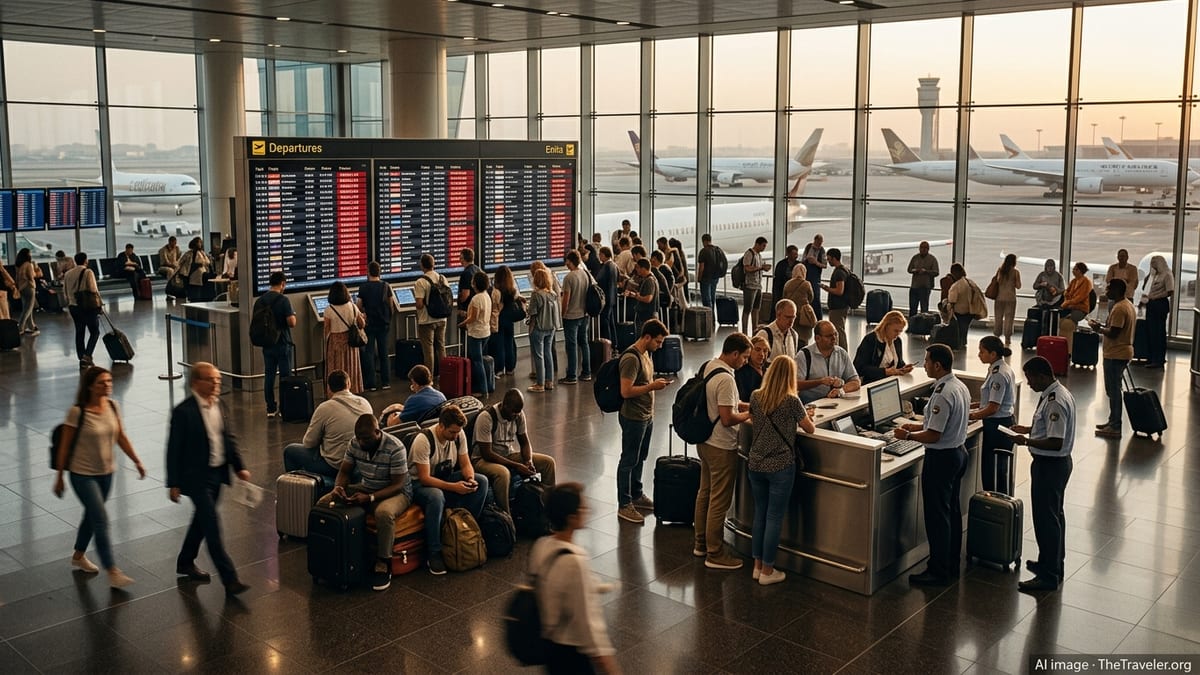
Middle East Airspace Closures Trigger Global Disruptions
Escalating regional conflict has led to widespread airspace closures and capacity cuts across key Middle East hubs, disrupting routes that link Europe, Africa, Asia, and Australasia. Publicly available aviation tracking data and travel advisories show that Iran’s airspace has been largely avoided, while countries including Qatar, the United Arab Emirates, Israel, Iraq, Kuwait, Bahrain, and Syria have imposed full or partial closures or severe operating restrictions. Airlines have been forced to reroute or cancel services at short notice, often adding hours of flight time or eliminating nonstops entirely.
Major transit airports such as Doha, Dubai, Abu Dhabi, and Kuwait City have experienced rolling cancellations and prolonged schedule reductions. Advisory documents compiled for the shipping and aviation industries in early March indicate that Qatar’s airspace in particular has remained tightly constrained under emergency conditions, with regular commercial operations sharply curtailed. Knock on effects have spread far beyond the Gulf, upending travel plans for passengers who never intended to set foot in the region but were relying on it as a transit corridor.
Risk assessments issued this month describe a patchwork of closures, limited operating windows, and fast changing security directives. Airlines are frequently adjusting routings on the day of departure to maintain separation from potential conflict zones, sometimes adding unscheduled technical stops for refueling along longer diversionary paths. The result has been acute congestion at alternative hubs and a sharp increase in missed connections, missed visa deadlines, and passengers stranded in third countries.
UK, Canada, Japan and Others Caught in the Fallout
The United Kingdom has become one of the latest states whose travelers are heavily affected by the turmoil. Published coverage in British and international media points to UK bound and UK originating flights that normally cross or connect through the Middle East now facing diversions via southern routes over Egypt, Saudi Arabia, and the wider Indian Ocean region, or being canceled altogether. Similar disruptions are being reported for Canada, Japan, the United States, South Africa, Germany, and Qatar, all of which depend on long haul connectivity through Gulf and Levantine airspace.
For carriers in Europe, North America, and Asia, the closure of multiple Middle Eastern flight information regions has complicated already tight long haul schedules. Longstanding nonstops between European cities and destinations in South or Southeast Asia that previously overflew Iran or the Gulf now require detours that increase fuel burn and tighten crew duty limits. This has led some airlines to prioritize core routes and temporarily suspend lesser served city pairs, with passengers rebooked through more circuitous journeys.
Reports from travel advisories and airline alerts show that travelers from countries such as the UK, Canada, Japan, South Africa, and Germany have been stranded not only in Gulf hubs but also in secondary transit points as cascading delays undermine connection banks. In some cases, travelers on multi stop itineraries have found themselves stuck in countries where they possess only short stay or transit visas, raising the risk of accidental overstays when flights are repeatedly postponed.
Saudi Arabia Balances Strict Penalties With Targeted Relief
Saudi Arabia’s immigration framework has drawn particular attention in this crisis because of its long standing emphasis on strict compliance. Public information from previous advisories details penalties of up to SAR 50,000 for visa overstays, alongside possible detention and deportation for serious or repeated violations. Sponsors who fail to report visitors who have stayed beyond their permitted period can themselves face substantial fines and other sanctions.
Against the backdrop of the current aviation turmoil, however, new guidance indicates that Saudi authorities are moving to cushion the impact on travelers who are stranded through no fault of their own. Government communications and regional travel advisories point to temporary mechanisms to extend visit and transit visas for passengers unable to depart due to flight cancellations or airspace closure, and to suspend or waive the application of the heaviest overstay penalties for those directly affected by the crisis.
Practical implementation appears to involve case by case reviews supported by documentation such as airline cancellation notices, rebooking confirmations, and evidence of airport disruption. While the formal legal ceiling of SAR 50,000 for overstay fines remains in place, the current relief measures are designed to ensure that travelers caught mid journey by sudden airspace decisions are not treated the same way as intentional violators. The balance reflects Saudi Arabia’s dual priority of upholding border rules while protecting the country’s reputation as a major transit and pilgrimage gateway.
Stranded Passengers Seek Clarity on Visas and Next Steps
As schedules continue to shift, one of the most acute challenges for passengers from the UK, North America, Asia, and Africa is understanding their legal status when an unexpected stopover turns into a multi day stay. Guidance compiled by travel risk consultancies and immigration specialists advises stranded travelers in Saudi Arabia and neighboring states to monitor airline communication closely, keep all boarding passes and delay notices, and verify their permitted length of stay with official channels when rebooked on later departures.
For travelers currently in Saudi Arabia, the emerging relief policies mean that those who entered legally and were later prevented from leaving by widespread cancellations have a clearer path to regularize their stay. Publicly available information suggests that visitors whose visas are nearing expiry or have just lapsed because of the crisis may be able to obtain short term extensions or fine exemptions, particularly if they present a documented history of disrupted flights. Nonetheless, passengers are being urged by airlines and advisory platforms not to make assumptions and instead to proactively confirm their status.
In practice, this often requires coordination between airlines, local immigration desks at airports, and, where applicable, sponsors or employers. Travelers are encouraged to arrive early for rebooked flights, as additional time may be needed for manual checks of visas and exit permissions. Those who have onward connections in Europe or Asia are also being reminded to review transit rules at their final routing, since altered itineraries can shift which country’s immigration rules apply and how long a traveler is allowed to remain airside or landside.
Airlines and Governments Adjust to a Prolonged Crisis
Airlines serving the Middle East and using it as a bridge between continents are steadily rewriting schedules in anticipation that restrictions could persist for weeks. Network planners are deploying longer range aircraft on some key routes to reduce dependency on vulnerable corridors, while grounding or reallocating capacity on others that have become operationally impractical. Industry analysis highlights that these adjustments can only partially offset the loss of access to some of the world’s most strategically located airspace.
Governments including the UK, Canada, Japan, the United States, South Africa, and Germany have updated travel advice urging citizens to allow extra time for journeys that might intersect with the wider region, even indirectly. Public advisories emphasize that passengers should check flight status immediately before departure, expect potential last minute changes to routings, and be prepared for unplanned overnight stays if aircraft need to divert to alternative hubs outside the primary conflict zone.
As the situation evolves, Saudi Arabia’s decision to pair firm long term visa enforcement with short term extensions and relief from the highest overstay fines illustrates how regional states are trying to protect both national security and traveler welfare. For the many passengers now navigating lengthy detours around a volatile Middle East, clarity on visa rules and flexible responses from both airlines and immigration systems are likely to remain critical to restoring confidence in long haul travel.