

More news on this day
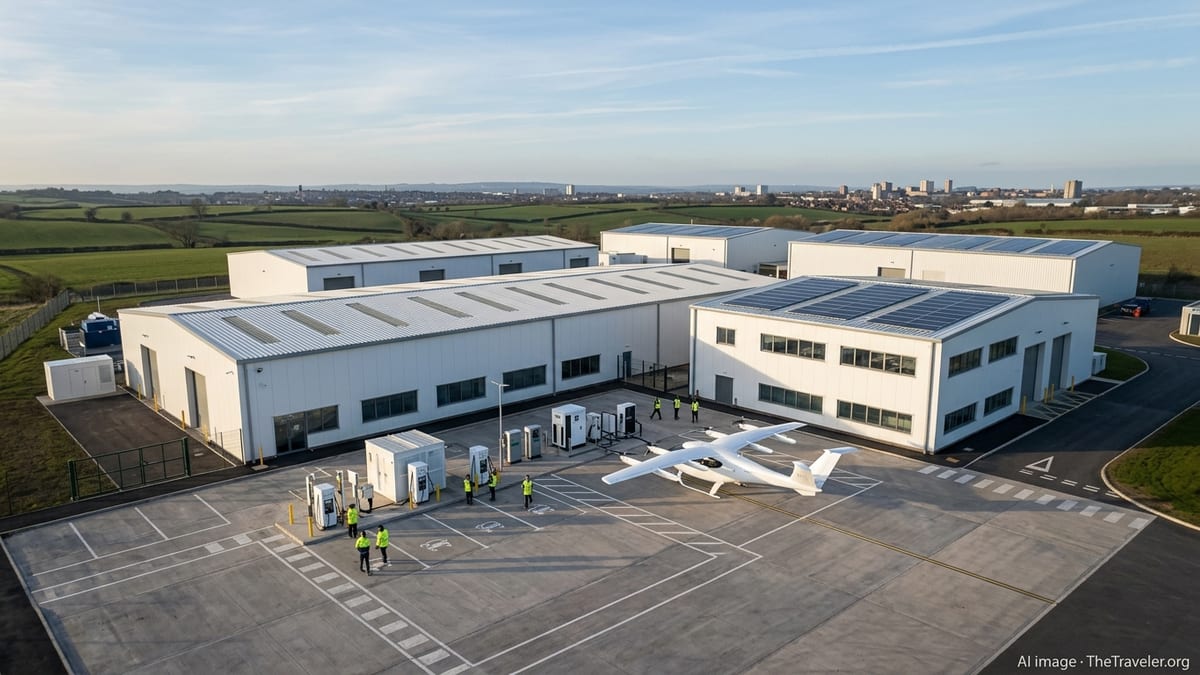
Vertical Aerospace’s upgraded battery manufacturing facility in the United Kingdom is emerging as a cornerstone of the country’s electric air mobility ambitions, underpinning next generation aircraft testing, future vertiport networks and a growing advanced air mobility ecosystem.
Get the latest news straight to your inbox!
Upgraded Energy Centre Signals Step Change in UK eVTOL Capability
The company’s Vertical Energy Centre, located near Bristol, has been highlighted in recent updates as one of the UK’s most advanced aerospace battery facilities, supporting both development and early-stage production of systems for electric vertical take off and landing aircraft. Publicly available information indicates that the site has been fitted with automated, aerospace grade manufacturing processes designed to deliver higher consistency, safety and performance in high density battery packs for aviation use.
The upgraded facility is described in corporate and industry material as a pilot production line that bridges the gap between laboratory innovation and full scale manufacturing. By focusing on certification ready designs and traceable, repeatable processes, the centre aims to meet the stringent requirements of airworthiness regulators as electric aircraft move from experimental trials to commercial operations.
The investment in this UK facility aligns with wider national objectives to retain high value aerospace engineering jobs and intellectual property within the country. Economic analysis commissioned by the company suggests that advanced air mobility manufacturing, anchored by sites such as the Vertical Energy Centre, could generate significant annual economic value and support thousands of highly skilled roles by the mid 2030s.
Supporting Valo and VX4 Test Campaigns and Future Certification
The energy facility is central to the battery architecture for Vertical Aerospace’s current and next generation aircraft programmes, including the VX4 prototype and the company’s planned certification aircraft, Valo. Recent disclosures show that the business has progressed into piloted transition flight testing in the UK, following a Permit to Fly from the Civil Aviation Authority, with battery systems produced and validated under aerospace grade conditions.
As the company refines the design of Valo ahead of a targeted concurrent certification process with the UK Civil Aviation Authority and the European Union Aviation Safety Agency, the UK battery centre is set to play an important role in qualification testing, performance optimisation and long term reliability studies. The move from hand built experimental packs to automated module assembly is regarded within the sector as a vital step toward demonstrating scalability and safety for passenger carrying operations.
The facility is also expected to support work on a hybrid electric variant intended for longer range logistics and regional missions. Industry briefings indicate that this parallel programme will use related battery and powertrain technology to extend the reach of advanced air mobility concepts beyond short hop city centre routes to defence, cargo and remote community applications.
Integration with Vertiport Testbeds and Emerging Route Networks
The strengthening of Vertical Aerospace’s UK facility comes as the country’s first vertiport testbed takes shape at Bicester Motion in Oxfordshire, led by Skyports Infrastructure. According to published coverage and government backed project descriptions, this test site will host demonstration flights by the company’s eVTOL aircraft and evaluate ground systems such as passenger processing, charging, automation and airspace integration.
The combination of a domestic battery manufacturing hub and a dedicated vertiport test environment positions the UK as a living laboratory for future electric air taxi operations. Work on the Oxford Cambridge advanced air mobility corridor, which involves partners from air navigation, helicopter operations and local government, is expected to draw on lessons from both the Bicester facility and Vertical Aerospace’s ongoing flight test activities.
Parallel planning activity for potential electric air taxi routes between London financial districts and major airports, highlighted in recent partnership announcements with infrastructure and helicopter operators, further illustrates how UK based facilities are feeding into real world route design. Battery performance and charging strategies validated at the Vertical Energy Centre are likely to influence vertiport layouts, turnaround times and service schedules for these proposed corridors.
Public Funding, Supply Chain Partnerships and UK Industrial Strategy
The expansion of Vertical Aerospace’s UK capability has been supported by a mix of private investment and public funding streams. Government programmes delivered through bodies such as the Department for Transport and the Aerospace Technology Institute have allocated grants to zero emission aircraft projects, including advanced air mobility demonstrators that rely on domestically developed energy storage and propulsion systems.
Recent supplier agreements with companies specialising in advanced materials and electric propulsion indicate that the battery facility is part of a wider UK centred supply chain strategy. High performance composite structures, lightweight propulsion units and battery management systems are being aligned to meet demanding safety and efficiency targets for electric aircraft entering service later this decade.
Observers of the sector note that clustering these capabilities within the United Kingdom supports national industrial policy priorities around clean growth and export led manufacturing. The battery facility’s focus on scalable, certifiable production processes is seen as a foundational element for attracting additional investment into advanced air mobility components, software and services.
Implications for Travelers and the Future of Electric Air Mobility
For future passengers, the strengthening of this UK battery hub moves the concept of electric air taxis from distant possibility toward operational reality. Reliable, high energy density batteries produced under aerospace standards are essential for delivering the quiet, low emission flights that underpin many visions of urban and regional air mobility.
Travel sector analysts suggest that early routes are likely to connect major transport hubs, business districts and key regional centres, offering journey time savings compared with congested ground networks. The performance, safety margins and lifecycle durability proven at facilities such as the Vertical Energy Centre will help determine how quickly such services can scale and how competitively they can be priced.
In the longer term, lessons learned in the UK about integrating electric aircraft, vertiports and grid infrastructure could inform similar deployments in other countries. The combination of a cutting edge battery facility, an expanding flight test programme and government backed corridors for advanced air mobility places the United Kingdom in a prominent position within the global race to commercialise electric air travel.