

More news on this day
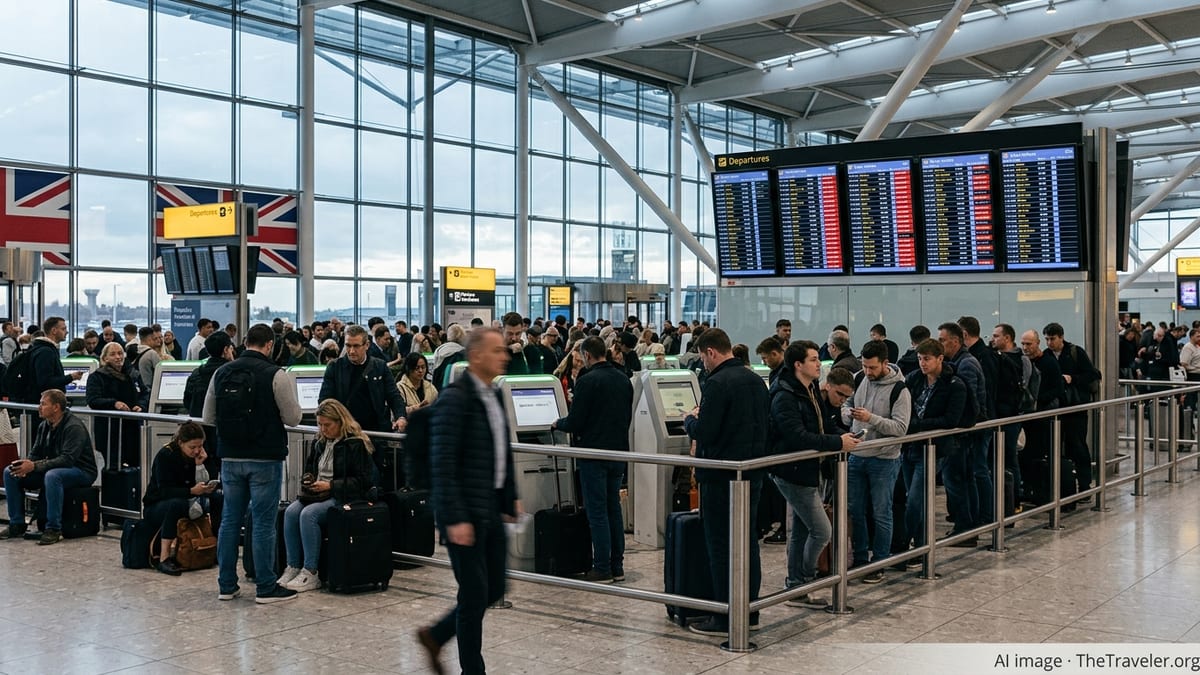
Air passengers traveling to and from the United Kingdom faced another day of disruption as more than 50 flights were cancelled, with services operated by British Airways, Gulf Air, Ryanair, Emirates and other carriers affected on key routes linking the UK to Dubai, Berlin, Oslo, New York and additional international destinations.
Get the latest news straight to your inbox!
Widespread Cancellations Across UK Airports
Flight-tracking data and published airline updates indicate that over 50 departures and arrivals connected to UK airports were cancelled within a short window, as carriers adjusted schedules in response to regional airspace restrictions and operational challenges. The cancellations impacted both long haul and short haul services, creating knock-on delays across already busy terminals.
Major UK gateways, including London Heathrow, London Gatwick and other regional airports, saw boards filled with cancellations and delayed services. Publicly available information shows that British Airways cut several services on high-demand long haul routes, while low cost and leisure-focused airlines scaled back frequencies on short haul city links to continental Europe.
Passengers reported disrupted journeys on routes to key European cities such as Berlin and Oslo, often involving last-minute rebooking and extended layovers. At the same time, transatlantic and Gulf-bound travelers faced uncertainty on services connecting the UK with New York, Dubai and other long haul hubs, as schedules were repeatedly updated throughout the day.
Industry data suggests that many of the cancellations were preemptive, designed to ease congestion and provide additional slack in the network, though that strategy still left hundreds of travelers dealing with missed connections and overnight stays near airports.
Middle East Airspace Closures Ripple Into UK Schedules
The latest wave of UK cancellations is closely linked to the wider disruption unfolding across the Middle East, where airspace closures and restrictions have sharply reduced normal traffic over parts of the Gulf. Publicly available information from airlines and aviation analytics firms shows that thousands of flights in the region have been grounded or rerouted in recent weeks, forcing carriers to redraw networks that typically rely on Gulf hubs for global connectivity.
Emirates, which ordinarily operates one of the world’s largest long haul networks via Dubai, has been running a much thinner schedule, prioritizing a limited number of flights that serve as lifelines for stranded travelers and cargo movements. The reduced flow of services to and from Dubai has directly affected UK-bound capacity, contributing to cancellations on routes that would usually run multiple times per day.
Gulf Air has also been strongly impacted by restrictions affecting Bahrain’s airspace, with widely shared operational notices indicating that scheduled services to and from Bahrain remain curtailed. For UK travelers who would normally use Bahrain as a connection point, the loss of these flights has removed a key alternative to other Gulf and European hubs.
According to published coverage and community flight-tracking analyses, the combined impact of these regional changes has forced airlines in Europe and the UK to eliminate or consolidate services, especially where aircraft and crews are tied up on longer replacement routings that circumvent closed airspace.
European and Low Cost Carriers Trim Short Haul Routes
While much of the attention has focused on long haul links to the Gulf and North America, the cancellations have also hit short haul European routes that feed into the UK’s major hubs. Low cost operators such as Ryanair, which normally maintain high daily frequencies between UK airports and European cities, have trimmed flight programs in response to broader network pressures.
Operational updates and airport departure boards show that select Ryanair services between the UK and cities including Berlin and other continental destinations were cancelled or combined into fewer departures. Aviation analysts note that even modest adjustments on these busy point-to-point routes can quickly reduce options for travelers relying on early morning or late-night departures to make same-day connections.
Other European carriers have adopted similar strategies, cancelling individual rotations to free up aircraft for more resilient core routes. This has led to sporadic gaps in service to secondary cities and seasonal destinations, with travelers reporting that some flights simply disappeared from schedules with little more than the minimum required notice.
The result for passengers has been a patchwork of cancellations that affect not only headline routes, but also the shorter sectors that underpin the UK’s role as a connecting hub between Europe, the Middle East and North America.
Transatlantic Links to New York and Beyond Under Strain
Services across the North Atlantic, one of the most important long haul markets for UK carriers, have also come under pressure. Publicly available timetables and disruption summaries indicate that selected UK to New York flights were cancelled as airlines rebalanced aircraft and crew resources across their global networks.
British Airways, which ordinarily operates multiple daily services between London and New York, has been adjusting its long haul schedule to reflect both regional constraints and broader strategic changes. Some New York-bound passengers have been offered rebookings on later departures or alternative routings via other European hubs, while others faced extended delays as the carrier sought to consolidate lightly booked flights.
Industry observers point out that the ripple effects extend beyond New York to other US gateways, where aircraft utilization patterns have been disrupted by longer routings that avoid sensitive airspace. This, in turn, has limited flexibility to add extra sections or last-minute rescue flights from UK airports when demand surges after earlier cancellations.
For business and leisure travelers alike, the fragmentation of the once highly predictable transatlantic schedule has added a new layer of uncertainty, particularly for those planning tight itineraries or onward connections beyond major US hubs.
What UK Travellers Are Being Advised to Do
With cancellations affecting multiple airlines and routes, guidance emerging from travel agents, consumer advocacy organizations and airline advisories has focused on preparation and flexibility. Travelers are being encouraged to monitor airline apps and airport information screens closely, as same-day changes remain common while carriers adjust to shifting operational constraints.
Publicly available advice highlights the importance of checking flight status before leaving for the airport, especially for services touching Dubai, Bahrain or other hubs still affected by airspace restrictions. Many airlines are allowing limited free changes or refunds in light of the disruption, although specific conditions vary by carrier and ticket type.
Travel insurance specialists and passenger rights groups also underscore that UK and EU regulations may provide compensation or care obligations in certain cancellation scenarios, particularly when disruptions are within an airline’s control. However, they note that large scale airspace closures and security-related restrictions can complicate eligibility, making it important for affected passengers to retain documentation such as boarding passes, booking confirmations and receipts for unexpected expenses.
As airlines gradually adapt to the new operating environment, schedules may stabilize, but for the moment UK travelers heading to destinations such as Dubai, Berlin, Oslo, New York and other key cities are being advised to build extra time into their journeys and to be prepared for last-minute changes to their plans.