

More news on this day
Air passengers across the United Kingdom are facing fresh disruption as more than 50 flights serving major airports have been cancelled, affecting services operated by British Airways, Gulf Air, Ryanair, Emirates and other carriers on routes linking the UK with Dubai, Berlin, Oslo, New York and additional key destinations.
Get the latest news straight to your inbox!
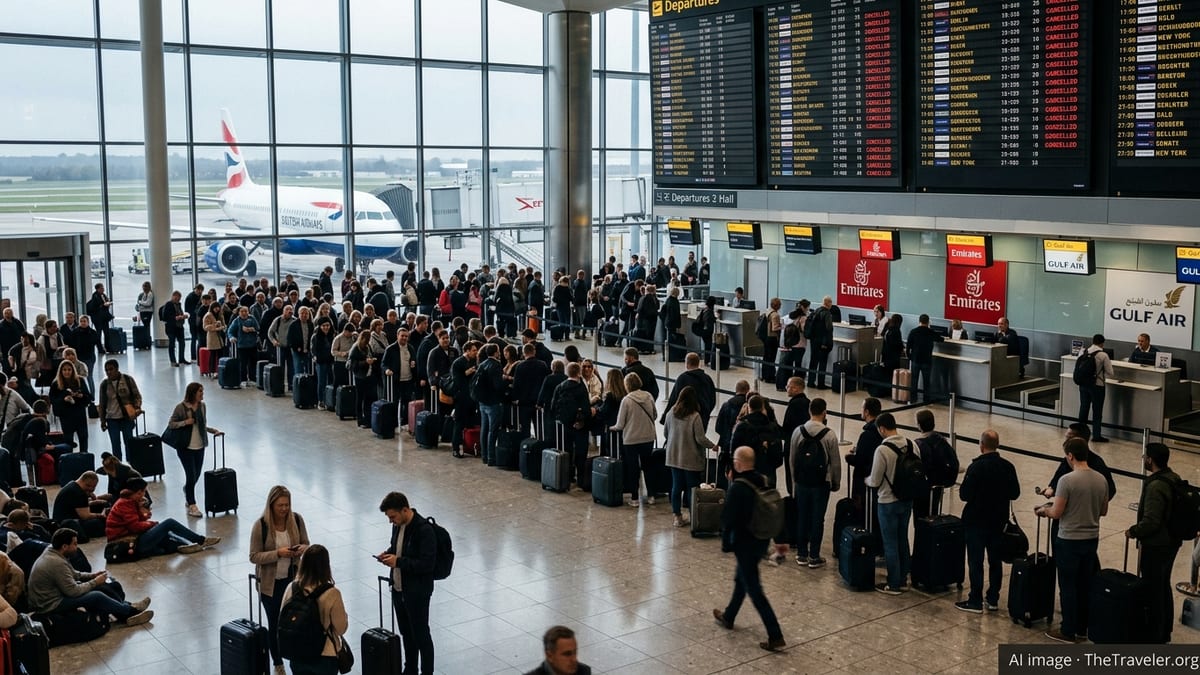
Wave of Cancellations Across UK Hubs
Disruption has intensified at the UK’s busiest airports as airlines trim schedules and cancel departures in response to ongoing airspace restrictions and operational pressures. Flight-tracking data and published airport boards show dozens of services scrubbed from timetables within a single operating window, with more than 50 cancellations recorded across London Heathrow, London Gatwick and other UK hubs.
Reports indicate that British Airways has withdrawn a series of short- and long-haul services, including departures to major European cities such as Berlin and Oslo, alongside adjustments on transatlantic links. Budget carriers including Ryanair have also cancelled rotations on intra-European routes, reducing capacity on popular city-pair corridors from UK regional airports.
Long-haul links have been particularly affected where services intersect with constrained airspace in the Middle East. Emirates flights connecting UK airports with Dubai have faced schedule changes and cancellations as the airline navigates airspace closures and reduced operational capacity in the region, with knock-on effects for passengers using Dubai as a hub to Asia, Africa and Australasia.
While some flights are being combined or retimed, a significant number are removed entirely from daily schedules, leaving travellers with limited same-day alternatives. The pattern of cancellations has created a patchwork of disruption, with some routes operating normally while others remain heavily reduced.
Middle East Airspace Closures Ripple Into UK Schedules
The latest wave of cancellations is closely linked to continued airspace restrictions across parts of the Gulf and wider Middle East, following recent regional tensions and strikes that have prompted authorities to limit or suspend overflights. Publicly available aviation notices and media coverage show that airspace affecting key hubs such as Doha, Dubai and Bahrain has been repeatedly curtailed or partially closed, forcing airlines to divert, delay or cancel services.
Gulf Air, which relies on Bahrain as its primary hub, has been among the hardest hit. Published passenger updates and travel advisories describe the carrier’s network as severely constrained, with many flights suspended and a rolling programme of cancellations and rebooking options offered to affected travellers. For UK passengers, this has disrupted itineraries linking British airports with destinations in Asia and beyond via Bahrain.
Other Gulf-based carriers, including Emirates, have had to reconfigure their operations as regional authorities adjust airspace availability. According to recent operational statements and flight information summaries, Emirates has been running a reduced schedule from Dubai, prioritising certain trunk routes while cancelling or consolidating others. UK-bound and UK-originating services are part of this balancing act, leading to last-minute changes for passengers connecting through Dubai.
The cascading effect of these regional constraints extends well beyond the Middle East. UK flights to New York and other long-haul destinations can be affected when aircraft and crews are not in the right place due to earlier disruptions on Middle Eastern rotations, adding another layer of complexity for airlines attempting to stabilise their networks.
European and Transatlantic Routes Also Affected
While Middle East airspace issues are a major driver, cancellations are also being recorded on routes that do not transit the region. Schedule data and airport operations updates show British Airways and other European carriers trimming flights between the UK and continental hubs such as Berlin, Oslo and other northern European capitals, in some cases to free up aircraft and crews for more pressured long-haul sectors.
Ryanair and other low-cost airlines have meanwhile adjusted point-to-point services from UK regional airports, including flights to popular city-break destinations in Germany, Scandinavia and central Europe. In a number of cases, these cancellations reflect knock-on constraints in aircraft availability and crew rostering, as well as the challenge of rerouting aircraft around affected air corridors.
On transatlantic routes, publicly accessible booking systems and departure boards point to selective cancellations between the UK and New York, one of the world’s busiest long-haul city pairs. While the majority of flights continue to operate, some services have disappeared from schedules or been merged, reducing flexibility for passengers accustomed to a high-frequency shuttle-style timetable.
The overall picture is one of a finely balanced network under strain, where any additional disruption spreads quickly. Airlines are attempting to preserve core frequencies on key business and leisure routes, but in doing so are scaling back less time-sensitive services and trimming off-peak frequencies.
Passenger Experience: Long Queues, Rebookings and Route Changes
For travellers, the impact of more than 50 cancellations within a short period is felt most acutely in terminals and on booking platforms. Passenger reports shared through social media and travel forums describe crowded check-in areas at major UK airports, long waits at customer service desks and repeated attempts to secure alternative flights online as inventory tightens.
Many passengers heading to or returning from Dubai, Doha and Bahrain report needing to replan journeys entirely, often rebooking on airlines that do not rely on Gulf hubs or accepting longer routings via Europe or North America. Some describe being offered travel on different dates rather than same-day alternatives, reflecting the limited spare capacity on unaffected routes.
Disruption has also reached those travelling to Berlin, Oslo and other European destinations, where day trips and short business visits are particularly sensitive to even small schedule changes. With some departures cancelled at short notice, travellers are faced with shortened stays, forced overnights or the need to switch to rail or other airports where possible.
Although some airlines are proactively contacting affected customers, others are relying on passengers to monitor their bookings and airport departure information. This has led to confusion in cases where travellers arrive at the airport only to learn that their flight has been cancelled or retimed after they set out from home.
What Travellers Should Watch for in the Days Ahead
Publicly available operational updates suggest that further adjustments to UK flight schedules remain likely as airlines continue to respond to evolving airspace restrictions and operational challenges. Industry observers note that recovery may be uneven, with some routes restored more quickly than others depending on demand, aircraft positioning and regulatory decisions.
Travellers holding tickets with British Airways, Emirates, Gulf Air, Ryanair and other carriers affected by the current disruption are being advised, through airline statements and consumer travel guidance, to monitor their bookings closely and make use of rebooking or refund options where available. Under UK and European air passenger regulations, eligibility for compensation or support will depend on the specific cause of the cancellation, the timing of notification and the airline’s jurisdiction.
Experts in air travel rights highlight that while safety-related airspace closures typically fall under extraordinary circumstances, passengers are still entitled to rerouting or refunds when flights are cancelled. For journeys involving multiple carriers or connections through closed airspace, resolving claims can take time, adding to the uncertainty faced by affected travellers.
With regional tensions and airspace restrictions showing few immediate signs of a complete resolution, the coming days are expected to bring continued disruption for some UK-bound and UK-originating flights. Passengers heading to or from Dubai, Berlin, Oslo, New York and other key destinations are therefore being encouraged, by publicly available travel advisories, to build extra flexibility into their plans and to check the status of their flights repeatedly in the 24 hours before departure.