

More news on this day
Passengers across the United Kingdom endured another day of severe disruption on Saturday, 7 March 2026, as flight cancellations and delays at Heathrow, Gatwick and major regional airports cascaded through British Airways, easyJet and Ryanair networks.
Dozens of Cancellations and Hundreds of Delays Across the Network
Fresh data from aviation analytics and passenger-rights platforms show that UK airports recorded 49 flight cancellations and around 248 delays as operational strains and wider European bottlenecks converged over the first week of March. The latest figures, centred on London Heathrow and Gatwick, also capture knock-on disruption at Manchester, Birmingham, Liverpool and Edinburgh, underscoring how vulnerable the country’s busiest corridors remain to even modest schedule shocks.
London Heathrow once again bore the brunt of the disruption, with the country’s main hub reporting the largest share of cancellations and a heavy concentration of delays on short haul and key long haul routes. Gatwick, the primary base for easyJet and a major node for leisure and low cost travel, registered a smaller but still significant number of grounded services and late departures, compounding frustration for weekend holidaymakers and business travellers alike.
Manchester Airport, the North’s principal international gateway, saw its own slate of cancellations and extended delays, particularly on transatlantic and Middle Eastern routes, while Birmingham and Edinburgh reported mounting schedule pressures throughout the day. At Liverpool John Lennon Airport, even a relatively small number of disrupted flights was enough to snarl terminal operations and leave passengers grappling with rebooking and missed onward connections.
Industry observers note that the headline figures tell only part of the story. Behind the statistics are hundreds of travellers confronting missed weddings and family events, forfeited hotel bookings and business meetings, as well as crews and aircraft pushed out of position in a way that is likely to reverberate through schedules into the start of the coming week.
British Airways, EasyJet and Ryanair Scramble to Contain Disruption
Among UK carriers, British Airways faced some of the most visible fallout, particularly at Heathrow and Gatwick. The airline cut a number of short haul services to create breathing room in its schedule, a tactic that helps stabilise operations but inevitably strands passengers booked on the affected flights. Long haul services generally departed, but many did so late, with crews and aircraft arriving out of sequence from earlier disruptions across Europe and the Middle East.
At Gatwick, easyJet wrestled with a surge of late-running departures and congested turnarounds, as aircraft arriving behind schedule from continental Europe struggled to make their slot times for outbound services to the UK’s regions and popular holiday destinations. For a carrier that relies heavily on quick turnaround times, even minor delays in one part of the network can propagate rapidly, leading to compounding disruption by late afternoon.
Ryanair, which maintains a strong presence at London and regional UK airports including Manchester, Liverpool and Edinburgh, also recorded a series of delays and selective cancellations. While the airline is known for aggressively protecting aircraft utilisation, today’s combination of weather-related constraints elsewhere in Europe and tight airspace capacity forced the carrier to trim certain rotations, leaving passengers facing last minute changes or overnight stays.
All three airlines said affected customers were being rebooked where possible, with options to travel later in the weekend or obtain refunds. Nevertheless, social media posts and passenger accounts from terminals in London and Manchester described long queues at service desks and difficulties reaching call centres during peak hours, highlighting a familiar gap between formal passenger rights and the reality of securing timely assistance during mass disruption.
Weather, Congested Airspace and Knock-On Effects From Europe
While no single catastrophic event was to blame, a cocktail of factors combined to create today’s wave of disruption. Earlier in the week, winter weather systems over parts of central and northern Europe triggered widespread delays and aircraft de-icing operations, slowing the flow of traffic into and out of major hubs such as Frankfurt and Amsterdam. As late arriving flights spilled over scheduled slots, the resulting congestion rippled outward across the network.
At the same time, pressure on European airspace linked to rerouted traffic around sensitive regions further constrained capacity on some of the most heavily used corridors between the UK and mainland Europe. Air traffic controllers were forced to impose periodic flow restrictions, limiting the number of take offs and landings permitted within specific time windows and compelling airlines to retime or cancel certain services.
For UK airports operating close to their practical limits during busy periods, even modest capacity reductions quickly translate into backlogs on the ground. Aircraft waiting for departure slots clogged taxiways and gate areas, while inbound flights were held in arrival stacks or diverted to secondary airports when runway movements fell behind schedule. That surge in complexity placed additional strain on ground handling, baggage and security operations that have already been running hard through the winter season.
Aviation analysts warn that this pattern of rolling, multi-day disruption is becoming more common in Europe, as tightly optimised airline schedules intersect with chronic staffing constraints in air traffic control and airport services. They note that without additional resilience built into both infrastructure and staffing, similar episodes of chaos are likely to recur with increasing frequency.
Passengers Face Long Queues, Confusion and Limited Options
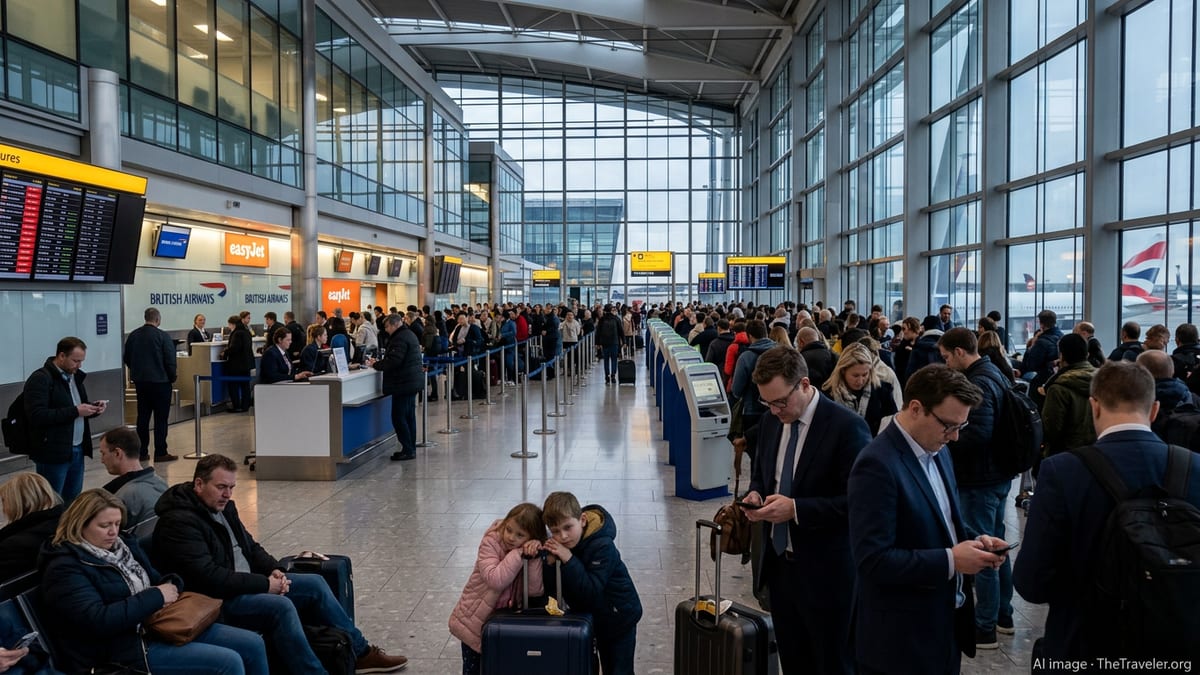
Inside terminals, the human impact of the statistics was immediately visible. At Heathrow and Gatwick, departure boards flickered with red cancellation and delay notices, prompting crowds around flight information screens and customer service counters. Travellers reported queues stretching across check in halls as they waited to rebook, secure hotel vouchers or obtain written confirmation of cancellations for insurance purposes.
In Manchester, Birmingham, Liverpool and Edinburgh, passengers described a patchwork of communication, with some airlines issuing timely text and app notifications about schedule changes while others left customers to discover cancellations only once they had reached the airport. For those with tight connections or onward rail and coach journeys, the lack of clarity proved especially stressful.
Accommodation near major airports quickly became scarce as disrupted passengers scrambled to secure rooms for the night. Several hotels around Heathrow and Gatwick reported high occupancy from stranded travellers, while local transport links faced surges in demand from those opting to abandon their journeys entirely and return home by road or rail.
Travel rights advocates reiterated that, under UK and retained European regulations, passengers on affected flights may be entitled to assistance, rerouting and in some cases financial compensation, depending on the cause and length of delay. They urged travellers to keep boarding passes, booking confirmations and any written notices from airlines, and to file claims once the immediate disruption has passed rather than attempting to resolve complex compensation issues in crowded terminals.
What Today’s Chaos Signals for the Months Ahead
The latest wave of cancellations and delays arrives just as airlines and airports prepare for the build up to the Easter holidays and the peak summer season. Capacity at Heathrow and Gatwick is already tightly constrained, and regional hubs such as Manchester, Birmingham, Liverpool and Edinburgh are counting on robust leisure and visiting friends and relatives traffic to bolster their recovery.
However, today’s events are likely to fuel renewed scrutiny of the sector’s resilience and its ability to protect passengers from the cascading effects of disturbances originating far beyond the UK’s borders. Industry groups have repeatedly called for investment in air traffic control staffing, digital infrastructure and airport ground operations, arguing that current systems leave little margin for error when weather, geopolitical tensions or technical glitches collide.
For travellers, the message is increasingly clear. Flexibility, travel insurance and real time information tools are becoming essential for anyone flying through Europe’s busiest hubs, particularly during shoulder seasons when adverse weather remains a risk. Frequent flyers are advised to build longer connection times into itineraries, favour earlier departures where possible and keep a close eye on airline apps and airport feeds in the 24 hours before travel.
As operations gradually stabilise after today’s disruption, attention will turn to whether Heathrow, Gatwick and the UK’s key regional airports can reinforce their defences before the next bout of pressure hits. With demand expected to remain strong through spring and into summer, both carriers and regulators face mounting pressure to ensure that the scenes of crowded terminals and fraying tempers seen today do not become a defining feature of the 2026 travel season.