

More news on this day
Thousands of travellers have been left stranded across the United Kingdom after a fresh wave of cancellations and rolling delays hit major international airlines, disrupting at least 56 flights and snarling key long haul routes through London, Manchester and Edinburgh on Friday.
Get the latest news straight to your inbox!
Major Airlines Cut UK Services Amid Ongoing Turmoil
Lufthansa, Qatar Airways, Gulf Air, Virgin Atlantic and American Airlines were among the carriers forced to trim or heavily delay services to and from the UK, as operational pressures and complex rerouting around Middle East airspace continued to cascade through global networks. While schedules were already fragile following days of upheaval, Friday’s disruption marked one of the most concentrated hits yet to UK hubs.
Long haul departures linking London Heathrow and Gatwick with the Gulf, North America and Asia bore the brunt, with several widebody services scrubbed at short notice and others departing hours behind schedule. At Manchester, at least a dozen intercontinental flights operated with significant delays, while regional connectors were held back to wait for inbound aircraft and crew. Edinburgh saw evening departures to key European and transatlantic gateways cancelled outright, forcing passengers into overnight stays.
Airports and airlines alike cited a combination of airspace restrictions, displaced aircraft and crew duty limits as primary triggers. With jets and flight crews out of position across multiple continents, carriers struggled to restore normal rotations, leading to last minute schedule cuts that caught many travellers already en route to the airport.
In several cases, airlines opted to consolidate lightly loaded services, combining passengers from two or more cancelled departures onto a single later flight. While this helped conserve scarce capacity and crew hours, it also meant longer waits in crowded terminals for those rebooked, particularly on high demand routes to the Middle East and North America.
Scenes of Frustration at London, Manchester and Edinburgh
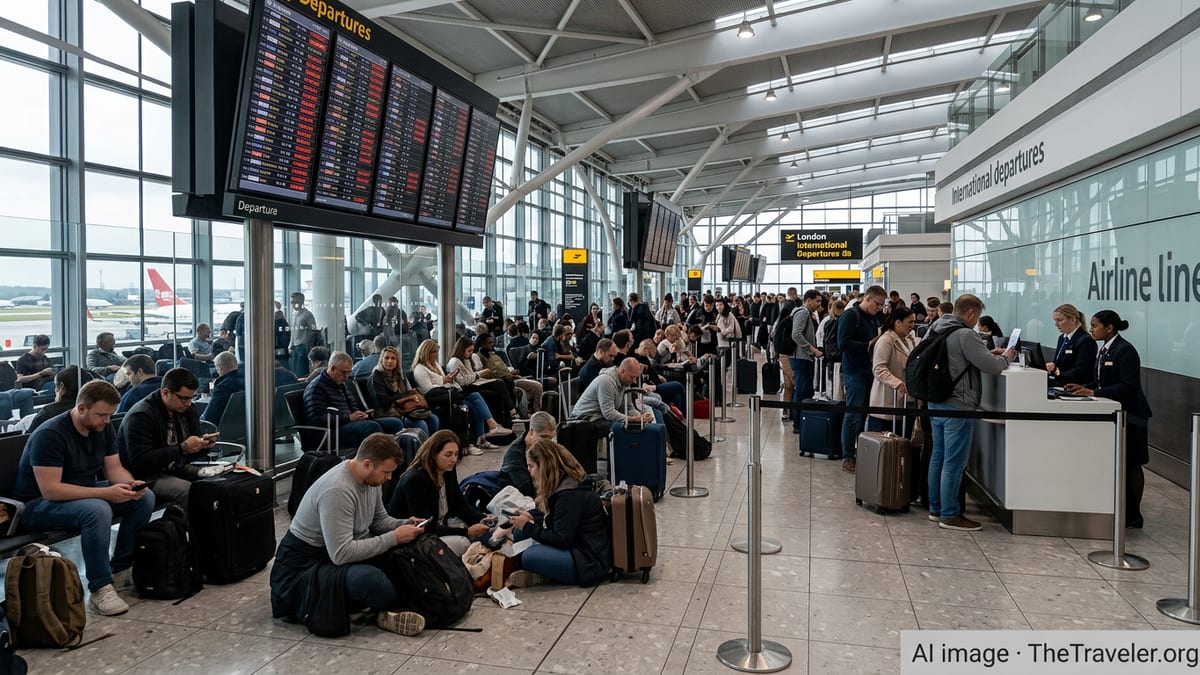
At London Heathrow, one of the world’s busiest international hubs, overflowing check in halls and security lanes quickly became the visible face of the disruption. Queues for airline service desks snaked along terminal corridors as passengers sought rebooking options, refunds or overnight accommodation after discovering their flights had been cancelled or pushed back by many hours.
In Manchester, travellers on Qatar Airways and Gulf Air services reported repeated departure time changes, followed by abrupt cancellations as crew duty time expired or connecting aircraft failed to arrive. Some passengers who had already boarded were asked to disembark when revised flight plans could not be cleared before local curfew windows, compounding frustration among families and business travellers alike.
Edinburgh Airport, which handles a growing mix of European and long haul services, also faced mounting challenges. Several late afternoon and evening departures operated by partner airlines feeding into the networks of the affected carriers were cancelled, leaving travellers bound for onward connections in London, Frankfurt, Doha and US hubs with limited same day alternatives.
Airport staff worked to distribute water, snacks and meal vouchers in congested departure halls, while public address systems carried frequent but often vague updates as operations teams raced to revise flight plans. Travellers described a patchwork of communication, with some receiving app notifications before arriving at the airport and others learning of cancellations only at check in or the departure gate.
Knock On Effects for Global Connections
The reduction in services quickly rippled far beyond the UK, disrupting carefully timed global connections that rely on London and Manchester as major transfer points. Transatlantic services operated by Virgin Atlantic and American Airlines were particularly affected, with several flights between London and key US hubs rescheduled into narrower operating windows or cancelled entirely.
For passengers travelling onward to Asia, Africa and Australasia, reduced frequencies on Lufthansa, Qatar Airways and Gulf Air flights meant longer layovers in European or Gulf hubs and, in many cases, unexpected overnight stays. Travel agents reported surging demand for scarce seats on alternative routings via continental Europe and North America as customers scrambled to salvage holiday departures, business trips and family reunions.
Industry analysts noted that airlines were still unwinding the impact of earlier airspace closures and security alerts affecting key Middle Eastern corridors. Even as some restrictions have eased, continued rerouting around sensitive areas has added flight time, consumed additional fuel and reduced the amount of flying each aircraft and crew can safely perform in a given day, leaving networks more vulnerable to fresh shocks.
With aircraft scattered away from their usual bases and maintenance slots under strain, carriers have been forced to prioritise certain trunk routes while trimming others. The result has been a patchwork of cancellations that can appear sudden to travellers but reflect days of cascading operational decisions behind the scenes.
Passengers Face Difficult Choices on Rebooking and Refunds
For stranded travellers, the immediate challenge has been navigating rebooking policies that differ not only between airlines but also by ticket type and point of purchase. Many passengers who booked through online travel agencies reported long call centre waits and limited real time information about alternative routings, even as airport queues lengthened.
Several of the affected carriers issued updated travel waivers, allowing passengers on cancelled or heavily delayed flights to change dates without fees, request vouchers or, in some cases, seek full refunds. However, seat availability on near term departures remained tight, especially in school holiday periods and on popular weekend services from London and Manchester.
Consumer advocates urged passengers to document delays, keep receipts for meals and accommodation, and check their rights under UK and European passenger protection rules. These regulations can, in some circumstances, require airlines to provide care, assistance and compensation when cancellations or long delays are not caused by extraordinary circumstances outside the carrier’s control.
Travel insurers, meanwhile, reported a rise in claims and inquiries related to missed connections and extended stays. Policy coverage varies, and many travellers expressed uncertainty over whether disruption linked indirectly to regional conflict or airspace closures would be treated as a covered event, adding a financial layer of worry to an already stressful situation.
Uncertain Outlook for Weekend and Early Week Travel
Operational planners at major airlines signalled that it could take several more days to fully stabilise schedules, particularly on long haul routes that require complex crew pairings and aircraft rotations. While some additional capacity is expected to be restored over the weekend, industry sources warned that rolling last minute changes are likely to persist into early next week.
Travellers with upcoming journeys through London, Manchester and Edinburgh have been advised to monitor their bookings closely, ensure contact details are up to date with airlines, and consider allowing extra time for connections. Those with flexible itineraries have been encouraged to explore alternative dates or routings where possible, easing pressure on the most heavily impacted peak services.
Airports across the UK are preparing for another busy period as rebooked passengers converge with new departures, raising the prospect of continued crowding at check in, security and passport control. Ground handling companies have ramped up staffing where feasible, though labour constraints and tight training pipelines limit how quickly additional resources can be deployed.
Despite the disruption, aviation officials stressed that safety considerations remain paramount in all decisions to reroute, delay or cancel flights. For now, however, that priority continues to translate into difficult days and nights for thousands of travellers, as the shockwaves from distant conflicts and airspace restrictions play out in departure halls from London to Edinburgh.