

More news on this day
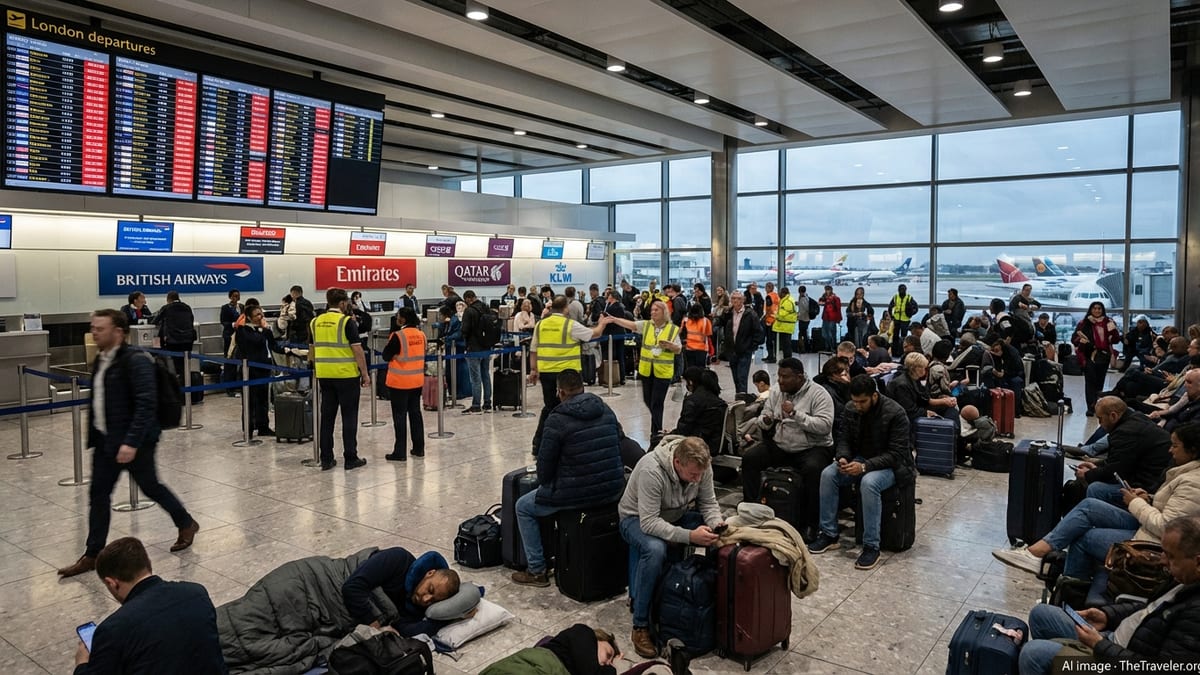
Thousands of passengers have been left stranded across the United Kingdom as Heathrow, Gatwick and Manchester airports report 319 delayed and 126 cancelled flights, with knock-on disruption hitting major carriers including British Airways, Emirates, Qatar Airways and KLM on routes to cities such as Barcelona, Paris, Dublin and Los Angeles.
Geopolitical Tensions Trigger Widespread Airspace Closures
The latest wave of disruption follows escalating geopolitical tensions in the Middle East, where recent military strikes and retaliatory attacks have prompted the closure or restriction of key air corridors. Airspace over parts of Iran, Iraq, Syria and neighbouring states has either been shut completely or heavily constrained, forcing airlines to reroute or ground long-haul services that typically pass through the region.
For UK hubs, those corridors are essential for flights linking London and northern England with the Gulf, wider Asia and parts of Africa. With usual flight paths suddenly unavailable, carriers have faced longer routings, tighter crew duty limits and slot bottlenecks, all of which have converged into significant same-day delays and rolling cancellations.
Aviation analysts say the episode underlines how interdependent global air networks have become. Disruption that originates thousands of miles away can quickly cascade into departure boards in London, Manchester or Edinburgh, as airlines struggle to reposition aircraft and crew while complying with evolving government and safety restrictions.
Officials have issued renewed travel advisories for parts of the Middle East, urging passengers to reconsider non-essential travel and to build in greater flexibility. However, the scale and speed of the airspace changes have meant that many travellers already en route have been caught mid-journey, facing diversions, unplanned overnight stays and uncertain onward connections.
Heathrow, Gatwick and Manchester Bear the Brunt
Across Heathrow, Gatwick and Manchester, operations teams spent Monday contending with crowded departure halls, long queues at customer service desks and a mounting backlog of aircraft waiting for revised slots. Heathrow, the country’s largest hub, has seen a concentration of long-haul disruption, with services to Gulf hubs and onward connections across Asia particularly affected.
Gatwick’s mixed short and long-haul schedule has created a different challenge, as European leisure flights compete for space with disrupted intercontinental services. Manchester has reported a similar picture, with disruption spreading from a handful of affected routes to the broader schedule as aircraft and crews fall out of position.
Airport authorities have urged passengers to arrive only if their flight is confirmed as operating, warning that terminal capacity, seating and hotel availability in surrounding areas are under strain. Ground staff have been drafted from less-affected parts of the operation to help manage crowds, provide updates and coordinate limited rebooking options.
Despite efforts to stabilise operations, the uneven nature of the disruption means some terminals appear almost normal while others are crowded with displaced travellers. Industry sources caution that even if airspace conditions improve, it could take several days to fully unwind the disruption and restore regular schedules.
Major Carriers Forced Into Cancellations and Rerouting
The impact has fallen heavily on full-service carriers that rely on intricate global networks and timed connections. British Airways has had to trim frequencies on selected long-haul routes and halt services to some Middle Eastern destinations entirely for safety and operational reasons. The airline has warned that passengers heading to or transiting through the region should expect last-minute changes and extended journey times.
Gulf carriers including Emirates and Qatar Airways have been similarly affected, with some departures from the United Kingdom postponed, cancelled or rerouted to avoid conflict-affected airspace. These airlines are key connectors for UK travellers bound for destinations in Asia, Australasia and East Africa, so even a single cancelled flight can disrupt hundreds of onward itineraries.
KLM and other European network airlines have also reported knock-on issues as they attempt to thread new routings between Europe and Asia and manage aircraft rotations affected by extended flight times. While many operators have been able to keep a proportion of services operating, longer routes and fuel requirements limit the number of flights that can be maintained on a given fleet.
Low cost and short-haul carriers are not immune. Schedules to key European cities are being squeezed as congestion at UK airports, crew shortages and air traffic restrictions collide. That has compounded challenges for passengers who might otherwise rely on alternative regional hubs to bypass the most disrupted long-haul corridors.
Global Destinations from Barcelona to Los Angeles Affected
The chaos has rippled across an array of popular destinations. Within Europe, passengers headed for Barcelona, Paris and Dublin have reported day-long waits, missed meetings and abandoned short breaks as departures from London and Manchester were pushed back repeatedly or removed from schedules altogether.
On transatlantic routes, flights to Los Angeles and other major North American gateways have faced delays as aircraft arriving late from disrupted regions struggle to turn around in time. Some services have departed without a full manifest of connecting passengers, leaving travellers stranded mid-journey in London or other European hubs.
Travel agents say the pattern of disruption is particularly challenging because it is not confined to any single region or airline. Families attempting to start holidays, business travellers on tight itineraries and students returning to overseas universities have all been affected, often with limited rebooking options during busy travel periods.
With aircraft and crew scattered across multiple continents, some carriers have resorted to consolidating several flights into one, prioritising passengers with the most urgent travel needs and those whose journeys involve essential work or compassionate circumstances. Even where seats exist, differing ticket conditions and alliance rules can slow the process of moving travellers between airlines.
Stranded Passengers Face Uncertainty and Patchy Support
For many affected passengers, the most immediate issue has been uncertainty. Departure boards have shifted repeatedly throughout the day, with flights moving from delayed to cancelled with little warning. Long queues have formed at airline service desks and call centres, while websites and apps have struggled to keep pace with rapid schedule changes.
Some travellers have reported sleeping on terminal floors or in seating areas after local hotel capacity was exhausted. Others have faced confusion over entitlements to meals, accommodation and compensation, as rules differ depending on the cause of disruption, the airline’s base and the specific route involved.
Consumer advocates are urging passengers to keep detailed records of expenses, communications and boarding passes, and to familiarise themselves with applicable air passenger rights. They note that while safety-driven airspace closures can limit compensation in some cases, airlines are still expected to provide basic care such as refreshments and reasonable accommodation where possible.
In the meantime, travel experts advise those with upcoming journeys to build extra time into itineraries, avoid tight connections, and monitor airline and airport communications closely. Flexibility, they say, will be crucial in the days ahead as the industry works to rebuild schedules and bring stranded passengers home.