

More news on this day
Hundreds of passengers travelling through London and Manchester airports faced cancellations and long delays over the weekend as British Airways, Qatar Airways, KLM, Emirates and other major carriers axed 63 flights and delayed a further 497 amid widening airspace disruption from the US–Iran–Israel conflict in the Middle East.
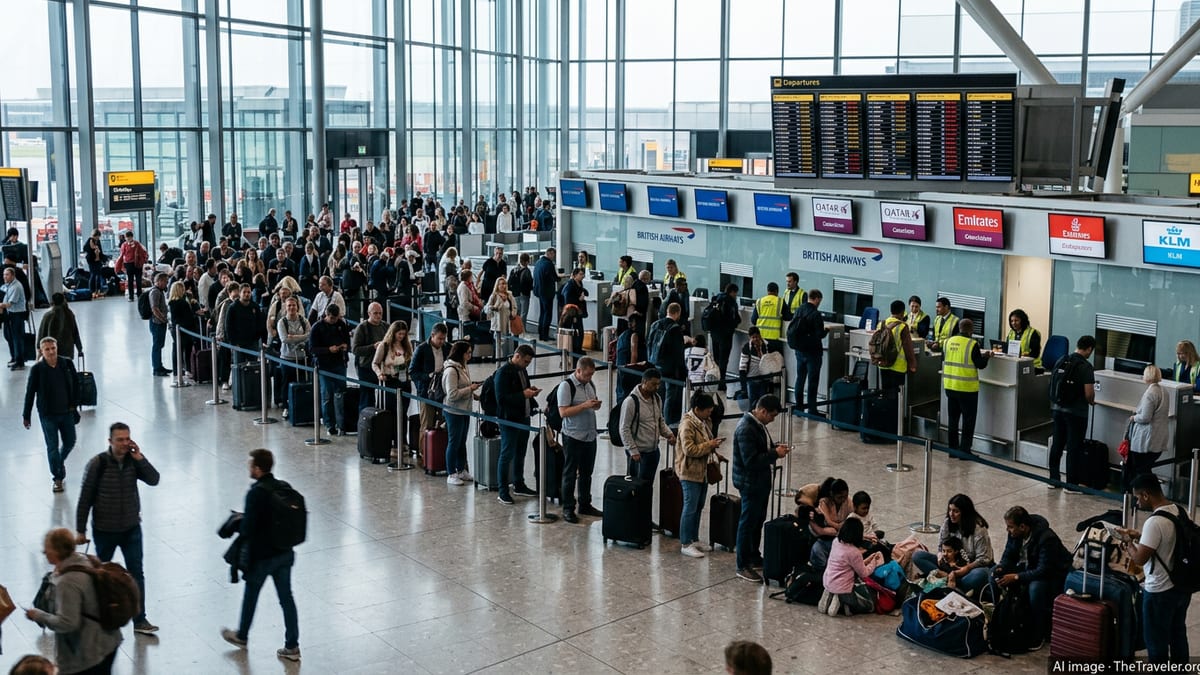
Ripple Effect of Middle East Airspace Closures Hits UK Hubs
The latest wave of disruption followed sweeping airspace restrictions across Iran, Iraq, Israel, Syria, Kuwait, Qatar and parts of the United Arab Emirates after US and Israeli strikes on Iran triggered retaliatory attacks and heightened security alerts. With key transit hubs in Dubai, Doha and Abu Dhabi operating at sharply reduced capacity, European services that usually overfly the region or connect through Gulf hubs have been forced to cancel, divert or operate on longer routings.
Industry data from flight tracking and analytics firms show thousands of flights cancelled worldwide since the conflict escalated, with Monday and Tuesday alone each seeing well over 15,000 cancellations globally. UK airports have not been at the epicentre of the fighting, but their role as gateways for Europe–Asia and Europe–Australasia itineraries means they are highly exposed to knock-on disruption when Gulf and Levant airspace constricts.
At London’s main airports and at Manchester, schedules on routes to the Middle East and beyond have been thinned, with some long-haul aircraft and crews stranded out of position. Airlines are working to consolidate passengers onto fewer departures, a process that has left terminals crowded and departure boards dominated by “delayed” and “re-timed” messages throughout the weekend.
British, Qatar, KLM and Emirates Forced to Retrench
UK flag carrier British Airways has already suspended services to Tel Aviv and Bahrain and cancelled selected flights to Amman as it steers clear of the most volatile airspace and reassesses routings towards the Gulf and South Asia. The airline has stressed that safety remains its “number one priority” and that it is following guidance from UK and international aviation authorities on which corridors remain safe to use.
Qatar Airways, one of the biggest Gulf operators into the UK, has been particularly hard hit because its Doha hub sits in airspace directly affected by the conflict. The airline has only recently started operating limited repatriation and point-to-point flights to and from Doha after days of blanket cancellations, and UK services are running at a fraction of normal levels. For passengers booked from London or Manchester to destinations such as Bangkok, Sydney or Johannesburg via Doha, that has meant last‑minute cancellations or long rebookings via alternative hubs.
Emirates, which normally runs multiple daily flights from London and Manchester to Dubai, has also been operating a reduced schedule while the United Arab Emirates manages the fallout from Iranian missile and drone attacks and the partial reopening of its skies. The carrier says it aims to restore full capacity “in the coming days,” but for now some UK‑Dubai services remain cancelled, while others depart significantly behind schedule as crews and aircraft rotate through a constrained network.
European network airline KLM has suspended services to Tel Aviv for the rest of the winter season and halted flights to Dubai, Dammam and Riyadh until at least mid‑March. While most KLM services between Amsterdam and the UK are still running, onward connections for British travellers heading to the Gulf or onward to Asia have been sharply curtailed, adding to the sense of uncertainty for those transiting via London and Manchester.
Scenes of Confusion and Long Queues for Stranded Travellers
At London Heathrow, passengers reported lengthy queues at transfer desks and airline ticket counters as staff attempted to rebook travellers whose onward Gulf or Asian connections had evaporated. With 63 outright cancellations and nearly 500 delays tied to the latest escalation, many travellers only discovered the impact on their itineraries after clearing security or arriving from domestic feeder flights.
Manchester Airport has seen similar scenes, particularly around departures to Dubai and Doha. A Qatar Airways flight to Doha and an Emirates service to Dubai were among those scrubbed, leaving leisure travellers, business passengers and families heading for onward connections scrambling to secure alternatives. Some were offered routing via European hubs such as Frankfurt or Rome, only to find that those flights were themselves under pressure from the regional disruption.
Airlines have been providing meal vouchers, hotel accommodation and ground transport where required, but high demand and limited hotel availability near major airports have left some passengers attempting to sleep in terminals or faced with lengthy transfers to out‑of‑town accommodation late at night. Staff on the ground have urged customers to check their flight status repeatedly and, where possible, to defer non‑essential trips until schedules stabilise.
What UK Passengers Are Entitled To Under Current Rules
The sudden squeeze on routes linked to the Middle East has also thrown a spotlight on what rights UK passengers have when conflict disrupts air travel. Under UK regulations mirroring earlier EU rules, travellers whose flights depart from a UK airport are entitled to a choice between a refund and re‑routing at the earliest opportunity when a service is cancelled, regardless of whether the carrier is British, European or based further afield.
For inbound flights to the UK, similar protections apply whenever the operating airline is registered in the UK or European Union. In both cases, airlines are also obliged to provide care and assistance during long delays, including meals, refreshments and overnight accommodation where appropriate, although the sheer scale of current disruption means that re‑routing options can be limited and waiting times long.
However, regulators and the UK Civil Aviation Authority have indicated that large‑scale cancellations and delays directly attributable to the Iran conflict are likely to be treated as an “extraordinary circumstance.” That classification means passengers are unlikely to be eligible for additional cash compensation on top of refunds and re‑routing, even when delays stretch into many hours, so long as airlines can demonstrate they took all reasonable measures to avoid disruption.
Consumer advocates are urging travellers to keep receipts for any unavoidable extra expenses, such as food or local transport, and to contact airlines promptly for reimbursement where policies allow. Travel insurance may cover certain costs, but many standard policies exclude war‑related disruption, making direct negotiation with the carrier the primary avenue for redress.
Outlook for Schedules as Conflict Continues
Airlines and aviation authorities caution that the situation remains highly fluid. While Emirates, Qatar Airways and Etihad have started to rebuild stripped‑back schedules, all three continue to operate fewer frequencies than normal across the Gulf, and many carriers are still avoiding wide swathes of Middle Eastern airspace for safety reasons. That keeps pressure on capacity between Europe and Asia and makes it harder for UK airlines to guarantee reliable connections for the weeks ahead.
For London and Manchester specifically, the coming days are expected to bring a patchwork of resumptions and fresh cancellations as carriers adjust to evolving risk assessments. Some flights may be reinstated at short notice as new routings become available or as airports in the region reopen more fully, while others could be pulled even after passengers have checked in if security conditions deteriorate.
Travel experts advise UK passengers with upcoming trips that involve the Middle East, or long‑haul services that usually route via Gulf hubs, to monitor bookings closely, sign up for airline alerts and consider flexible tickets or alternative routings where possible. With tensions between the US, Iran and Israel still unresolved, and with airlines wary of sending aircraft into contested skies, further waves of cancellations and delays at London and Manchester remain a distinct possibility.