

More news on this day
Tourism leaders are eyeing a radical new vision for travel across the British Isles as an architect’s proposal for a 300 mph high speed rail “Loop” linking major cities in the United Kingdom and Ireland sparks debate over whether lightning-fast trains could transform how visitors move between Dublin, Belfast, Glasgow, Edinburgh and the great cities of northern England.
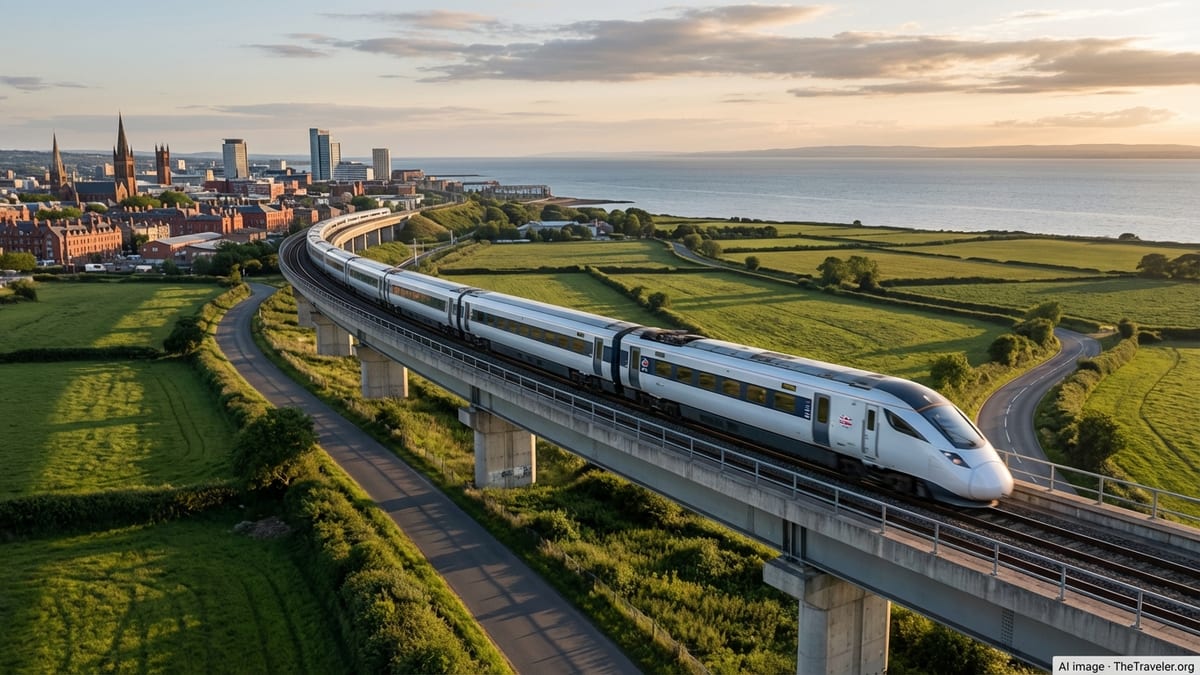
A 300 mph Ring Around the Irish Sea
The concept, unveiled by British architect Chris Williamson, envisages a 740-mile high speed rail circuit connecting Dublin, Belfast, Glasgow, Edinburgh, Newcastle, Leeds, Manchester, Liverpool and Bangor in Northern Ireland. Trains running at up to 300 mph would race along largely elevated viaducts, crossing the Irish Sea twice and tying together a population of around 12 million people in a single integrated corridor.
Early outlines of the scheme suggest journey times of under 90 minutes between any two cities on the Loop, compressing distances that today can involve full travel days of flights, road transfers and ferry crossings. The proposal is positioned as a bold follow-on to Britain’s existing high speed projects, HS1 in Kent and the much-debated HS2 spine between London and the Midlands.
Unlike traditional point-to-point high speed lines, the Loop is marketed as a continuous orbital network, designed to spread benefits more evenly between the UK’s nations and regions. Supporters argue that such a structure would create a new, clearly branded “British Isles high speed circuit” that could be easily marketed to international visitors as a one-ticket, multi-stop experience.
At an estimated cost of about £130 billion, the Loop remains a vision rather than a government-backed project. But its sheer ambition, and its promise to connect key urban tourism hubs at aircraft-rivalling speeds, has ignited a discussion about what the next frontier of rail-enabled tourism could look like in the UK and Ireland.
Tourism Reimagined: From City Breaks to High Speed Circuits
If built, the Loop would dramatically recast the way visitors plan and sequence their trips across the region. Travel analysts say the ability to move from, for example, Dublin to Glasgow in well under an hour and a half, then on to Manchester or Leeds in similar times, could encourage longer, multi-city stays rather than quick single-city breaks.
European city breaks have already been reshaped by high speed lines such as France’s TGV and Spain’s AVE, which turned once-overnight journeys into comfortable morning or afternoon hops. Proponents of the Loop argue that a 300 mph network could do something similar for the British Isles, but with even shorter travel times and more predictable schedules than many short-haul flights.
Tour operators are already exploring scenario-based itineraries on paper: a week-long journey starting in Dublin, moving to Belfast for Titanic heritage, then to Glasgow’s museums and music venues, on to Edinburgh’s Old Town, across to Newcastle’s quayside culture, and down to Leeds, Manchester and Liverpool for sport, nightlife and The Beatles heritage, before ending in coastal Bangor. With sub-90-minute links, such a route becomes logistically simple for both group tours and independent travellers.
Regional tourism boards in northern England and across Ireland see particular promise in the prospect of dispersing visitors more widely. Faster links between cities that today compete for short weekends could encourage travellers to string together two or three urban centres in one trip, lifting hotel occupancy and cultural spending beyond classic hotspots such as London or the Ring of Kerry.
HS2, European Ambitions and the Leap to 300 mph
The Loop vision lands at a delicate moment for rail policy in the UK. HS2, the country’s flagship high speed line between London and Birmingham, is deep into construction but has been dogged by delays, cost overruns and political rows over its curtailed northern extensions. The line is now expected to open in the 2030s after a comprehensive programme reset, with tunnelling between Old Oak Common and Euston in central London only recently restarted.
Official plans for HS2 envisage trains running at up to around 225 mph on the dedicated line, already placing it among the fastest services in Europe. The Loop’s proposed 300 mph operations would significantly push that envelope, stepping into a speed category only a handful of new-build Asian projects have seriously explored. Rail engineers caution that the higher the speed, the more demanding the requirements become for track alignment, signalling, maintenance and energy supply.
At the same time, Brussels has floated new aspirations for a continent-wide high speed network by 2040, aimed at shrinking journey times between major European capitals and promoting rail as a lower-carbon alternative to short-haul air. For UK and Irish policymakers weighing whether to support visionary schemes like the Loop, those European moves provide a backdrop: if mainland corridors are upgraded and integrated while the British Isles lag behind, some fear the region could lose competitiveness as an easy, rail-oriented destination for long-haul visitors.
Yet railway planners and economists warn that any leap from today’s troubled HS2 delivery to a much faster, cross-sea circular line would require not just technical innovation but a cultural reset in how mega-projects are planned, financed and communicated. For now, the Loop serves as a thought experiment in what a truly next-generation tourism rail network might involve, rather than a near-term policy commitment.
Engineering the Impossible: Viaducts, Sea Crossings and City Gateways
At the heart of the Loop idea is its physical form. Preliminary visualisations show long stretches of elevated viaduct skimming above motorways and countryside, designed to limit land acquisition and reduce conflicts with existing communities and infrastructure. The line would have to cross the Irish Sea twice, likely using a mix of long-span bridges, tunnels or causeways, each carrying complex trade-offs in cost, environmental impact and resilience to severe weather.
Engineers familiar with HS2’s civil works say that building high speed infrastructure across varied British and Irish geology is already challenging at 200 to 225 mph. At 300 mph, curves must be gentler, gradients more forgiving and track geometry maintained to tighter tolerances, increasing the length and complexity of structures such as viaducts and cuttings. The line would also require a new generation of signalling and power systems, capable of handling very high speeds and dense timetables safely.
Urban planning is another key dimension. Stations on the Loop would have to act as both high performance transport hubs and tourism gateways. Cities like Belfast and Liverpool, which already rely heavily on cruise terminals and airports for inbound tourism, could see their rail stations become equally important arrival points. That would put pressure on local authorities to redesign streets, public spaces and transit links around the new terminals to handle visitors efficiently and comfortably.
Any sea crossings between Ireland and Great Britain, meanwhile, would come under intense scrutiny from environmental groups and local communities. Issues such as disruption to marine ecosystems, visual impact on coastlines and potential vulnerability to storms and sea level rise would need to be thoroughly assessed and mitigated if the project were ever to move beyond the drawing board.
Economic Promise for Regions Beyond London
One of the most powerful arguments behind the Loop is its promise to rebalance tourism away from a London-centric model. By forming a ring through northern England, Scotland, Northern Ireland and the Republic of Ireland, the network would channel international arrivals directly into cities that have often struggled to convert their cultural assets into sustained visitor numbers.
City leaders in places like Leeds and Newcastle have long campaigned for better cross-country rail links, arguing that slow, indirect services deter visitors from combining northern cities into single itineraries. A 300 mph line that effectively turns the north of England and the Irish Sea basin into a single high speed catchment area could shift investor perceptions, encouraging new hotels, museums and event venues to cluster around the route.
For smaller destinations along or near the proposed alignment, the opportunity lies in becoming day-trip or overnight add-ons to the main circuit. North Wales, the Lake District and the Scottish Highlands, for example, could market themselves as nature-focused escapes just an hour or two off the high speed line, relying on improved regional connectors and coach services to funnel visitors from Loop stations into rural areas.
Tourism economists caution, however, that such benefits are not automatic. Experience with other high speed networks shows that cities with clear destination brands, strong local transport and coordinated marketing often gain the most, while less-prepared areas see travellers simply pass through at speed. For the Loop to drive broad-based tourism growth, it would need to be accompanied by long-term investment in place-making, skills and support for small tourism businesses across the corridor.
Competing With the Plane: Climate Credentials Under Scrutiny
Advocates of high speed rail are quick to frame projects like the Loop as climate solutions, arguing that faster, more frequent trains can lure passengers away from short-haul flights, cutting emissions while still supporting tourism growth. A 300 mph service linking Dublin, Belfast and key UK cities would directly compete with busy air routes between Ireland, Scotland and northern England, potentially reshaping regional aviation patterns.
Yet environmental campaigners point out that the climate balance of such a project would hinge on several factors: the carbon intensity of the electricity powering the trains, the volume of traffic diverted from planes and cars, and the emissions embedded in constructing hundreds of miles of concrete viaducts and tunnels. Construction for HS2 has already prompted heated debate about habitat loss, ancient woodland clearance and heavy use of materials like steel and concrete.
In tourism terms, the question is whether high speed rail encourages greener travel patterns overall, or simply adds new capacity for additional trips. Some sustainability experts argue that, to be compatible with national climate targets, mega-rail projects should be paired with policies that cap or reduce short-haul flights on equivalent routes, and that use ticket pricing and marketing to push visitors towards longer, slower, more locally rooted stays.
For Ireland, where aviation plays an outsized role in bringing international visitors, any shift towards rail-based circulation between Dublin and regional cities would be significant. While long-haul arrivals would still mostly land by air, a high speed Loop could enable those visitors to explore the island and neighbouring parts of the UK with a far smaller domestic carbon footprint than a series of connecting flights.
Political Hurdles and Public Perception
Even more than engineering and finance, politics may be the decisive factor determining whether visions like the Loop ever progress. The UK’s experience with HS2 has left voters and ministers alike wary of initial promises about timelines, budgets and regional benefits. Successive governments have scaled back or cancelled parts of the HS2 network to contain costs, triggering anger in some towns and relief in others.
In Ireland, where no high speed rail currently operates, the leap to a shared, ultra-fast, cross-border loop would require unprecedented coordination between Dublin, Belfast, London and the devolved administrations in Scotland, Wales and Northern Ireland. Issues such as who pays what share of construction and operating costs, who owns and runs the trains, and how ticket revenue is divided would all be politically sensitive.
Public perception is another wild card. While travellers are increasingly used to high speed services on the continent, communities along the route are often sceptical until they see clear local benefits. In both the UK and Ireland, residents affected by any new rail line would likely demand strong guarantees on noise protection, visual design, compensation and ecological safeguards. Without that, the project could face the kind of protests and legal challenges that have delayed other major infrastructure schemes.
For now, governments in London and Dublin have not committed to the Loop. Instead, officials are focusing on completing or upgrading existing rail priorities, including HS2’s cut-back first phase and incremental enhancements to conventional lines. But the traction the Loop has gained in public debate suggests that demand is building for a more comprehensive, long-term vision of how rail can underpin tourism and economic development across the British Isles.
A Vision Shaping the Next Era of Rail Tourism
Whether or not the Loop is ever built as currently imagined, its emergence is already shaping the conversation about the future of tourism in the UK and Ireland. By sketching out a world in which all the major cities around the Irish Sea are less than 90 minutes apart, it challenges policymakers, industry leaders and travellers to think differently about geography, time and the value of proximity.
For tour operators, airlines, hoteliers and attractions, the possibility of a 300 mph rail circuit raises strategic questions. Should they plan for a world in which travellers hop between Dublin and Manchester as easily as today’s movements between Paris and London, or treat the Loop as an inspiring but unlikely dream? How the sector answers those questions over the next decade will influence investment decisions, marketing strategies and workforce planning.
For travellers, the idea captures a broader shift towards rail-based exploration that has gathered pace since the pandemic, fuelled by both climate concerns and a desire for less stressful journeys. Even without a 300 mph network, incremental improvements to existing routes, combined with pan-European efforts to simplify cross-border rail journeys, are already nudging more visitors away from short-haul flights.
In that sense, the 300 mph Loop may be as much a symbol as a blueprint: a provocative reminder that the choices made today about rail, tourism and climate will determine whether the British Isles becomes a showcase for sustainable, fast, interconnected travel, or risks being left on the sidelines of Europe’s next great rail revolution.