

More news on this day
The United Kingdom has issued one of its most far-reaching travel advisories for the Middle East in years, following joint US-Israel strikes on Iran that have prompted a cascade of airspace closures from the Gulf to North Africa, grounding flights, trapping tourists and dealing a sudden blow to one of the world’s fastest-growing tourism regions.
Foreign Office Tightens Advice As Regional Risk Spikes
The UK Foreign, Commonwealth and Development Office (FCDO) updated its guidance over the weekend, advising against all travel to Israel, the Occupied Palestinian Territories and Iran, and urging British nationals across the wider Middle East to exercise heightened vigilance and be prepared for rapid changes to flight and security conditions. Officials cited the risk of further escalation after the latest wave of strikes and retaliatory missile fire.
The advisory, which references a threat of fast-moving regional spillover, now explicitly flags the possibility of sudden airspace closures, flight cancellations and diversions affecting major hubs such as the United Arab Emirates, Qatar, Saudi Arabia, Bahrain, Kuwait, Oman and Jordan. Travellers are being told to monitor local media, register their presence where possible and keep documents and essentials ready in case evacuation options become available at short notice.
Diplomatic sources describe the move as one of the most sweeping region-wide warnings issued by the UK since the early phases of the Arab Spring and the 2003 Iraq war. While the FCDO had already carried strict advisories for high-risk destinations, the renewed guidance extends practical caution to a much broader group of countries that had recently marketed themselves as safe, high-end holiday and transit hubs.
Other European governments have also tightened their notices for the region, but the UK’s explicit focus on the risk of airspace disruption and missile activity has sharpened the picture for airlines, insurers and tour operators weighing whether and how to maintain services.
Gulf Hubs Close Skies And Suspend Flights
The most immediate impact of the crisis has been felt in the skies. Iran and Israel rapidly shut their airspace to civilian traffic as strikes began, and a string of countries followed with partial or total closures, citing aviation safety concerns amid reports of missile interceptions and debris risks.
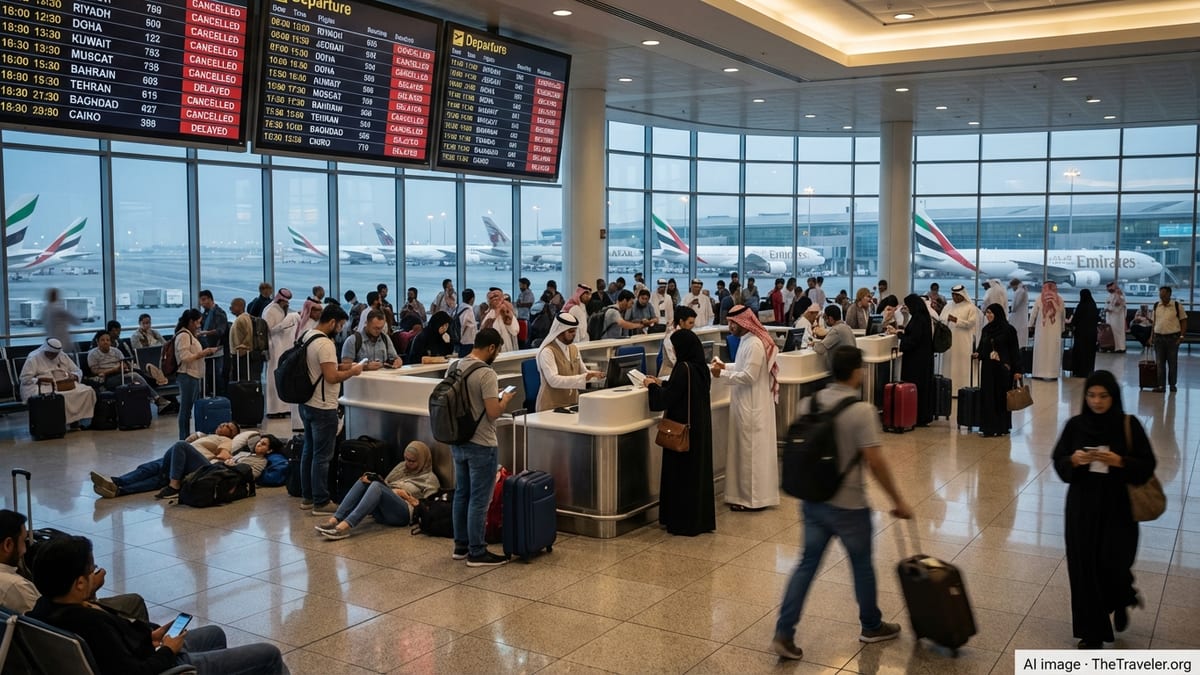
In the Gulf, the United Arab Emirates announced a temporary and partial closure of its airspace as an exceptional precautionary measure, forcing Dubai and Abu Dhabi, two of the world’s busiest long-haul transit hubs, to halt or sharply curtail operations. Flag carriers Emirates and Etihad suspended departures for several hours, while flydubai also paused services, leaving aircraft out of position and thousands of passengers in terminals.
Qatar’s civil aviation authority moved to suspend air navigation over the country, grounding flights at Doha’s Hamad International Airport and prompting Qatar Airways to halt operations until conditions stabilise. Bahrain, Kuwait and Iraq likewise closed their skies, while Saudi Arabia and Oman imposed restrictions and rerouting that have created bottlenecks over alternative corridors such as the Red Sea and eastern Mediterranean.
Further west, Morocco and parts of Egypt have implemented short-term airspace or routing adjustments as operators seek to keep aircraft away from potential conflict zones. With Russian and Ukrainian airspace largely unavailable, the closures across the Gulf and Levant have severed many of the remaining high-capacity links between Europe and Asia, forcing carriers into longer, more fuel-intensive detours.
Tourism Boom Abruptly Stalled
The timing of the crisis is particularly painful for Middle Eastern tourism economies that had been celebrating a strong rebound. Regional travel spending recently surpassed pre-pandemic levels by more than 20 percent, supported by aggressive investment in hospitality, sports events and cultural attractions in destinations such as the UAE, Saudi Arabia, Qatar and Jordan.
Now, with airspace restrictions rippling outward, that momentum has been abruptly checked. Industry analysts report that a significant share of bookings into Gulf hubs, Red Sea resorts and key city-break destinations has either been cancelled or placed on hold within days, as travellers scramble to interpret changing advisories and airlines freeze sales on affected routes.
Hotel groups in Dubai, Doha and Riyadh are bracing for a wave of late cancellations, particularly from European and Australian markets that rely heavily on seamless long-haul connections through Gulf hubs. Cruise itineraries that rely on ports in the UAE, Oman and Bahrain are also under review, with operators weighing whether to reroute ships to the eastern Mediterranean or suspend voyages.
Beyond immediate cancellations, there is concern that the perception of the Middle East as a high-risk aviation corridor could linger even after airspace is fully reopened, pushing some carriers to favour alternative transit hubs in Europe or Central Asia and complicating long-term tourism growth strategies laid out by Gulf governments.
Travellers Stranded As Airlines And Insurers React
For travellers caught mid-journey, the crisis has meant long queues, uncertainty and, in many cases, unexpected overnight stays. Hundreds of thousands of passengers have been stranded or diverted as flights into and across the region were cancelled at short notice, according to aviation tracking and consultancy estimates.
Major European, Asian and US airlines including British, European flag carriers and several large Asian operators have suspended flights to high-risk airports and are rerouting services to avoid affected airspace, sometimes adding several hours to flight times. Low-cost and regional airlines with heavy exposure to Gulf and Levantine markets have been forced to cancel rotations altogether as they wait for clarity on safety assessments and insurance cover.
Travel insurers are fielding a surge in claims and queries, with policies scrutinised for war and civil unrest exclusions. Consumer advocates are urging passengers to document all communications, keep receipts for accommodation and meals, and insist on their rights where cancellations are initiated by airlines rather than travellers themselves.
Industry experts note that while the aviation sector has become more adept at handling conflict-zone risks since past tragedies involving civilian aircraft, the concentration of global traffic through Middle Eastern hubs leaves travellers more exposed to cascading disruptions when those nodes are compromised.
Escalating Security Concerns Cloud Regional Outlook
Security analysts warn that the joint US-Israel strikes on Iran, followed by Tehran’s retaliatory actions and missile activity near Gulf states hosting Western military facilities, have created a volatile environment that could see further episodes of brinkmanship and disruption. Authorities in Qatar, the UAE, Bahrain and Saudi Arabia have all reported heightened military readiness and interception operations in recent days.
The UK advisory reflects fears that civilian infrastructure, including airports and key tourist areas, could be indirectly affected by any miscalculation or spillover. Even where the immediate threat to visitors remains low, the proximity of military assets to major urban and resort zones has raised the risk profile in the eyes of governments and insurers.
Tourism boards across the region are attempting to balance reassurance with realism, emphasising that many destinations remain calm on the ground but acknowledging that airspace restrictions and global perceptions will take time to unwind. Some are working on targeted campaigns aimed at regional visitors who can reach resorts by land or short-haul flights avoiding the most sensitive corridors.
For now, however, the message from officials and industry alike is caution. Travellers considering trips to the Middle East over the coming weeks are being urged to review official advisories, maintain flexible bookings and assume that further sudden changes to flight schedules and security conditions are likely as the crisis continues to unfold.