

The UK government has issued an urgent travel warning for Spain after a deadly high-speed train collision near Adamuz severely disrupted one of Europe’s busiest rail corridors, with services between Madrid and much of Andalucía only now partially resuming and key routes still hampered by infrastructure repairs.
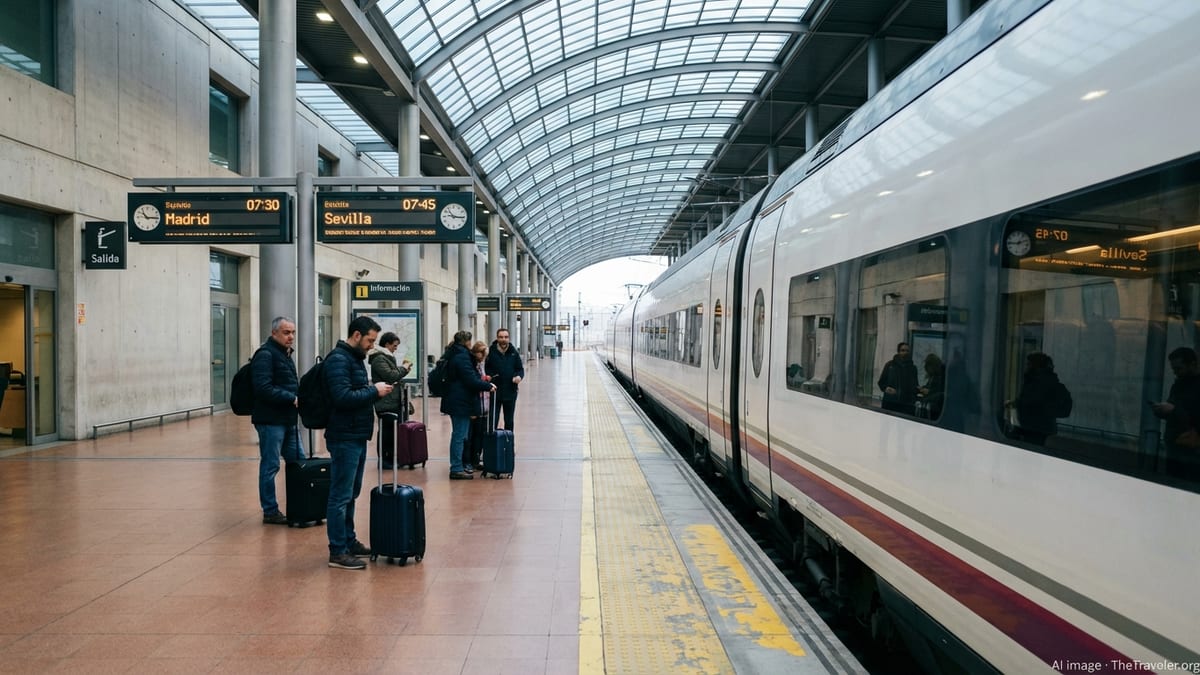
UK Tightens Travel Advice as Britons Head for Spain
The UK Foreign, Commonwealth and Development Office has updated its travel advice for Spain following the fatal high-speed rail collision on 18 January near Adamuz in the province of Córdoba. Officials are warning British travellers to expect ongoing disruption, altered timetables and longer journey times on several flagship high-speed services linking Madrid with southern Spain.
The advisory, aimed at holidaymakers and business travellers alike, highlights that while some trains are running again between the capital and major Andalusian cities, residual delays, capacity constraints and short-notice changes remain likely. Britons planning to travel by rail in Spain over the coming weeks are being urged to check schedules carefully on the day of departure and to allow extra time for connections.
The warning comes as Spain works to restore confidence in a network that has long been one of Europe’s high-speed success stories. UK officials stress that rail remains a generally safe and efficient way to travel in Spain, but say the scale of the Adamuz disaster and the complexity of the repairs justify heightened caution for now.
With thousands of UK visitors typically using high-speed trains to reach Andalucía’s cities and coastal resorts, the updated guidance is expected to influence travel plans throughout the late winter and early spring holiday period.
Deadly Adamuz Collision Shakes Confidence in High-Speed Safety
The Adamuz crash, which occurred on the evening of 18 January, involved two high-speed services on the Madrid–Seville line: an Iryo-operated Frecciarossa unit and a Renfe Alvia train. Investigators say one train derailed on a straight stretch of track before being struck by the oncoming service on the adjacent line, causing catastrophic damage across both formations.
Forty-six people lost their lives and nearly 300 were injured, making it Spain’s worst railway disaster since the Santiago de Compostela derailment in 2013 and one of the deadliest train crashes in the country’s modern history. Images from the scene showed carriages ripped open and lying on their sides, with emergency crews working through the night to reach trapped passengers.
Questions quickly emerged over the state of the infrastructure at the crash site. Spain’s transport minister later acknowledged that the section of line near Adamuz had undergone only partial renewal during recent upgrade works, with some original rail components retained. That admission has fuelled political debate over maintenance standards on a route that carries millions of passengers each year.
Investigators are examining a possible fracture in a rail section and the quality of welds connecting newer and older elements of track. Early statements from officials have ruled out excessive speed as a cause, noting that the trains were reportedly travelling below the 250 km/h line limit when the derailment began. A full technical and judicial investigation is expected to take months.
Key Madrid–Andalucía Corridor Reopens After Month-Long Closure
Following almost a month of intense engineering work, Spain’s rail infrastructure manager Adif has now formally reopened the main high-speed artery between Madrid and much of Andalucía. The line, which was severed at Adamuz after the crash, returned to service on 17 February, restoring direct high-speed links between the capital and cities including Seville, Córdoba, Granada, Cádiz and Almería.
Spanish operator Renfe says it has resumed its full high-speed timetable on the core Madrid–Seville axis and on connected routes towards Huelva, Granada and Almería via Granada. Private rivals Iryo and Ouigo Spain have also restarted their Madrid–Seville services, bringing back a degree of competition and capacity that had been absent during the closure period.
Adif engineers report that repairs to the damaged section took longer than initially forecast due to adverse weather in Andalucía and the need for judicial authorisation before heavy machinery could access the crash site. The reconstruction work included replacing damaged track, overhead lines and signalling equipment, followed by extensive safety testing and trial runs before commercial trains were allowed back onto the route.
The reopening marks a crucial step in reconnecting central Spain with the south, where high-speed rail is a lifeline for residents, tourists and businesses. Journey times between Madrid and Seville are now returning to their pre-accident durations, typically between around two hours forty minutes and just over three hours, depending on intermediate stops.
Partial Restoration Leaves Málaga High-Speed Link on Hold
Despite the return of trains on the main Madrid–Seville corridor, not all high-speed links between the capital and Andalucía are back to normal. Services to Málaga, one of Spain’s most popular destinations for British holidaymakers, remain suspended on the final stretch between Antequera and Málaga due to separate infrastructure damage caused by recent severe weather.
Adif says landslides near Álora have compromised a section of the high-speed line leading into Málaga, forcing trains to terminate further inland while engineers stabilise slopes and repair a damaged retaining wall. Officials currently expect through high-speed services between Madrid and Málaga to resume in early March, although no firm date has been set.
In the meantime, Renfe plans to operate replacement buses between Antequera and Málaga from 18 February, providing a stopgap for travellers who still wish to reach the Costa del Sol by rail. However, this arrangement will add time and complexity to journeys, especially for those with luggage or tight onward connections to coastal resorts.
Budget operators Iryo and Ouigo, which had both expanded aggressively into the Madrid–Málaga market in recent seasons, are also affected by the closure. Their focus has shifted back to consolidating restored services to Seville while waiting for confirmation that the Málaga spur is once again safe to operate.
Weeks of Disruption Force Travellers Onto Buses and Planes
The Adamuz crash and subsequent line closure have already caused significant upheaval for domestic and international travellers. For nearly a month, high-speed trains from Madrid ran only as far as Villanueva de Córdoba, where passengers were transferred to fleets of buses for the onward journey to Córdoba and Seville before rejoining rail services further south.
Renfe says these emergency bus shuttles, in place since 20 January, carried more than 70,000 passengers while the high-speed line was out of service. The operator underscores that it was the only company to provide comprehensive alternative transport throughout the shutdown, as private high-speed rivals suspended their services entirely.
The disruption has also had knock-on effects at airports and on Spain’s motorway network, as some travellers opted to switch to domestic flights or car hire rather than face multi-leg rail and bus journeys. Travel agents in both Spain and the UK report a short-term uptick in bookings for internal flights linking Madrid with Seville and Málaga, even as many customers express a desire to return to high-speed rail once reliability is assured.
Industry analysts note that while Spain’s high-speed network retains a strong safety record overall, a disaster of this magnitude inevitably dents public confidence. Operators are expected to respond with a mix of fare promotions, schedule improvements and enhanced communication in an effort to reassure passengers ahead of the busy Easter and summer seasons.
Ongoing Investigation and Political Scrutiny
The judicial and technical investigation into the Adamuz crash is continuing, with Spain’s rail accident body and independent experts examining track components, signalling data and maintenance records. Authorities are also scrutinising how the partially renewed section of line behaved under stress and whether any earlier warning signs were missed.
Opposition parties in Spain have seized on the minister’s admission that the track near Adamuz was only partly replaced during recent works, questioning whether cost or time pressures influenced engineering decisions. They are demanding greater transparency over the criteria used to determine which parts of the line were renewed and which were left in place.
For travellers, the immediate impact of this scrutiny is heightened caution in the short term. Authorities insist that the reopened line meets all safety requirements and has undergone exhaustive testing, including multiple proving runs by Renfe before Adif signed off on the return of service. Nevertheless, the investigation’s findings could lead to further infrastructure interventions or new operating rules later in the year.
UK officials are monitoring developments closely, with any major changes to Spain’s high-speed operations or safety protocols likely to prompt further updates to the Foreign Office’s advice. Travel industry bodies say clear, timely information from Spanish and British authorities will be vital to rebuild trust.
What British Travellers Need to Know Now
For UK visitors heading to Spain in the coming weeks, the message from officials and operators is to plan carefully but not to abandon rail altogether. Travellers intending to use high-speed services between Madrid and Seville, Córdoba, Granada, Cádiz or Almería can once again book through trains, but should verify departure times on the day, as operators fine-tune timetables following the reopening.
Those bound for Málaga and the wider Costa del Sol should be prepared for a more complicated journey until high-speed services are fully restored. The likely scenario involves taking a high-speed train from Madrid to Antequera, then transferring to a bus into Málaga before continuing by local or regional rail along the coast. Allowing additional buffer time for these transfers is strongly recommended, particularly for passengers with flights to catch.
Travel insurers are advising customers to read policy terms carefully, as disruption arising from infrastructure failures or industrial action may be treated differently from delays directly attributable to accidents. Some policies may cover additional accommodation or alternative transport costs if rail services are significantly disrupted after a booking has been made.
Despite the challenges, both Spain’s government and rail operators are keen to emphasise that high-speed rail remains a cornerstone of the country’s tourism offer. With the main Madrid–Seville corridor now back in operation and repair work advancing towards Málaga, officials hope that travellers will soon once again view the trains as one of the most convenient ways to explore southern Spain.