

More news on this day
The UK Foreign, Commonwealth and Development Office has tightened travel guidance for 21 countries as the widening Middle East conflict and Iran-linked tensions drive a fresh round of urgent warnings for British travellers.
Get the latest news straight to your inbox!
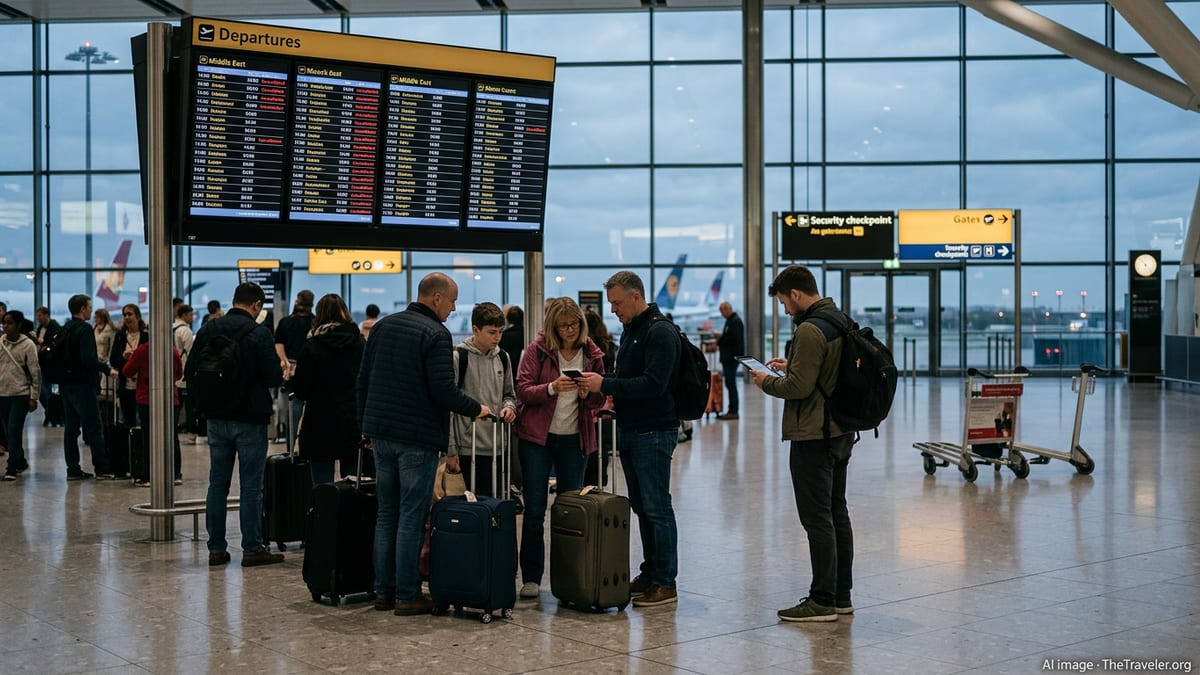
Expanded Risk Map as Middle East Conflict Widens
Publicly available government updates and media coverage show that the Foreign, Commonwealth and Development Office has moved to align its travel advisories with a rapidly changing security picture across the Middle East and beyond. The shift follows months of escalating confrontation involving Israel, Iran and armed groups across the region, as well as knock on effects on airspace, shipping routes and domestic stability in several states.
Reports indicate that the latest round of warnings consolidates existing advice against all or all but essential travel to high risk states such as Iran, Iraq, Syria, Yemen, Afghanistan and parts of Lebanon, Israel and the Palestinian territories, while also highlighting emerging concerns in countries that have so far remained outside the main theatres of conflict. The 21 country figure cited in recent coverage reflects a cluster of destinations now explicitly linked to the Middle East crisis in official guidance, in addition to a wider global list of do not travel advisories.
Commentary in UK and international outlets notes that the updated posture is intended to capture both direct exposure to conflict and the indirect risks facing transit hubs, popular holiday destinations and countries where domestic unrest has been exacerbated by regional tensions. These include locations where British nationals traditionally travel in large numbers for tourism, business and family visits, but where authorities now consider the security situation to be significantly less predictable.
The Middle East conflict has also intersected with existing political instability and economic pressure in several states on the FCDO list. In some cases, analysts point out that long standing concerns about terrorism, kidnapping, border clashes or internal unrest have been reframed through the lens of a broader regional crisis, reinforcing the UK government’s message that conditions can deteriorate quickly with limited scope for consular support.
Which Countries Are Affected by the Latest Warnings
Recent explainers on the evolving FCDO risk map highlight that the 21 countries referenced in coverage span multiple regions but are tied together by exposure to Middle East conflict dynamics, Iranian influence or heightened terrorism concerns. Core conflict states such as Israel, the Palestinian territories, Lebanon, Syria, Iraq, Yemen and Iran feature prominently, with advice that often includes blanket warnings against all travel to some areas and highly restrictive guidance for others.
Travel industry reporting also points to Afghanistan, Russia, parts of Ukraine, and several African states including Burkina Faso, Mali, Niger, South Sudan and others as forming part of the broader group where the United Kingdom advises against all travel. Venezuela and Haiti are frequently cited as non Middle Eastern examples on the same high risk list, underlining that the FCDO’s latest language reflects multiple overlapping crises rather than a single conflict theatre.
Media briefings on the new guidance further note updated instructions affecting key transit and tourism hubs such as Qatar and Saudi Arabia, where British nationals are being encouraged to register their presence with the UK government to receive rapid security updates. Similar registration schemes have previously been promoted for Bahrain, Kuwait, the United Arab Emirates and other Gulf states in response to concerns that sudden escalations between Israel and Iran could trigger airspace closures or flight disruptions.
Commentary in specialist travel publications suggests that the net effect is a multi tiered warning structure. At the highest level sit countries subject to do not travel advice because of active conflict or near total breakdown of security. A second tier features states where the primary risk stems from regional spillover, missile or drone activity, or the potential for protests and unrest linked to developments in Gaza, Israel or Iran. A further tier includes destinations where the main emphasis is on monitoring airspace, maritime routes and the resilience of local infrastructure.
Airspace, Aviation and Transit Disruption Risks
Security analysts and aviation trackers have drawn particular attention to the risk that the Middle East conflict could disrupt long haul flight corridors, particularly those crossing Iranian, Iraqi and eastern Mediterranean airspace. Previous episodes of missile and drone exchanges in the region have led to temporary closures of national airspace in Israel, Iraq and Jordan, forcing airlines to reroute services and, in some cases, cancel flights at short notice.
Recent travel advisories and industry commentary note that Gulf states including Oman, Qatar, Bahrain, Kuwait, Saudi Arabia and the United Arab Emirates are under closer scrutiny because of their role as major aviation hubs. While these countries are not active conflict zones, updated FCDO language and related reporting warn that airspace could be closed, reconfigured or subject to overflight restrictions if hostilities between Israel and Iran intensify or if nearby missile activity is detected.
For travellers, these risks translate into a greater likelihood of delays, diversions and unexpected overnight stays in third countries. Travel risk consultancies point out that even where the security threat on the ground remains relatively low, the cumulative impact of air traffic control measures, airline risk assessments and insurance conditions can significantly alter the practical feasibility of certain itineraries, especially those reliant on tight connections through regional hubs.
In parallel, shipping security briefings continue to highlight the effect of Houthi attacks and related naval operations in the Red Sea and Gulf of Aden. These incidents have prompted some cruise lines and freight operators to alter routes or cancel calls, which in turn affects coastal states that rely on tourism and trade. While such developments may not automatically push a country onto the do not travel list, they can contribute to a more cautious overall posture in official UK guidance.
Implications for UK Holidaymakers and Travel Businesses
For British holidaymakers, the expansion and sharpening of travel warnings means that familiar booking assumptions no longer apply in several once routine destinations. Travel industry coverage notes that standard insurance policies may be invalidated if a traveller visits a country or region against explicit FCDO advice, leaving individuals exposed to potentially high medical or evacuation costs. Tour operators and airlines may also alter or cancel services with limited notice when a destination is upgraded to a stricter warning category.
Consumer advocates emphasise that travellers planning trips to or through affected regions should pay close attention to the exact wording of the FCDO advisories, which distinguish between advice against all travel, advice against all but essential travel, and more limited regional cautions. This distinction can determine whether package holiday customers are entitled to refunds or alternative arrangements, and whether airlines are obliged to offer rebooking or vouchers when risk levels change.
Travel trade publications report that companies are increasingly building flexibility into itineraries touching the Middle East and North Africa, including provisions for rapid rerouting, alternative transit points and the option to postpone travel without heavy penalties. Some operators are also reviewing staff deployment, shore excursion programmes and on the ground security protocols in countries that sit adjacent to active conflict zones.
Despite the heightened warnings, analysts caution that the picture is uneven. While some destinations have seen a marked drop in UK arrivals, others continue to attract visitors, particularly where major cities and resort areas remain far from front line hostilities. Industry observers suggest that this divergence reflects differing risk appetites among travellers, as well as variations in how airlines and insurers interpret evolving security assessments.
How Travellers Can Respond to Rapidly Changing Advice
Specialist risk briefings and university travel guidance documents stress the importance of treating the FCDO advisories as a living tool rather than a one off pre departure check. With the Middle East conflict and associated protests evolving on an almost weekly basis, travellers are being urged by publicly available guidance to review the official advice not only when booking, but again shortly before departure and during their stay.
Experts in corporate travel management recommend that individuals transiting through or visiting any of the 21 highlighted countries ensure that their contact details are up to date with airlines and tour operators, and that they monitor mainstream news outlets and official channels for signs of airspace closures, border disruptions or large scale demonstrations. Where possible, travellers are advised to keep digital and printed copies of passports, visas and insurance policies, and to have a basic contingency plan in case a rapid departure becomes necessary.
For organisations that send staff to higher risk destinations, recent security advisories recommend more formal risk assessments, including scenario planning for sudden deterioration in local conditions. These assessments typically factor in the availability of commercial flights, the capacity of local healthcare systems, and the potential for internet or mobile network outages that could complicate communication in a crisis.
Ultimately, the UK Foreign Office’s urgent warnings for 21 countries underline how closely global travel is now intertwined with the trajectory of the Middle East conflict and related geopolitical tensions. For British nationals, the evolving advisory landscape points toward a more cautious and actively managed approach to international travel, particularly in regions where security conditions can shift quickly and unpredictably.