

More news on this day
Britain’s cruise market is laying early foundations for a major push into no-fly Mediterranean sailings in 2028-29, as cruise lines expand ex-UK deployment, commission new ships and respond to strong demand for stress-free holidays that bypass airports entirely.
Get the latest news straight to your inbox!
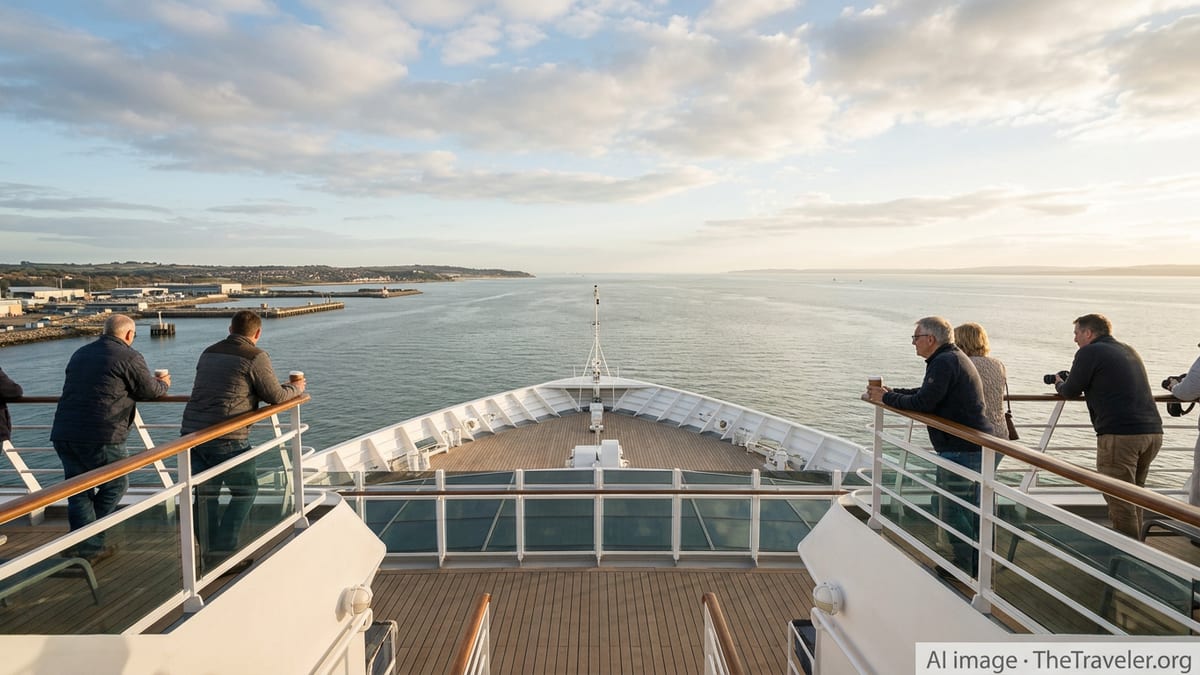
No-fly demand reshapes Britain-to-Mediterranean planning
Publicly available booking data and trade coverage indicate that no-fly cruises from UK ports are gaining ground in the second half of the decade, with the Mediterranean emerging as a key focus. Cruise specialists report that itineraries sailing directly from Southampton, Liverpool, Newcastle and other British ports are selling strongly for 2026 and 2027, setting the stage for more expansive programmes into 2028 and 2029 as ship capacity grows.
Industry overviews of the UK market show that brands including P&O Cruises, MSC Cruises, Cunard, Ambassador Cruise Line, Fred. Olsen, Princess and Royal Caribbean already offer extensive ex-UK departures, including warm-weather runs to Spain, France, Italy, Croatia and Greece. As these lines secure additional tonnage and newbuilds scheduled to enter service around 2028 and 2029, analysts expect a larger share of that capacity to be deployed on round-trip itineraries from British ports to the Mediterranean.
Travel trade platforms tracking no-fly products note that consumer interest is driven by a mix of airport fatigue, tighter household budgets and a desire for simpler, slower travel. For many British travellers, the ability to step aboard in a familiar UK port and wake up days later in Barcelona, Civitavecchia or Dubrovnik has become a compelling alternative to short-haul flights and hotel stays.
While most detailed sailing schedules are only published two to three years in advance, deployment announcements through 2027-28 suggest that patterns visible today will continue, and likely intensify, into the 2028-29 seasons, particularly on ships purpose-built or upgraded for the British market.
Lines extend deployment and eye new tonnage for late decade
Recent deployment updates provide an early glimpse of how the late 2020s could look for UK-based cruisers headed to the Mediterranean. Ambassador Cruise Line’s 2027-28 programme, for example, highlights a network of no-fly sailings from multiple British homeports, including London Tilbury, Newcastle, Dundee, Liverpool, Belfast, Bristol and Portsmouth, with featured itineraries such as “Mediterranean Moments” pointing to sustained focus on southern European routes into spring 2028.
Similarly, MSC Cruises and other major operators continue to refine their European portfolios with a mix of Northern Europe and Mediterranean schedules. Trade reporting on MSC’s late-decade programme notes expanded Mediterranean coverage in winter 2027-28, alongside a broader strategy of rotating vessels between UK and continental homeports. These moves, combined with the brand’s pipeline of large new ships due around 2028-29, are expected to increase overall capacity available for ex-UK Mediterranean voyages.
Shipbuilding data published in specialist outlets shows that several of the world’s largest cruise companies, including the parent groups behind Royal Caribbean and Celebrity Cruises, have new vessels on order for delivery in 2028 and beyond. As those ships enter service, older but still premium vessels can be redeployed to mature markets such as the UK, where they are likely to operate longer, itinerary-rich seasons to the Mediterranean.
Luxury and upscale brands are also planning deep into the 2027-28 period, with yacht-style and expedition fleets adding Mediterranean legs around peak summer. While many of these sailings homeport in the region rather than the UK, industry observers expect at least some repositioning voyages and extended itineraries to be adapted for no-fly demand from Britain by 2028-29.
Stress-free travel: avoiding airports, embracing slow journeys
The appeal of no-fly cruising for British holidaymakers is closely tied to convenience and predictability. Travel trade analysis points out that sailings from Southampton, Dover, Liverpool and other ports allow guests to travel by train or car, check in once and have luggage handled for the duration of the trip. For families and older travellers in particular, this can remove the stress of airport queues, luggage restrictions and potential flight disruption.
Itinerary planners are responding by designing routes that balance sea days with headline ports. Recent and forthcoming ex-UK Mediterranean voyages typically string together calls in Iberian and Western Mediterranean hubs such as Lisbon, Cádiz for Seville, Barcelona, Marseille, Livorno for Florence and Pisa, and Civitavecchia for Rome. Some programmes also extend eastward to Valletta, Dubrovnik, Split, the Greek islands and the Adriatic, offering what companies market as grand tours of southern Europe without a single flight.
Observers note that the length of these holidays is increasing as travellers embrace slow travel. Fourteen to twenty-one night itineraries are becoming more visible in brochures, allowing ships to reach deeper into the central and eastern Mediterranean while still operating round-trip from British ports. As new ships arrive later in the decade with enhanced fuel efficiency and hotel-style comforts, analysts expect longer no-fly voyages to become a hallmark of the 2028-29 seasons.
On board, cruise lines are tailoring experiences to British tastes, from familiar dining options and entertainment to pricing in pounds sterling. This localisation, combined with simplified travel logistics, positions ex-UK Mediterranean cruises as a mainstream alternative to traditional package holidays by the time 2028 and 2029 programmes open for sale.
Accessibility, sustainability and value shape late-2020s offerings
As cruise companies refine their long-range plans, accessibility and environmental performance are emerging as important factors for late-2020s ex-UK itineraries. Industry reports highlight that newer ships scheduled for delivery around 2028-29 are being built with improved energy efficiency, shore-power connectivity and advanced waste treatment systems, in line with evolving European regulations and port expectations.
For UK-based guests, this shift is likely to translate into quieter, cleaner-running vessels on Mediterranean routes, alongside more detailed communication about environmental initiatives. Ports across Spain, France, Italy and the Adriatic are investing in infrastructure upgrades, which are expected to make it easier for cruise lines to operate longer, port-intensive itineraries while managing local impact.
Value is another key driver. Analysts covering the British cruise sector note that no-fly holidays can offer cost advantages when compared with peak-season flight and hotel packages, particularly for families sharing cabins or older travellers taking advantage of off-peak sailings. By 2028-29, with additional capacity in the market, competitive pricing and added-value promotions are expected to be central to filling ships on longer Mediterranean runs from the UK.
Accessibility also extends to source markets across the regions surrounding major UK ports. Rail connectivity to Southampton and other embarkation points allows travellers from across England, Wales and Scotland to reach their ship in a single day, making a two or three-week Mediterranean voyage viable without complex pre- and post-cruise arrangements.
Booking horizons and what travellers can expect for 2028-29
Most cruise operators release detailed itineraries two to three years ahead, meaning that the bulk of 2028 and 2029 ex-UK Mediterranean sailings have yet to appear in consumer brochures. However, the deployment announcements already published through early 2028, alongside ship order books and trade commentary, give a clear sense of direction: more ships, more choice of UK departure ports and a deeper roster of Mediterranean routes tailored to British tastes.
Travel agents specialising in cruise are advising customers who favour no-fly holidays to monitor early-release programmes and register interest in longer Mediterranean voyages, particularly those that include marquee destinations or niche ports. Given the strong advance booking patterns seen for certain ex-UK sailings in 2026-27, prime cabins and school-holiday dates for 2028-29 may sell quickly once schedules are published.
For now, travellers can look at 2026 and 2027 brochures as a template for what is likely to come: a mix of Western and Central Mediterranean routes from Southampton and other UK ports, increasingly joined by extended itineraries that reach further east and south. As new, larger and more efficient ships join the fleets of major brands, the late-2020s picture points to a UK-to-Mediterranean cruise market that is broader, more accessible and more firmly rooted in the concept of relaxed, flight-free travel.