

More news on this day
The United Kingdom’s Civil Aviation Authority has demanded a full and detailed explanation from Air India after a Boeing 787 Dreamliner departed London Heathrow for Bengaluru despite pilots repeatedly flagging a problem with a critical fuel control switch.
The incident, which occurred on February 1, 2026, has sharpened scrutiny on Air India’s operations and revived concerns about fuel switch design and procedures following a fatal Dreamliner crash in India last year. For travelers, it raises new questions about how regulators respond when a potential safety issue is detected before takeoff and what this means for confidence in one of Asia’s fastest-growing carriers.
More News
- Caribbean Travel to U.S. Upended by New Visa Freezes and Expanded Bans
- Mexico Restores E-Visas for Brazilians, Paving the Way for Borderless Tourism
- Philippine Airlines Joins Regional Carriers Powering Southeast Asia’s Tourism Boom
What Happened on Air India Flight AI 132 from London to Bengaluru
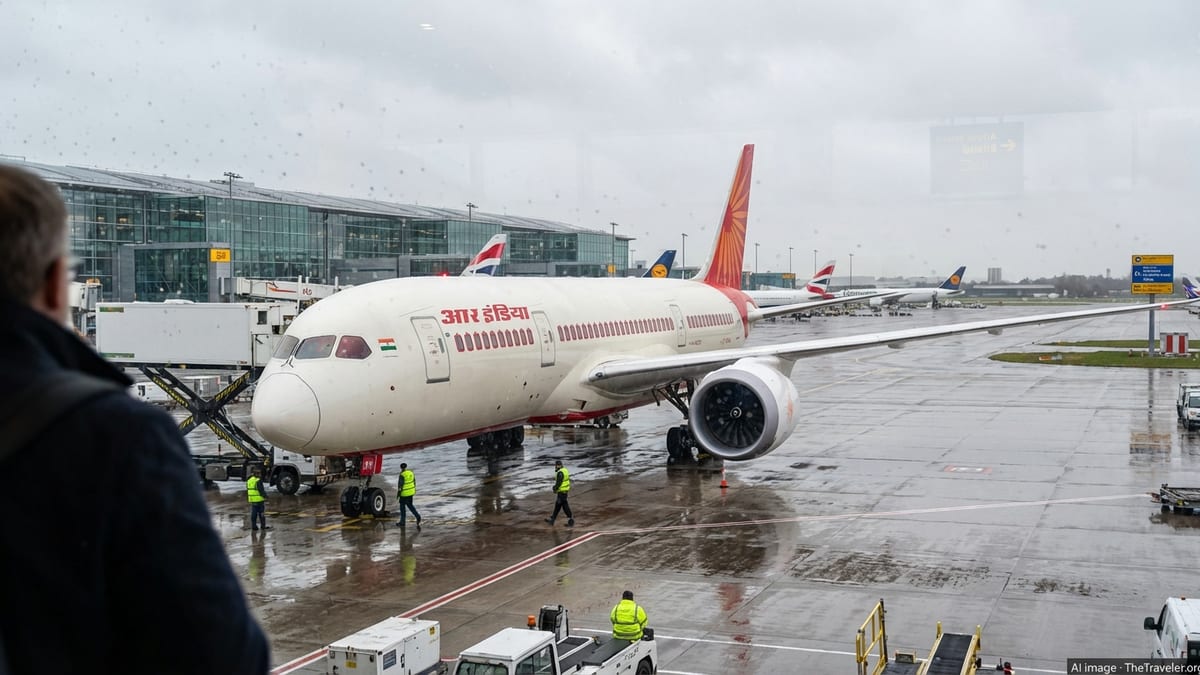
The incident at the heart of the UK investigation involves Air India flight AI 132, operated by a Boeing 787-8 Dreamliner registered VT-ANX, which was scheduled from London Heathrow to Bengaluru on February 1, 2026. During the engine start procedure at Heathrow, the cockpit crew noticed that the fuel control switch for one of the engines did not behave as expected during standard checks. On two separate attempts, the switch reportedly failed to remain positively latched in the “RUN” position when light vertical pressure was applied.
On the third attempt, the switch did latch correctly and remained stable. Pilots then carried out a physical verification to confirm that it was fully and positively locked in the “RUN” position, and engine indications remained normal. With no abnormal cautions, warnings or system messages and with engine parameters appearing within limits, the crew decided to proceed with the departure to Bengaluru. The long-haul flight was completed without further incident, and no technical irregularities were flagged by the aircraft’s onboard systems during the journey.
Once the Dreamliner arrived in Bengaluru, the crew logged the observation in the post-flight defect report. Air India then grounded the aircraft for checks and referred the matter to Boeing for guidance. Despite the absence of in-flight anomalies, the nature of the switch and its role in controlling fuel flow into the engines triggered concern among regulators, particularly given the heightened sensitivity around fuel switch behavior following an earlier crash involving another Air India 787.
Why the UK Civil Aviation Authority Has Intervened
Britain’s Civil Aviation Authority has written to Air India demanding a detailed account of how the aircraft was cleared to depart from Heathrow after the abnormal behavior of the fuel control switch was observed during pre-flight checks. The CAA’s letter, sent in the days following the incident, asks the airline to explain exactly what engineering assessments were performed before departure, what guidance was given to the crew, and how the airline determined that the aircraft was safe to continue to India.
The regulator has also requested a comprehensive account of all maintenance actions carried out on the aircraft related to the fuel control system, including any inspections conducted before or immediately after the flight. Air India has been given a deadline of around one week to provide a full response. The CAA has indicated that the request forms part of standard safety assurance procedures when an aircraft incident is reported, but it has also warned that regulatory action against Air India and potentially its wider Dreamliner fleet could follow if the explanation is incomplete or unsatisfactory.
The CAA’s involvement is particularly significant because the incident occurred at Heathrow, one of the world’s most heavily regulated hubs, and because UK authorities have been closely engaged in investigations into last year’s fatal Air India crash involving a similar model of aircraft. The letter underscores a determination not only to understand what happened on AI 132, but also to ensure that any lessons from previous accidents are being fully applied to current operations.
How Indian Authorities and Air India Are Responding
As the UK regulator presses for answers, Indian aviation authorities have issued a series of statements seeking to reassure passengers and counter suggestions of a mechanical defect. India’s Directorate General of Civil Aviation has said that inspections carried out in accordance with Boeing’s recommended procedures found the fuel control switches on the affected aircraft to be functioning properly. According to the regulator, both the left and right switches were examined, and their locking mechanisms were confirmed to be fully seated and not slipping from “RUN” to “CUTOFF” when operated correctly.
Investigators reported that the switches remained secure when force was applied parallel to the base plate, the method Boeing prescribes for normal operation. However, when external force was applied in an incorrect direction, the switch could move more easily from “RUN” to “CUTOFF,” a behavior attributed to the angular design of the base plate. Regulators have emphasized that this observed behavior does not represent a defect when the switch is used according to approved cockpit procedures and that no abnormal engine parameters or warnings were recorded before or during the flight.
Air India, for its part, has said it completed a precautionary re-inspection of the fuel switches across its Boeing 787 fleet and has not identified any systemic issues. The airline has grounded the specific aircraft involved while further checks are completed and has committed to sending the relevant fuel control switch module to the original equipment manufacturer for deeper examination. With the switch having been used for a fraction of its certified life, the airline and regulators are keen to confirm whether the behavior seen on the ground in London reflects a design characteristic, a handling issue, or any subtle manufacturing anomaly.
Background: The Deadly Air India Dreamliner Crash and Fuel Switch Concerns
The heightened reaction to the AI 132 incident cannot be understood without the context of the tragic crash of Air India Flight 171 in June 2025. That Dreamliner, also operating a London-bound service, crashed shortly after takeoff from Ahmedabad in the Indian state of Gujarat, killing 260 people on board and on the ground. It was India’s worst aviation accident in three decades and prompted intense scrutiny of both Air India’s safety culture and the systems on the Boeing 787.
A preliminary report by India’s Aircraft Accident Investigation Bureau indicated that cockpit switches controlling fuel flow to the engines had moved to the “CUTOFF” position just after takeoff. While the full chain of events remains under investigation, the focus on the fuel switches linked the physical act of moving those controls directly to the catastrophic loss of thrust, putting their design, ergonomics and procedures under a microscope.
In the months following the crash, Indian regulators ordered airlines to inspect fuel switch locks on several Boeing aircraft types, including 787s and 737s. Airlines were instructed to confirm that locking mechanisms required a deliberate pull-to-unlock action and that switches could not be inadvertently moved through casual contact or vibration. For Air India, the crash and subsequent directives prompted a significant review of cockpit checklists, training, and maintenance practices relating to fuel control and engine start procedures.
When news emerged that, on AI 132, a fuel control switch had again appeared to slip towards the “CUTOFF” position during pre-flight checks at Heathrow, the incident immediately drew comparisons with the 2025 crash. Campaigners and some pilot groups questioned why the flight had been allowed to depart at all, arguing that any irregularity involving the same class of component should trigger the most conservative possible response. The UK CAA’s demand for a full explanation is in part an effort to clarify how those post-crash lessons are being applied in day-to-day operations.
What This Means for Travelers Flying with Air India and on Boeing 787s
For passengers booked with Air India, particularly on its long-haul Dreamliner routes between Europe, India and beyond, the incident feeds into a broader narrative of safety oversight and regulatory vigilance. On one hand, the fact that the crew detected unusual switch behavior during checks, reported it, and that regulators in two countries are now combing through the details can be seen as evidence that the system works and that potential issues are not being swept aside. On the other, the decision to proceed with the flight despite abnormal switch behavior raises understandable questions about risk tolerance and decision-making on the flight deck.
A key point for travelers is that, so far, both Indian regulators and Air India state that no actual in-flight anomaly was detected on AI 132 and that post-flight inspections have not revealed a mechanical defect in the fuel control switches when they are handled according to Boeing’s instructions. There is no indication at this stage of a fleet-wide grounding or of any changes to the Dreamliner’s airworthiness status. Flights on the Boeing 787 remain in regular operation across multiple airlines around the world, and the model has an extensive service record in commercial aviation.
Nonetheless, the episode reinforces how critical human factors, training and cockpit ergonomics are in modern jet operations. If, as regulators suggest, the switch can be moved relatively easily when pressed in the wrong direction, then clear procedures and disciplined handling become crucial. Travelers may not see visible changes when boarding a Dreamliner, but behind the scenes airlines can be expected to reinforce correct switch handling techniques through crew bulletins, simulator sessions and amended checklists.
From a consumer perspective, the UK CAA’s move to publicly demand answers signals to passengers that regulators are not waiting for another serious incident before acting. While investigations unfold, most travelers will continue to judge airlines like Air India on their overall safety record, transparency, and responsiveness to regulator concerns. In an age of social media and rapid news cycles, the speed and clarity with which airlines explain technical issues can be as important for public trust as the engineering details themselves.
Next Steps: Investigations, Maintenance Actions and Potential Regulatory Fallout
In the immediate term, Air India must provide the UK Civil Aviation Authority with a comprehensive report covering the AI 132 incident. That report is expected to detail the exact sequence of events during the engine start at Heathrow, the risk assessment made by the crew and airline operations staff, and any maintenance or engineering checks conducted prior to departure. It will also need to outline post-flight inspections, test results on the fuel control switch and related systems, and any internal guidance issued to pilots and technicians in the aftermath.
Regulators will scrutinize this information to decide whether the airline’s actions were consistent with international safety standards and with the additional precautions that would reasonably be expected after the 2025 crash. If the CAA concludes that Air India’s processes were deficient, it has the option to impose additional oversight measures, mandate specific engineering checks on the airline’s Dreamliner fleet, or in extreme circumstances restrict operations into and out of UK airports until corrective actions are verified.
On the technical side, Air India has said it will replace the fuel control switch module involved and send the removed component to the original equipment manufacturer, Boeing or its supplier, for further examination. Detailed bench testing and forensic analysis could reveal subtle issues with the component’s tolerances, wear patterns or assembly that are not easily detected during on-wing inspections. Any findings could feed back into updated maintenance manuals, revised service bulletins or even design tweaks if a broader pattern emerges.
Parallel to the UK-led inquiry, India’s DGCA is likely to continue its own monitoring of Air India’s fuel switch checks across the Dreamliner fleet, particularly given the lingering impact of last year’s crash. Internationally, other regulators will be watching the outcome, not only for what it says about this specific airline, but for insights into how cockpit controls can be designed, maintained and operated to minimize the risk of inadvertent fuel cutoff even under unusual handling or stressful conditions.
FAQ
Q1. What exactly is the fuel control switch on a Boeing 787?
The fuel control switch is a cockpit control that regulates the flow of jet fuel to each engine. On the Boeing 787 there are two such switches, one for each engine, and they are designed with a locking mechanism that normally requires a deliberate action to move between the “CUTOFF” and “RUN” positions.
Q2. What happened on Air India flight AI 132 from London to Bengaluru?
During engine start at London Heathrow on February 1, 2026, the crew observed that on two attempts the fuel control switch for one engine did not stay firmly locked in the “RUN” position when light vertical pressure was applied. On a third attempt the switch latched correctly, all engine parameters appeared normal, and the crew decided to depart. The flight reached Bengaluru without further incident.
Q3. Why is the UK Civil Aviation Authority demanding an explanation from Air India?
The UK regulator wants a detailed account of how the aircraft was cleared to take off from Heathrow after an abnormal behavior was noted in a critical safety-related control. It is seeking information on the engineering checks performed, the risk assessment made, and the steps taken by Air India to ensure the continued airworthiness of the aircraft.
Q4. Did the aircraft experience any problems during the flight?
According to Indian regulators and Air India, no abnormal engine indications, warnings or system messages were recorded during engine start after the final check or at any time during the flight to Bengaluru. The issue was confined to the pre-departure checks, and the flight itself was completed normally.
Q5. How is this incident linked to the 2025 Air India Dreamliner crash?
The fuel control switches were also a focus of the investigation into the June 2025 crash of Air India Flight 171 from Ahmedabad to London, in which 260 people died. A preliminary report indicated that switches controlling fuel flow had moved to the “CUTOFF” position shortly after takeoff, contributing to loss of thrust. Because of that, any new irregularity involving fuel switches on Air India 787s attracts intense scrutiny.
Q6. Have any defects been found in the fuel control switches on AI 132’s aircraft?
Post-flight inspections carried out using Boeing’s recommended procedures have so far found the switches to be serviceable when operated correctly. Regulators say the switches remain locked when force is applied in the proper direction, though they can move more easily if pressed incorrectly due to the design of the base plate. The component involved is being replaced and will be sent for further examination.
Q7. Is it still safe to fly on Air India and on Boeing 787 Dreamliners?
At present there is no directive grounding Air India’s Dreamliner fleet or the Boeing 787 more broadly, and the type continues to operate around the world. Regulators stress that safety checks, inspections and incident reporting are ongoing and that the AI 132 episode is being investigated precisely to ensure that any potential risks are identified and addressed.
Q8. What actions are regulators expecting from Air India now?
Air India is expected to provide the UK CAA with a detailed written response outlining the incident, the decision-making process at Heathrow, all maintenance and inspection steps taken, and any changes to procedures or training. Indian authorities have also advised the airline to circulate Boeing’s recommended procedures for operating fuel switches to all relevant crew.
Q9. Could this lead to flight cancellations or schedule disruptions?
There has been no announcement of broad operational restrictions as a result of this incident. However, individual aircraft may be temporarily grounded for inspection or component replacement, which can occasionally lead to schedule changes. Travelers booked with Air India should monitor airline communications and booking updates, particularly on routes operated by the Boeing 787.
Q10. What should passengers watch for when choosing or boarding a flight?
Passengers generally cannot assess technical details like fuel switch behavior themselves, but they can pay attention to how transparently airlines communicate about incidents and safety measures. Choosing carriers with strong regulatory oversight, established safety records and clear public statements when issues arise is one of the most practical ways for travelers to feel confident in their journey.