

More news on this day
UK rail operators Southern and Thameslink have launched enhanced passenger support measures as the escalating war in the Middle East grounds thousands of flights, forcing disrupted travellers onto Britain’s already busy rail network.
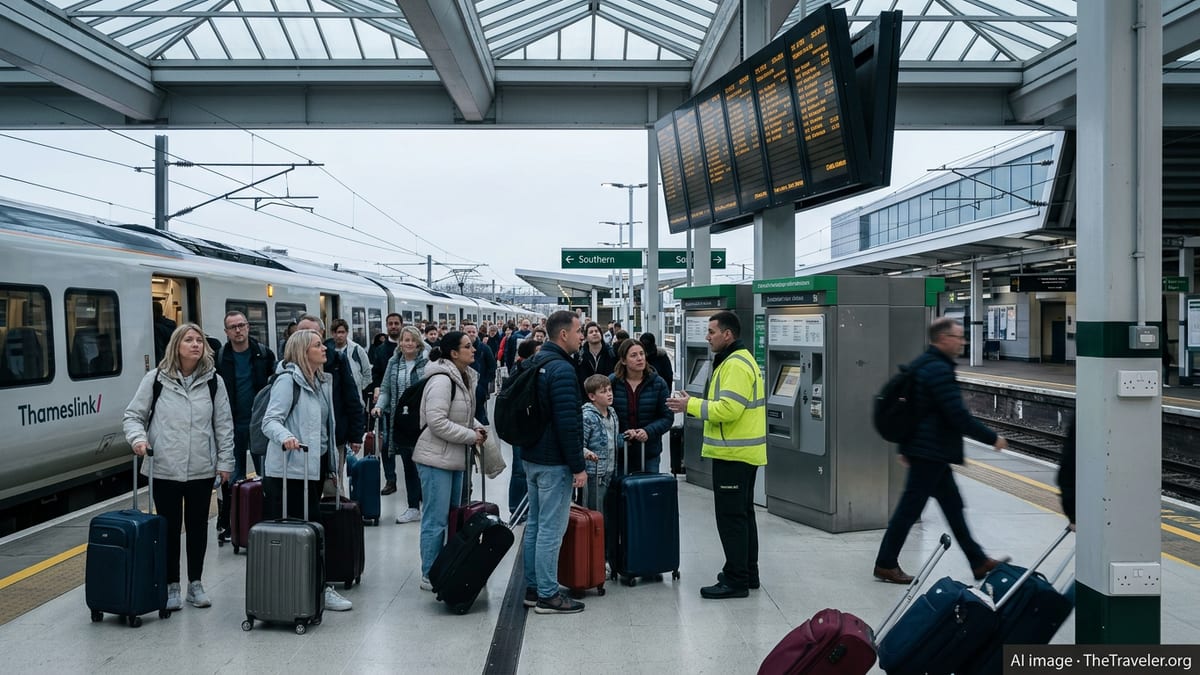
Rail Operators Brace for Surge in Displaced Air Travellers
With airspace closed or restricted over large parts of the Middle East and Gulf hubs struggling to clear backlogs of stranded passengers, UK airports are seeing a volatile pattern of late-night arrivals, sudden cancellations and emergency repatriation flights. Aviation analysts estimate that nearly 25,000 flights across the region have been cancelled since hostilities flared on 28 February, sending shockwaves through Europe to Asia corridors and pushing some long-haul passengers to complete their journeys by rail once they reach Britain.
Southern and Thameslink, which serve Gatwick, Luton and key London interchanges, have begun treating the air disruption as a de facto civil contingency event. Passenger information teams have been briefed to expect higher volumes of fatigued long-haul travellers arriving without onward plans, while control rooms are coordinating closely with airport station staff to extend support where possible during late-running evening services.
Industry sources say National Rail Enquiries has also been updating guidance to frontline staff on how to assist passengers arriving from repatriation flights, including those whose baggage has been delayed or who face missed connections to regional UK cities. While rail operators are not legally responsible for disrupted air itineraries, they are under pressure from ministers and passenger groups to avoid compounding an already chaotic travel picture.
Thameslink, which connects Luton Airport Parkway and Gatwick Airport with central London and the Midlands, is understood to be prioritising additional staff presence at airport stations during peak arrival waves flagged by airport operations teams. Southern is adopting a similar stance on key coastal and commuter routes that typically absorb overspill from Gatwick when major aviation disruption occurs.
Enhanced On-the-Ground Assistance for Stranded Passengers
The immediate focus for Southern and Thameslink has been practical, low-friction help at stations for passengers who have just endured multi-day detours, unexpected hotel stays and last-minute government charter flights out of the region. Staff are being instructed to proactively identify confused or distressed travellers and help them navigate ticketing, route options and real-time disruption on the rail network.
At Gatwick Airport station, staff have been given updated briefing notes on the Middle East situation and its impact on flight schedules, including the UK government’s rolling programme of repatriation flights from Oman, Jordan and Saudi Arabia. This allows them to anticipate waves of arrivals following government charters or diverted commercial flights and to pre-position crowd-management and information staff on the concourse and platforms.
Rail managers say they are placing particular emphasis on clear, calm communication and wayfinding. Many passengers stepping off late-night arrivals now face additional complexity such as closed Underground lines, reduced overnight rail services and the need for last-minute hotel or taxi arrangements. Southern and Thameslink teams have been told to work closely with station partners, including airport authorities and contracted security staff, to prevent bottlenecks at ticket gates and information points.
While the operators have not announced free travel schemes, they are encouraging staff to use discretion in signposting the most economical rail options for groups and families and to ensure that passengers are aware of off-peak and railcard discounts when they apply. Airport station teams have also been reminded of protocols for supporting vulnerable passengers, including those experiencing anxiety after difficult evacuations.
Critical Support for Vulnerable and Disabled Travellers
The sudden shift from air to rail has highlighted longstanding concerns about how well the UK transport system serves disabled, elderly and otherwise vulnerable passengers during crises. Southern and Thameslink, which share an established assisted travel framework, have activated what one manager described as a more “urgent and flexible” use of existing accessibility policies to respond to the current disruption.
Through pre-booked assistance services, including the industry-wide Passenger Assist scheme, the operators are coordinating with other train companies to arrange staff help for passengers who may be arriving from the Middle East with mobility issues, sensory impairments or mental health conditions exacerbated by the conflict and extended travel. Call centres have been briefed to treat last-minute assistance requests linked to emergency repatriations as a priority even when they fall outside normal booking windows.
Station staff at key interchanges such as London Bridge, St Pancras International and East Croydon have been reminded of procedures for providing ramps, boarding support and escorted transfers between platforms, as well as quiet waiting areas for those overwhelmed by crowds. Operators are also reinforcing internal guidance on compassionate handling, recognising that some travellers may be returning from conflict zones or family emergencies.
Advocacy groups have long argued that in major international crises, disabled passengers are at disproportionate risk of being left behind by fragmented transport systems. Rail industry figures say the current situation is testing recent improvements in accessibility training and processes, and that feedback gathered during this episode will be fed into future revisions of assisted travel policies across the Southern and Thameslink networks.
Pressure Grows as Government Repatriation Flights Land
The first UK government-chartered evacuation services from the Middle East have now begun arriving at airports including London Stansted and Heathrow, adding a new layer of unpredictability for ground transport planners. These flights are carrying passengers who often have no checked baggage, limited cash and little advance notice of when or where they will land, placing additional strain on local public transport connections.
Southern and Thameslink are liaising with the Department for Transport and airport authorities to receive approximate manifests and arrival timings where security rules allow. This enables them to consider small tactical measures such as holding certain late-evening trains for a few minutes to allow groups of evacuees to board, or reallocating staff to help manage sudden surges in footfall at interchange stations on affected nights.
At the same time, rail planners are constrained by existing engineering works and the need to preserve reliability for regular commuters and domestic leisure travellers. Overnight and weekend maintenance programmes on busy corridors like the Brighton Main Line and the Midland Main Line leave limited room for extra services, meaning operators must instead focus on smoother transfers and clearer communications rather than wholesale timetable changes.
Government officials say they expect further repatriation flights in the coming days as airspace restrictions across the region continue and commercial carriers struggle to restore normal schedules. Each additional charter is likely to feed more displaced passengers into the rail system at short notice, sustaining pressure on operators throughout March.
Escalating Global Disruption Hits UK Travel Planning
The wider aviation fallout from the Middle East war is reshaping travel choices far beyond the immediate crisis zone. As Gulf super-hubs in Dubai, Abu Dhabi and Doha operate on reduced or intermittent schedules and airlines reroute away from airspace over Iran, Iraq and neighbouring states, passengers are scrambling to rebook via Europe, Central Asia or southern routes over the Arabian Sea. This has led to sharp fare increases on remaining corridors and extended journey times of up to two hours on some Europe Asia flights.
For UK travellers, the impact is twofold. Those already abroad face uncertainty about when they will be able to fly home and on which carriers, while those yet to depart are rethinking itineraries, avoiding routings via the Middle East and in some cases cancelling or postponing trips altogether. Travel agents report a pivot towards itineraries that connect via Istanbul, Rome, Delhi or Singapore rather than Gulf hubs, which in turn redistributes arrival patterns across UK airports.
The knock-on effect for Southern and Thameslink, both of which serve major London gateways used by long-haul carriers, is an increasingly erratic demand profile. Rather than stable peaks tied to scheduled departures and arrivals, rail demand now mirrors the jagged curve of last-minute flight changes, diversions and emergency government charters. That volatility is likely to persist as long as regional airspace remains heavily restricted and airlines continue to adjust schedules on a daily basis.
Transport planners say the current episode underlines how deeply intertwined UK rail and global aviation have become, particularly in the South East of England where airport stations sit at the heart of commuter networks. As the conflict and its aviation repercussions evolve, Southern and Thameslink will be under continued scrutiny from passengers and regulators alike to maintain resilience, protect vulnerable travellers and keep Britain moving amid one of the most disruptive air travel crises in recent years.