

More news on this day
The UK’s Marine Accident Investigation Branch has issued a damning final report on Saga Cruises’ Spirit of Discovery, finding serious shortcomings in voyage planning, bridge decision-making and onboard medical care during a violent Bay of Biscay storm in November 2023 that left one passenger dead and more than 100 injured.
Get the latest news straight to your inbox!
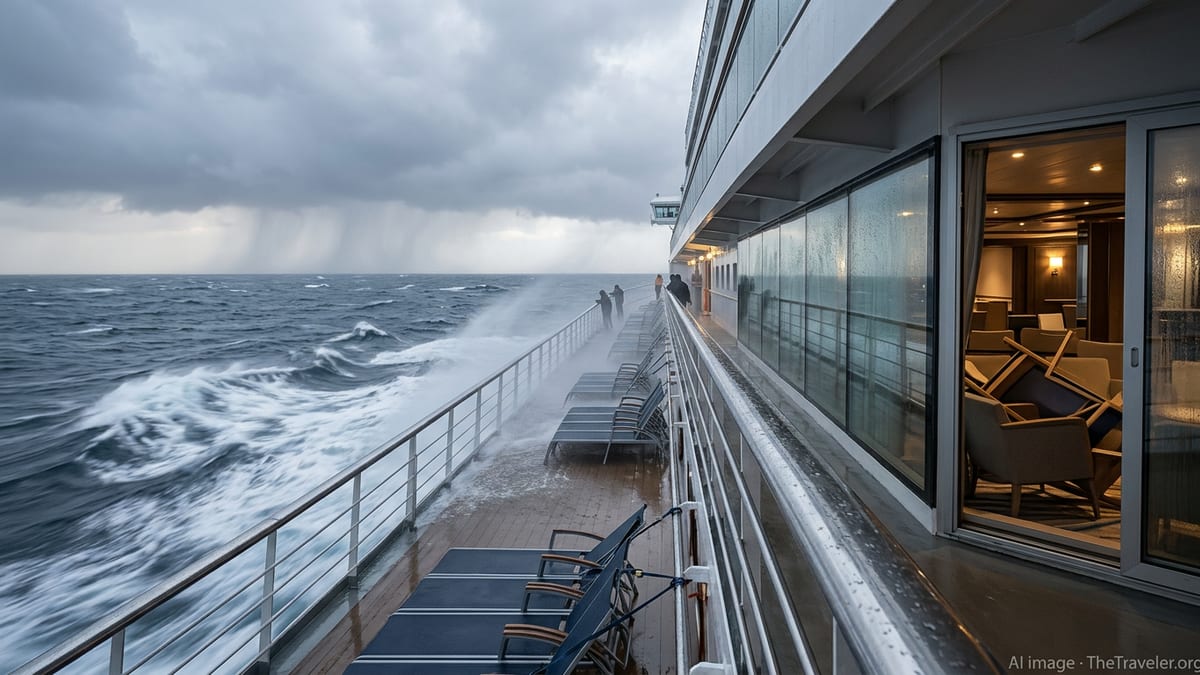
Report Details Chain of Failures in Violent Storm
The report, published on 11 March 2026, reconstructs how Spirit of Discovery encountered storm-force conditions in the Bay of Biscay on 4 November 2023 during a return voyage to the UK. The ship lost propulsion in heavy seas, triggering violent rolling as engineers worked to restore power while the vessel was effectively adrift.
Investigators describe a complex sequence of technical and operational events that exposed passengers, many of them older travellers, to extreme motions for hours as the ship rode out the storm. The loss of propulsion, combined with force 11 winds and very high seas, caused furniture to move, passengers to be thrown to the deck and public spaces to become hazardous.
More than 100 passengers were injured during the incident, several of them seriously. One passenger, 85-year-old Trevor Gilks, suffered severe spinal injuries when his high-backed armchair toppled, and he later died in hospital. The Marine Accident Investigation Branch classed the case as a very serious marine casualty because of the fatality and the scale of injuries.
The agency stresses that cruising remains statistically safe, but says the accident highlights how quickly conditions can deteriorate when a large passenger ship loses propulsion in extreme weather and when protective measures for passengers are not fully effective.
Decision to Cross Bay of Biscay Under Scrutiny
Central to the report’s criticism is the decision by the ship’s command and supporting shore teams to proceed with a Bay of Biscay crossing despite widely publicised storm forecasts linked to Storm Ciarán’s aftermath. Investigators found that prevailing and predicted conditions in the area included severe gale to storm-force winds and very high seas on the planned route.
The report concludes that the master’s decision to continue across the Bay of Biscay was not effectively challenged either on the bridge or by company shore-based staff. According to the Marine Accident Investigation Branch, internal discussions did not sufficiently explore more conservative options such as delaying the transit, diverting earlier or adopting a route that avoided the worst of the storm.
Safety investigators say this points to weaknesses in the company’s safety management system, particularly around how bridge teams and shoreside operations jointly assess weather risks and empower officers to question or escalate concerns about voyage plans. The report urges cruise operators to reinforce a culture in which challenging a proposed plan in adverse weather is encouraged and clearly supported.
While acknowledging commercial pressures and schedule considerations, the Marine Accident Investigation Branch notes that passenger safety must remain the overriding priority when forecasts point to rapidly worsening conditions on open-ocean crossings used by cruise traffic.
Medical Response Found Suboptimal After Passenger Injuries
The report is particularly critical of the medical response provided to the fatally injured passenger once the worst of the storm had passed and the ship was heading back toward the UK. Investigators found that diagnostic efforts and subsequent treatment did not meet the standard expected for a suspected serious spinal injury.
According to the findings, initial X-rays taken on board were inconclusive, and a consulting radiologist recommended further imaging to clarify the extent of possible cervical spine damage. Those additional images were not obtained, and the passenger was moved to a bed rather than being fully immobilised on a spinal board, a step the report says could have offered better protection against further harm.
The Marine Accident Investigation Branch concludes that the combination of incomplete imaging and inadequate spinal precautions amounted to suboptimal care that may have affected the passenger’s outcome. It emphasises that cruise ships carrying large numbers of often elderly travellers must be prepared to manage complex trauma cases until shore-based hospital care is available.
In response, the report issues recommendations aimed at strengthening medical protocols, training and decision-making standards in cruise ship infirmaries, with a particular focus on suspected head and spinal injuries following slips, falls or violent ship motions.
Cruise Line Accepts Recommendations but Disputes Conclusions
Saga Cruises, which owns and markets Spirit of Discovery, has publicly stated that it accepts the Marine Accident Investigation Branch’s safety recommendations and has already introduced a series of operational and medical changes across its fleet. These include revised severe-weather operating limits, enhanced procedures for securing public spaces and additional training for bridge and medical teams.
However, the company also signalled that it disagrees with some of the investigation’s conclusions, particularly around the assessment of the bridge team’s judgment and the characterisation of the medical response. Saga maintains that crew members acted in good faith based on the forecasts and information available at the time and that they worked tirelessly during and after the storm to care for passengers.
The report notes that the ship’s propulsion and safety systems have since been modified in consultation with manufacturers to reduce the risk of a similar loss of power in extreme conditions. Saga has also reiterated that it operates to high safety standards and that serious incidents of this kind remain rare across the cruise sector.
Despite those assurances, the findings are likely to prompt renewed scrutiny of how older-passenger specialist lines balance ambitious itineraries with the vulnerabilities of their typical guest profile when planning late-autumn and winter sailings through storm-prone regions.
Industry-wide Lessons on Weather Risk and Stability Monitoring
Beyond the actions of a single cruise line, the Marine Accident Investigation Branch report sets out wider lessons for the international cruise industry. It highlights the need for more conservative weather thresholds on itineraries that cross known storm tracks, as well as more robust systems for monitoring ship motions in real time.
Among its recommendations, the agency calls for the mandatory installation of electronic devices on cruise ships capable of continuously measuring stability-related parameters and vessel motions. Such data, it argues, would give bridge teams clearer insight into the forces acting on a ship in heavy weather and help inform decisions about speed, heading and passenger safety measures.
The report also urges operators to review how quickly they restrict access to public areas, secure loose furniture and instruct passengers to remain in cabins when forecasts indicate that severe rolling or pitching is likely. On Spirit of Discovery, many injuries occurred when passengers were still moving around lounges and public spaces as conditions worsened.
Regulators and safety experts say the incident underlines the importance of learning from near misses and serious casualties alike, particularly as climate change is expected to influence storm patterns and intensity in North Atlantic cruising grounds frequented by British and European passengers.