

More news on this day
European governments are escalating urgent sea evacuation efforts across the Gulf after a fast-moving Middle East crisis left thousands of cruise passengers and other travelers stranded in ports from the United Arab Emirates to Saudi Arabia, Qatar, Kuwait and Bahrain.
Get the latest news straight to your inbox!
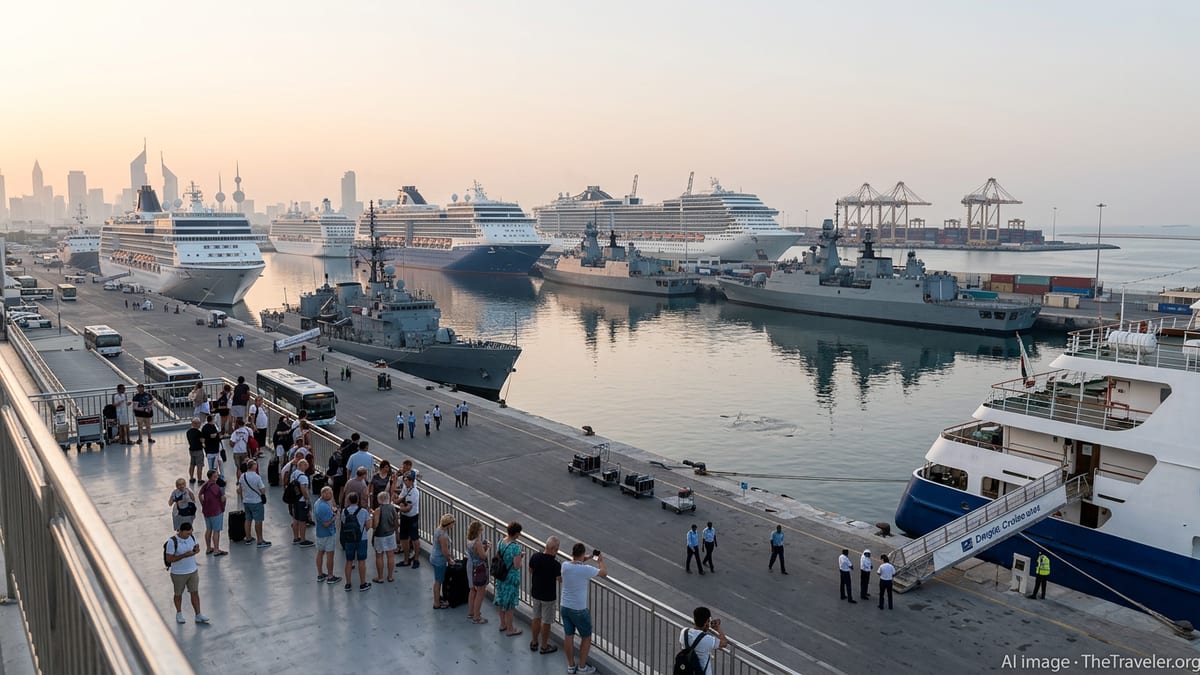
Escalating Security Fears Choke Gulf Travel
The latest surge in tensions around Iran and the Strait of Hormuz has rapidly reshaped travel and maritime movements across the Gulf. Publicly available advisories from port agents and shipping firms show that while the strait has not been formally closed, heightened military risk and company-level directives have sharply reduced traffic, with many vessels avoiding the narrow waterway altogether.
Middle East port circulars issued in early March describe a patchwork of restrictions. Jebel Ali in the United Arab Emirates, one of the region’s busiest container hubs, has seen operations suspended, while Bahrain has halted port activities amid reports of explosions near anchored tankers and attacks on commercial vessels. Some Saudi ports remain open, but carriers are rerouting or holding ships at anchor as they reassess risk.
At the same time, airspace closures across multiple Gulf states have triggered widespread flight cancellations. Customer advisories from airlines and logistics providers indicate that scheduled services to and from the UAE, Bahrain, Kuwait and Qatar have been suspended for periods, cutting off the usual route for tourists and residents trying to exit the region quickly.
These overlapping closures have created a bottleneck for travelers in major Gulf destinations. Cruise ships that had been operating winter itineraries in the Persian Gulf now find themselves holding position in port or loitering near safer anchorages, with thousands of passengers unable to disembark onward as planned.
Thousands of Cruise Passengers Caught in Port Lockdowns
The evolving crisis has had an acute impact on cruise tourism, a sector that had expanded rapidly in the Gulf in recent seasons. Coverage of the 2026 Strait of Hormuz crisis describes at least six large cruise ships forced to curtail operations in the region, including vessels based in Saudi Arabia and European-owned ships that had been offering itineraries linking Dubai, Doha and Manama.
Reports shared by cruise-tracking communities and travel forums suggest that some ships, including major European brands, have been held alongside in ports such as Dubai while operators wait for safe corridors or alternative itineraries. Others have diverted to less exposed harbors on the Arabian Sea, including ports in Oman, to keep distance from the most volatile chokepoints.
Passengers on board face an unusual mix of disruption and relative comfort. While ships remain fully provisioned and able to maintain hotel operations, the inability to disembark freely or travel onward has turned vacations into open-ended stays at sea. With regional airspace restricted, even those able to leave their vessels in safer ports may struggle to find flights back to Europe or other home countries.
Travel industry analysts note that this episode underscores the vulnerability of cruise operations in politically sensitive waters. The Gulf had marketed itself as a sun-drenched alternative to Caribbean routes, but proximity to key energy corridors and military flashpoints has now become a central operational risk.
UK Joins European Partners in Naval Evacuation Efforts
In response to the worsening situation, European governments are leaning more heavily on their naval assets in and around the Gulf. Following earlier moves by France, Germany, Italy, the Netherlands, Spain, Portugal and other European Union states to dispatch frigates and support ships to safeguard commercial traffic, the United Kingdom is now preparing its own seaborne evacuation options for nationals stranded in the region.
Publicly available information on European defense deployments indicates that several states have reinforced an existing multinational maritime security presence from the Red Sea to the Gulf of Oman. French officials recently outlined an expanded escort mission for merchant shipping, while German, Italian, Dutch, Spanish and Portuguese vessels have been reported moving into key sea lanes to provide additional surveillance and, where necessary, convoy support.
In London, government briefings and parliamentary statements have highlighted a growing focus on the welfare of British nationals in Gulf states, particularly in the UAE, Qatar, Bahrain and Kuwait. Earlier contingency plans centered on charter flights and potential land routes through Saudi Arabia, but with airspace closures enduring and overland options constrained, sea lift is gaining prominence in planning.
Analysts observing Royal Navy posture in the region note that the UK’s longstanding logistics footprint in Bahrain and air bases in the UAE and Qatar provide staging points for larger ships to embark passengers. While specific sailing schedules are not publicly detailed, the shift in language around “any options” to secure the Strait of Hormuz and nearby waters has been interpreted as paving the way for dedicated evacuation voyages if commercial routes do not reopen quickly.
Airspace Shutdowns Push Evacuation Plans to the Sea
The pivot toward seaborne evacuations is directly tied to the unprecedented scale of airspace restrictions across the Gulf. Port and aviation advisories circulated in early March record the temporary suspension of flights to and from major hubs including Dubai, Abu Dhabi, Doha, Manama and Kuwait City as authorities reacted to missile and drone activity linked to the Iran conflict.
Logistics providers describe a sharp rise in uncertainty, with ships slowing, diverting to alternative ports outside the Gulf, or pausing at anchor while waiting for updated security guidance. For travelers, the effect is visible in crowded terminals, rebooked tickets and, in many cases, a complete lack of clear onward options. Online travel forums feature accounts from passengers whose connections through the Gulf were abruptly canceled, leaving them stranded without immediate replacement flights.
European capitals have increasingly treated this aviation standstill as more than a short-term disruption. Planning documents and public commentary point to scenarios in which commercial flights may remain limited for weeks, forcing governments to rely on military transport planes operating from safer third countries, combined with sea-based transfers from ports deemed less risky.
For cruise passengers in particular, this means that their route out of the region may involve a combination of ship-to-shore tendering, bus convoys to secondary ports, and eventual boarding of naval or chartered vessels. The complexity and time required for such operations highlight why several governments, including the UK, are signaling preparations well before any large-scale embarkations begin.
Travel and Shipping Industries Brace for Prolonged Disruption
The unfolding evacuations are part of a wider shock to global travel and trade tied to the Strait of Hormuz crisis. Shipping advisories from major lines reveal temporary suspensions of cargo bookings in and out of the UAE, Oman, Iraq, Kuwait, Qatar, Bahrain and parts of Saudi Arabia, citing crew safety and insurance limitations. Some container and tanker operators are re-routing via longer sea lanes around the Arabian Peninsula, adding days or weeks to transit times between Europe and Asia.
Travel experts warn that the knock-on effects will extend well beyond the Gulf. With cruise itineraries canceled, flights rerouted or grounded, and freight networks reconfigured, both leisure travelers and business passengers face higher costs and more complex journeys. Ports in neighboring countries such as Oman are already experiencing increased traffic as carriers seek alternatives that avoid the most exposed sections of the Gulf.
Tourism boards in Gulf states, which have invested heavily in cruise terminals, beachfront resorts and mega-events to attract visitors, may now confront a difficult season. The image of passengers trapped on ships in Dubai or unable to fly from Doha and Manama runs counter to years of marketing that emphasized seamless connections and modern infrastructure.
For now, the focus of European governments, including the UK and its partners France, Germany, Italy, the Netherlands, Spain and Portugal, is on safely extracting their citizens and stabilizing maritime routes. How quickly regular tourism can return to the Gulf will depend on security developments, the reopening of airspace and the confidence of cruise lines and travelers to once again sail through one of the world’s most contested waterways.