

More news on this day
The United Kingdom has entered a new era of border control, enforcing digital travel permission from February 25, 2026, for citizens of 85 visa-exempt countries, with airlines now legally required to deny boarding to passengers who lack an approved Electronic Travel Authorisation or other valid permission to travel.
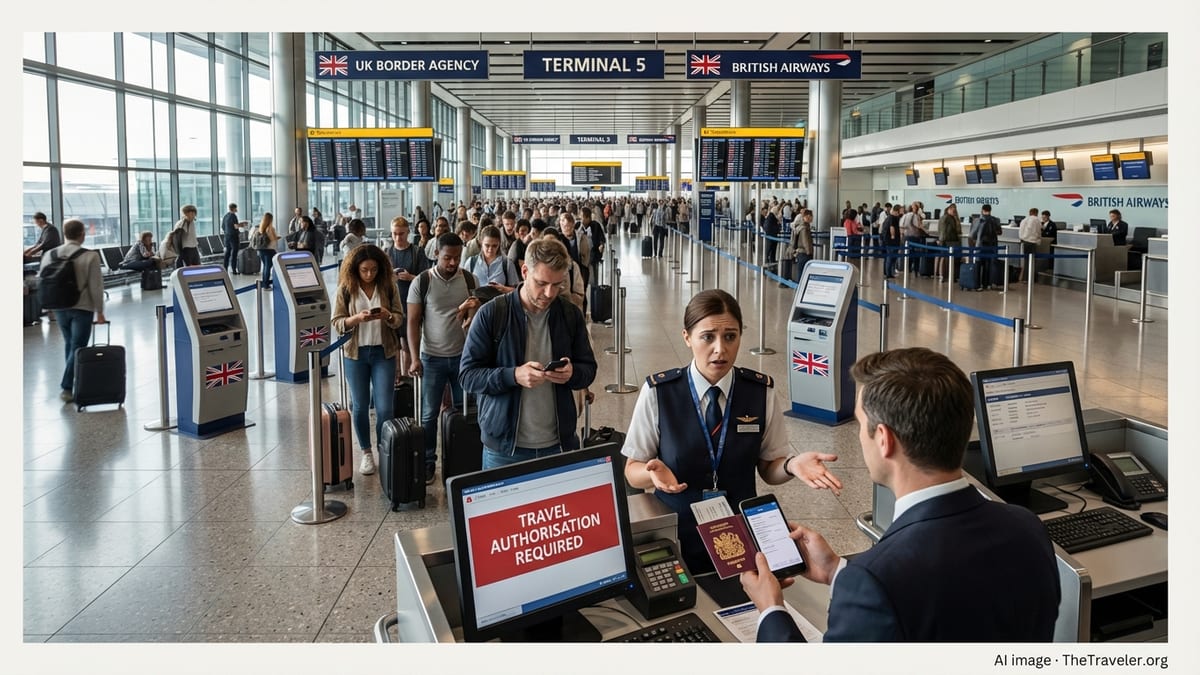
From Visa-Free to Digital Gatekeeper
The core of the change is the UK’s Electronic Travel Authorisation, or ETA, a low-cost digital permit that has shifted from soft rollout to full enforcement. Until now, many travellers from the United States, Canada, Australia, Japan and most European countries could simply arrive in the UK with a valid passport and clear border control on arrival. That era has ended.
From February 25, 2026, most non-visa nationals must hold an approved ETA, an eVisa or another recognised immigration status before they even board a plane, ferry or international train bound for the UK. The Home Office has made clear that carriers are now on the front line, with check-in systems required to confirm that each eligible traveller holds valid digital permission linked to their passport.
The ETA costs £16, is applied for online or via the official app, and usually returns a decision within minutes, though authorities advise allowing up to three working days in case of additional checks. Once granted, it is valid for multiple short stays over two years, or until the traveller’s passport expires, whichever comes first.
Officials present the scheme as the final step in a phased transition to a fully digital immigration system, aligning the UK with comparable pre-travel screening programmes already operating in the United States, Canada and soon in the European Union.
Who Is Affected – And Who Is Exempt
The new rules apply to citizens of 85 visa-exempt countries who previously did not need a visa for short visits to the UK. This group includes nationals of the United States, Canada, France and other EU member states, along with countries such as Australia, Japan, South Korea, Brazil, the United Arab Emirates and Saudi Arabia.
Every traveller from these countries, including children and infants, must now hold their own ETA or other recognised permission to travel. An ETA allows stays of up to six months for tourism, family visits or short business trips, mirroring the conditions that applied under the previous visa-free regime but adding a mandatory layer of pre-clearance.
There are limited exemptions. British and Irish citizens do not require an ETA, reflecting existing rights under UK law and the Common Travel Area. However, recent Home Office guidance has underlined that British dual nationals must travel on a British passport or hold a Certificate of Entitlement to the right of abode; they are not eligible for an ETA and may be refused boarding if they cannot prove their status.
Transit rules are more nuanced. Passengers who remain strictly airside in some UK airports may not need an ETA, but those who pass through passport control or use the UK as a formal entry point to continue their journey will fall under the new requirement and must secure permission in advance.
Airlines on the Hook: Fines for Boarding Without Permission
For airlines and other carriers, the policy shift is stark. Under an expanded civil penalty regime, operators face fines if they transport passengers who arrive in the UK without the required documentation, now explicitly including digital permissions such as ETAs and eVisas.
Historically, carriers could be penalised for bringing inadequately documented passengers, such as those lacking a valid passport or visa. The new rules extend that responsibility to include verifying a traveller’s digital status in real time. Check-in systems are integrated with Home Office databases so that, where no permission is found, boarding passes cannot be issued.
Industry guidance circulated in recent weeks has warned carriers that, from the enforcement date, there is effectively no room for discretion. An airline that allows an ETA-eligible passenger to travel without permission risks a civil penalty of up to £2,000 per individual, on top of the cost and disruption of returning them to their point of origin.
The result is a sharp change in where travel disruption is likely to occur. Problems that once surfaced in the UK’s arrival halls are now much more likely to be felt at departure gates around the world, with passengers turned away long before they see a British border officer.
Practical Risks for Travellers: Last-Minute Chaos Looms
For travellers, the most immediate risk is simple: turning up at the airport without realising that a passport alone is no longer enough. Because carriers must check digital permission before boarding, an overlooked ETA application can mean being denied travel altogether, even when a trip is fully paid and bags are packed.
The Home Office insists that the vast majority of ETA requests are approved quickly, but warns that a small percentage require additional security or criminality checks that can take longer. Travel advisers are now urging visitors to apply several days before departure, particularly for peak holiday seasons or major events when processing volumes rise.
The scheme also carries hidden pitfalls. An ETA is tied to the passport used in the application; if a traveller renews or replaces their passport, the existing authorisation does not transfer and a fresh ETA is needed. Families and frequent business travellers are being cautioned to double-check that every member of their party, including infants, holds valid permission connected to the passport they present at check-in.
Even those only passing through the UK on connecting flights are advised to examine their itineraries carefully. Depending on ticketing and airport layout, a “simple” connection could involve formally entering the UK, in which case an ETA becomes mandatory despite the traveller’s ultimate destination lying elsewhere.
A Tighter, More Digital Border – But At What Cost?
The UK government argues that full ETA enforcement will enhance border security, keep high-risk individuals from travelling in the first place and support a shift to contactless border checks. Officials point to the revenue raised from application fees and promise that it will be reinvested in modernising the immigration system and reducing queues at major hubs such as Heathrow, Gatwick and Manchester.
Critics, however, warn of confusion and uneven communication as the deadline takes effect. Although the scheme has been in phased rollout since 2023, many occasional travellers are only now learning of the requirement through media coverage and airline reminders. Consumer groups say that, without a broad public information push, there is a real prospect of families discovering the rules for the first time at the check-in desk.
Travel industry figures are also watching closely for early signs of disruption. While digital authorisation programmes are now standard in global travel, implementation missteps can lead to queues, system slowdowns and inconsistent advice between carriers. For the moment, the UK is betting that its technology and communications have matured enough to avoid widespread chaos.
For anyone planning a trip, the message is blunt: in the UK’s new system, “no permission, no travel” is not a slogan but a legal reality. The question for would-be visitors from 85 countries is no longer whether they need an ETA, but how early they are prepared to apply to make sure an unexpected glitch does not leave them grounded.