

More news on this day
British travellers face a more complex trip to Europe from April 2026, as Italy is highlighted alongside Hungary, Germany, Sweden, Poland, Switzerland and the Netherlands in updated UK travel advice tied to tougher security checks, new digital border controls and looming visa-style authorisation rules across the Schengen area.
Get the latest news straight to your inbox!
Heightened Security Focus Across Key Schengen Destinations
Publicly available UK guidance now clusters Italy with a group of European countries already subject to heightened security attention, reflecting wider concerns about terrorism risk, politically motivated unrest and large-scale public events across the continent in 2025 and 2026. Existing advisories for destinations such as Germany, Sweden, the Netherlands, Poland, Switzerland and Hungary already highlight the possibility of attacks in crowded public places, transport hubs and tourist sites, and Italy is increasingly framed in similar terms for travellers planning city breaks and summer holidays.
Reports indicate that recent updates emphasize situational awareness rather than deterring travel altogether. The language continues to stress that millions of visits pass without incident, but it underlines that security alerts, temporary closures and visible policing may be more frequent, particularly around major transport nodes and historic centres in Rome, Milan, Florence and Venice. Travellers are being urged to build flexibility into itineraries, allow additional time for security checks and monitor local announcements during their stay.
This re-framing of Italy within a broader high-alert group does not in itself create new legal barriers to entry, but it does signal that risks once perceived as isolated to a small number of states are now being treated as a shared European challenge. For British visitors, the effect is that more of the continent’s most popular holiday destinations are covered by similar cautions on crowded spaces, political demonstrations and short-notice changes to security postures.
Entry/Exit System Fully Digitises Schengen Borders In April 2026
The most immediate structural change for non-EU visitors, including those from the UK, is the European Union’s Entry/Exit System, set to be fully operational at all external Schengen border crossing points by 10 April 2026. The system, which began a phased launch on 12 October 2025, replaces manual passport stamping with a centralised digital record of each traveller’s entry and exit, capturing passport data as well as biometric identifiers such as facial images and fingerprints for most third-country nationals.
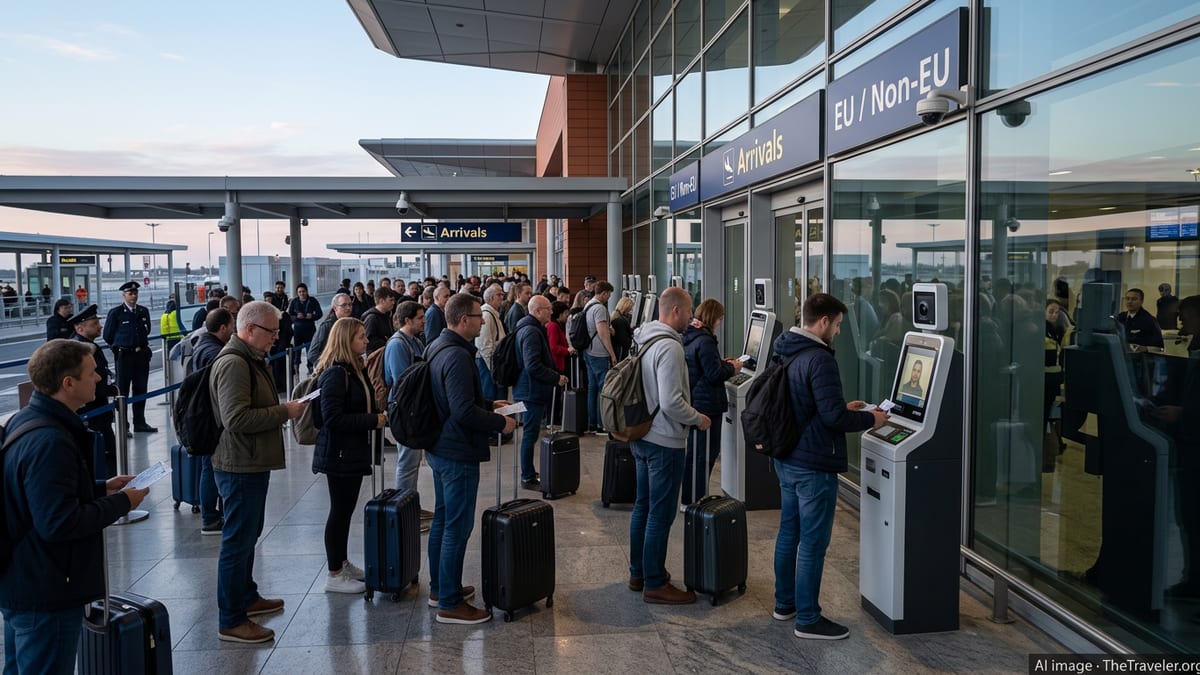
For British travellers heading to Italy or other Schengen destinations, this means that from April 2026 passport control will typically involve a biometric enrolment at first entry into the zone, often at dedicated kiosks or staffed booths. Once registered, subsequent crossings are expected to be processed more quickly, but the initial rollout period is likely to bring queues and longer processing times, especially at peak holiday seasons and busy land crossings between the UK and continental Europe.
The digitalisation of border checks is designed to improve enforcement of the 90 days in 180 rule that governs short stays for visa-exempt nationals after Brexit. The new system will automatically track time spent within the Schengen area, making it significantly harder to overstay unnoticed. Travellers are being advised to keep personal records aligned with the official 90/180 calculation, as disputes at the border will be resolved by reference to the Entry/Exit database rather than physical passport stamps.
Although the change is framed as a security and migration-management measure, it tangibly alters the arrival experience. Airports in Italy, France, Spain, Germany and beyond have been upgrading terminals, testing kiosks and training staff ahead of the April deadline, and infrastructure readiness is expected to vary. Early reports from the initial rollout phase suggest that some crossings process passengers swiftly, while others are still adjusting to the new technology, a difference that could shape UK travellers’ choice of routes and hubs.
New Passport Expectations For UK Travellers To Italy And Beyond
Alongside the Entry/Exit System, British visitors to Italy and other Schengen states face reinforced passport validity expectations that, while not entirely new, are being stressed more prominently in official guidance and consumer reporting. Post-Brexit, UK passports must generally be less than 10 years old on the date of entry and have at least three months’ validity remaining after the intended date of departure from the Schengen area, and many travel providers are now recommending a six-month buffer to avoid problems.
Travel industry briefings highlight that mismatches between passport issue dates, printed expiry dates and airline check-in rules have already led to denied boarding for some UK travellers. With the move to digital exit records from April 2026, carriers and border guards are expected to rely more consistently on harmonised rules, reducing the scope for leniency at check-in or on arrival. Advisers are urging travellers to renew passports well in advance of busy travel periods, particularly for Easter and early summer trips that will coincide with the full switch to Entry/Exit.
Travellers are also being reminded that minor differences between machine-readable data, expiry dates and booking details can delay processing in a more automated environment. Names, dates of birth and document numbers are now tied into multiple systems, from airline passenger records to European border databases, and discrepancies may trigger manual review. As the new technology beds in, passengers heading for Italian airports could encounter additional questioning if anything in their documentation appears inconsistent.
The tightening of expectations is especially relevant for those accustomed to last-minute weekend breaks or cross-border road trips from the UK into mainland Europe. With digital logs replacing passport stamps, it becomes more important for travellers to verify that previous trips and stays have not already used much of their 90-day allowance, a consideration that will affect long-term Italy fans who combine several short visits across a single year.
ETIAS And Visa-Style Authorisation Still Looming In The Background
Beyond April 2026, the most significant looming change for British, American and other visa-exempt travellers remains the long-delayed European Travel Information and Authorisation System, widely known as ETIAS. After repeated postponements, European institutions and specialist travel publications now converge on a timeline that would see ETIAS launch in the final quarter of 2026, with enforcement only becoming mandatory several months later, likely in 2027, following a transition and grace period.
ETIAS is not a traditional visa, but a pre-travel security screening similar to systems already used by the United States and the United Kingdom. Once operational, it will require most short-stay visitors from non-EU countries to complete an online application, pay a modest fee and receive an electronic authorisation linked to their passport before boarding transport to Italy or any other Schengen destination. For now, though, UK nationals travelling in early and mid-2026 continue to enter without this additional step, even as information campaigns begin to ramp up.
Analysts suggest that the UK’s own electronic travel authorisation scheme, progressively extended to more nationalities between 2025 and 2026, has influenced how British travellers perceive ETIAS. Many are already familiar with the idea of advance online clearance, biometric checks and carrier responsibility for verifying approvals at check-in. As a result, while ETIAS is likely to add administrative friction once in force, the concept may feel less disruptive than the initial shift to digital border controls taking effect in April 2026.
In the interim, the UK’s travel advisories for Italy, Germany, Sweden, Poland, Switzerland, Hungary, the Netherlands and other Schengen states increasingly refer to “upcoming changes” to border procedures and authorisations, even when exact start dates are still pending. This reflects an effort to prepare travellers for a layered system in which traditional passport checks, biometric enrolment, digital entry records and pre-travel approvals will all play a role in shaping the Europe trip experience.
Practical Impact On Spring And Summer 2026 Travel Plans
For British holidaymakers looking ahead to trips to Italy and neighbouring countries in spring and summer 2026, the combination of stricter advisories, the Entry/Exit System and passport rules translates into a need for earlier planning and more realistic timing. Travel insurers and consumer advocates are already urging passengers to factor in extra time at ports, airports and busy land crossings, particularly during school holidays and major events that could intensify both crowds and security vigilance.
Travel planners note that April 2026 sits at the intersection of several trends: the final switch from passport stamping to full digital border recording, continued emphasis on terrorism and public-order risks in crowded tourist cities, and the build-up to ETIAS. Italy’s inclusion in lists of states where the UK highlights elevated security considerations is likely to drive more questions from travellers, but industry voices generally stress that it remains a highly popular and accessible destination, provided visitors adapt to the new rules.
In practical terms, that adaptation means checking advisories shortly before departure, keeping passport details up to date, carrying proof of onward travel and accommodation where possible, and being prepared for biometric capture on first arrival in the Schengen area. While these steps may lengthen the journey slightly, they sit within a broader global trend toward more data-driven border security that is affecting travel in multiple directions between the UK and continental Europe.
As April 2026 approaches, Italy’s alignment with countries such as Germany, Sweden, Poland, Switzerland, Hungary and the Netherlands in UK guidance illustrates how security concerns and border-technology reforms are increasingly being treated as a shared European issue rather than a patchwork of national exceptions. For British travellers, the message is clear: Europe is still open, but entering and moving around the Schengen zone will look and feel more controlled than it did before.