

More news on this day
The United Kingdom has issued updated travel guidance for trips to continental Europe as Switzerland joins Romania, Germany, Italy, Poland, Hungary, Denmark and other Schengen states in rolling out full biometric registration at external borders, marking a significant shift in how UK and other non EU visitors are processed on arrival and departure.
Get the latest news straight to your inbox!
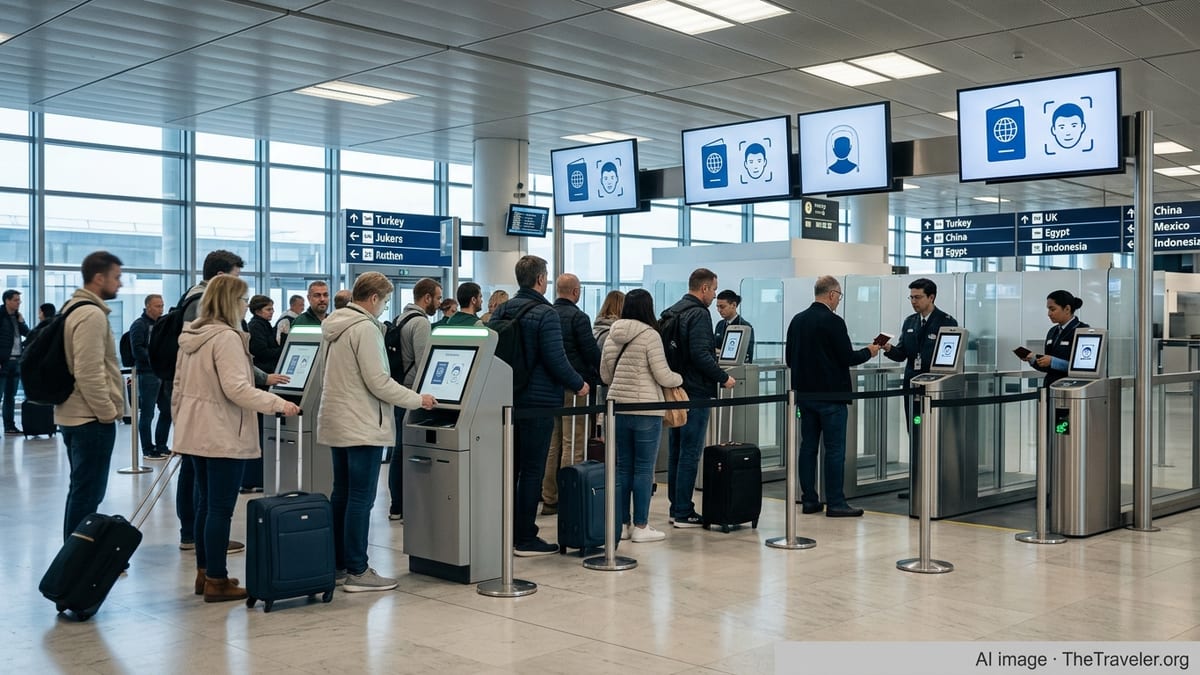
Schengen Biometric Border Checks Now Fully Live
The European Union’s Entry Exit System, a bloc wide biometric border database, has now moved from pilot phase to full operation across the Schengen Area’s external frontiers. Publicly available information from EU institutions indicates that the system completed its phased introduction on 10 April 2026 following an initial launch in October 2025, replacing manual passport stamping for most non EU and non EFTA visitors crossing into or out of Schengen countries.
Under the new regime, travellers from the United Kingdom and other non EU countries are required, on their first entry after the launch, to provide a facial image and fingerprints alongside passport data. These details are stored electronically and matched at subsequent crossings, with the stated aim of strengthening border security, verifying identities more reliably and enforcing the 90 day in 180 days stay rule that governs short visits to the Schengen zone.
Reports in European and British media highlight that Switzerland, already a Schengen member but outside the EU, is applying the same biometric procedures as its neighbours at airports and key land crossings. The change brings Swiss border posts into line with those of Romania, Germany, Italy, Poland, Hungary, Denmark and other participating countries that have been progressively switching on automated Entry Exit System hardware over recent months.
Travel analysts note that while the technology is designed to speed up repeat journeys once biometric profiles are captured, the first registration is more time consuming. Airports serving popular holiday destinations in Italy, Spain, France, Germany and now Switzerland are therefore advising non EU visitors to allow extra time, especially during school breaks and peak summer weekends when queues may lengthen.
UK Travel Advisory Highlights Longer Queues And Data Rules
The UK government’s latest travel advice for European destinations, updated in response to the Schengen biometric rollout, points to a higher likelihood of delays at border control for British passport holders. Public guidance summarised in domestic media emphasises that travellers should be prepared for lengthier checks during the first trip in which their fingerprints and facial image are recorded, and that children may also be asked to provide biometric data subject to local rules.
The advisory reiterates that UK citizens remain third country nationals in EU law following Brexit and are therefore fully subject to Entry Exit System registration when entering Schengen states from the United Kingdom, Ireland or other non Schengen territories. Travellers are reminded that overstaying the 90 day in any 180 day allowance could be more easily detected under the new system, potentially leading to fines, entry bans or other penalties according to national legislation.
Insurance providers and corporate travel managers are also updating their own guidance, advising customers to factor in possible congestion when planning connections through major European hubs such as Frankfurt, Munich, Zurich, Milan, Rome, Copenhagen and Warsaw. Some business travel briefings recommend longer minimum connection times for journeys that involve a Schengen border crossing between two flights, particularly where a terminal change is required.
Privacy and data protection considerations are receiving growing attention too. Official documentation on the scheme explains that biometric records are held for several years for compliant travellers and longer where overstaying or immigration violations occur. The UK advisory therefore encourages passengers to familiarise themselves with local data rights and to check how long their details may be retained within EU databases.
Switzerland Joins Wide Schengen Lineup Using New System
Switzerland’s inclusion among countries now using the Entry Exit System is being closely watched by UK travellers, given the popularity of Swiss ski resorts in winter and lakeside destinations in summer. As a Schengen member located outside the European Union, Switzerland participates fully in the shared border infrastructure, meaning the same biometric checks apply at Swiss airports and land borders as in neighbouring France, Italy, Germany and Austria.
Travel industry reporting indicates that the Swiss upgrade covers major entry points such as Zurich, Geneva and Basel Mulhouse airports along with key motorway crossings. For UK visitors driving from France or Italy into Switzerland, this means that biometric registration may first occur at a French or Italian port or airport and then be reused within the Schengen zone, rather than being repeated at each internal frontier.
Romania’s formal adhesion to the Schengen area for air and sea borders, alongside the long standing participation of Germany, Italy, Poland, Hungary, Denmark and others, has enlarged the geographical footprint of the new system. For UK holidaymakers, the practical effect is that more destinations within easy reach now share common biometric entry procedures that are closely linked through EU wide databases.
Airlines, rail operators and ferry companies serving Switzerland and other Schengen states are updating pre departure information to explain the changes, often warning that travellers who decline to provide biometrics could be refused boarding or denied entry. Some carriers are trialling additional pre screening questions in booking flows and check in apps so that passengers understand what will happen at border control on arrival.
Passport Validity And Reform: What UK Travellers Must Check
Alongside biometric registration, the UK’s tougher travel advisory reinforces existing passport validity rules that have caught out some passengers in recent years. Guidance distributed through travel agents and consumer media reiterates that Schengen countries typically require passports to be valid for at least three months beyond the planned date of departure from the Schengen area, and that documents must be less than ten years old on the date of entry.
The shift to electronic entry records means that the old practice of relying on physical passport stamps to calculate time spent in the Schengen zone is being phased out. Instead, Entry Exit System logs determine how many days a visitor has already used within the rolling 180 day window. Travel information sites are therefore urging UK citizens who make frequent short trips for work, family or second home visits to track their stays carefully and to renew passports in good time to avoid last minute problems.
Looking ahead, the European Travel Information and Authorisation System, commonly referred to as ETIAS, is expected to add an additional digital pre screening layer for visa exempt travellers, including most UK citizens. Public statements from EU bodies indicate that ETIAS will require an online application and fee in order to obtain travel authorisation before departure, with data cross checked against security and migration databases.
In combination, the new biometric border checks and forthcoming electronic travel authorisation are widely viewed as amounting to a structural reform of how non EU visitors, including UK nationals, access Schengen countries. For leisure travellers who plan ahead, the changes may eventually deliver smoother automated crossings, but in the near term the UK advisory signals that flexibility and extra time at the border will be essential.
Practical Tips Emerging From Early Rollout
Although implementation details can vary between airports and land crossings, a number of practical themes are emerging from early reports across Romania, Germany, Italy, Poland, Hungary, Denmark, Switzerland and other participating states. Passengers are commonly advised to remove hats and non prescription glasses before biometric capture, to keep travel documents ready and to travel together as a family or group when approaching border kiosks where possible.
Some airports have introduced dedicated lanes for travellers who have already completed biometric enrolment on a previous trip, aiming to separate first time registrations from faster follow up checks. Industry commentary suggests that this model could spread further across the Schengen zone, potentially restoring some of the pre 2025 processing speeds for regular visitors once the initial surge in enrolments has passed.
Transport operators are also urging travellers to pay close attention to airline communications in the days before departure, as local authorities may adjust staffing levels, queue management strategies or operating times for biometric booths at short notice in response to demand. For now, the UK travel advisory frames the Schengen changes as manageable but significant, encouraging citizens to stay informed and to treat border formalities as a more substantial part of any journey to or through Europe than in the past.