

More news on this day
British travellers heading to Switzerland, Romania, Poland, Italy, Iceland, Hungary and Denmark face a tougher set of rules from April 2026, as the UK government tightens its travel advisory in response to new biometric border checks across the Schengen area, evolving passport validity requirements and a looming shift toward online travel authorisations for short stays.
UK Travel Advisory Widens List of “Check Before You Go” Countries
Switzerland has been added to a growing cluster of European destinations singled out in updated UK Foreign, Commonwealth and Development Office guidance, which urges travellers to plan for longer border checks and stricter document screening from spring 2026. The latest notice groups Switzerland with Romania, Poland, Italy, Iceland, Hungary and Denmark, reflecting how rule changes in the wider Schengen area and its closely associated states will affect British passport holders transiting the continent.
The advisory does not warn against travel, but it does flag a step change in procedures at airports, ferry ports and rail terminals serving these routes. That includes an expectation that first-time visitors after the switchover will be held slightly longer at immigration while new biometric records are created, particularly at busy hubs in Italy, Switzerland and the Nordic region that handle large volumes of UK leisure and ski traffic.
Officials have paired the country list with broader messaging about “checking passports early” and leaving more time at ports of departure. This follows several months of test operations, during which British travellers have already encountered extra questions or manual processing at certain continental border posts ahead of the full digital system going live.
Biometric Entry/Exit System Fully Live by April 2026
The main trigger for the tougher tone is the European Union’s Entry/Exit System, a digital border database that records the time and place of entry and exit for non-EU nationals visiting the Schengen zone. After a phased introduction that began in October 2025, EU and UK sources now confirm that the scheme is due to be fully operational at all external Schengen border crossing points around 10 April 2026.
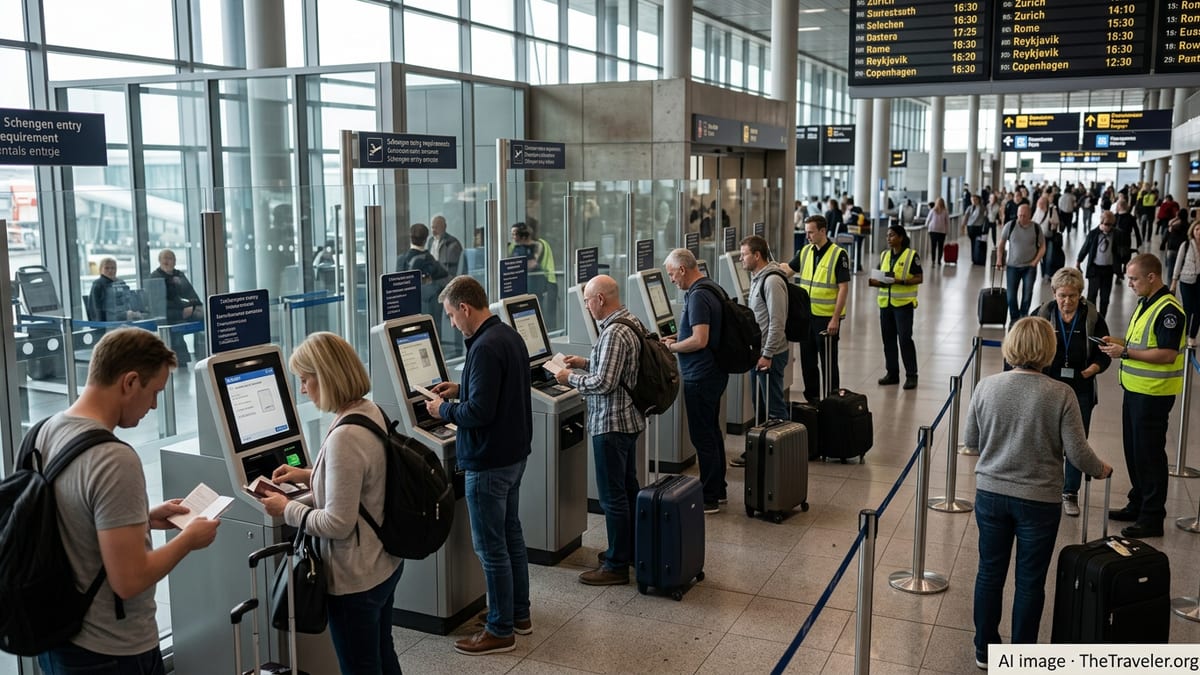
From that point, UK visitors arriving in Schengen countries such as Italy, Switzerland and Iceland, or entering via land and sea links through Denmark and Poland, will be asked to provide fingerprints and a facial image on their first trip. These biometric details, along with passport information and travel dates, will be stored electronically, replacing the familiar ink passport stamp that has marked British arrivals and departures since Brexit.
Although the registration itself is expected to take only one to two minutes per person, British officials acknowledge that queues could build at peak times, particularly at airports popular with UK holidaymakers and at juxtaposed controls on UK soil where Schengen border checks are carried out before departure. The government has highlighted ongoing work with operators at Dover, Folkestone and London St Pancras to add self-service kiosks and extra staffing in an effort to keep traffic moving once every eligible traveller must be processed through the new system.
Passport Validity, First Trip Delays and What Travellers Should Expect
Alongside the technical rollout, London has renewed its guidance on passport validity for travel to Schengen destinations, including Italy, Switzerland, Iceland and Denmark. British travellers are being reminded that, under existing rules that will continue to apply, passports must generally be less than 10 years old on the date of entry and carry at least three months’ validity beyond the date of intended departure from the Schengen area.
Officials stress that the first trip after April 2026 is likely to be the slowest, because biometric data must be captured at the border. On return visits, most UK nationals should pass through more quickly because their details will be retrieved from the database and simply updated with a new entry or exit record. However, any change of passport will trigger a repeat registration, meaning travellers who renew their documents in 2026 or 2027 should factor in additional time on their next journey.
For families heading to the Alps, the Mediterranean or city breaks in Rome, Copenhagen, Zurich or Krakow, the message from both UK and EU authorities is to allow extra time before boarding and at passport control. Carriers are expected to help by pre-screening documents and directing passengers who have not yet undergone biometric capture to specific lanes or kiosks so that registration can be completed without holding up others.
ETIAS “Visa-Style” Authorisation Follows After Biometric Rollout
The biometric reforms are only part of a broader shift in how Europe manages its external borders. Once the Entry/Exit System is functioning across all Schengen frontiers, the European Travel Information and Authorisation System, or ETIAS, is due to come on stream in the last quarter of 2026. This online permit will apply to citizens of visa-exempt countries, including the United Kingdom, visiting Schengen destinations such as Italy, Switzerland, Iceland and Denmark for short stays.
Current indications from Brussels and member states point to a staggered introduction, with ETIAS applications becoming available in late 2026 and a grace period running into 2027 before the authorisation becomes mandatory for all UK tourists and business travellers. The UK advisory notes that, while ETIAS is not a visa in the traditional sense, it will function in a similar way to the United States ESTA or the UK’s own Electronic Travel Authorisation scheme, requiring an online form, a fee and advance approval before departure.
Travellers heading to the seven highlighted countries are being told to monitor official channels through 2026 as the ETIAS timetable firms up. Airlines and ferry operators will be responsible for checking that passengers have obtained the necessary digital pass once it becomes a condition of carriage, adding another layer of pre-departure scrutiny for trips that were previously as simple as turning up with a valid passport.
Romania, Poland, Hungary and Non-Schengen Nuances
While Italy, Switzerland, Iceland and Denmark are directly tied into the Schengen border regime, the inclusion of Romania, Poland and Hungary in the latest UK advisory underscores the complexity of Europe’s patchwork of travel rules. Each of these states participates in or is aligning with the wider European digital border architecture, meaning that UK nationals transiting through their airports and land borders will encounter the same biometric capture and data-sharing framework.
The UK guidance highlights that routes via Warsaw, Budapest or Bucharest may involve both Schengen and non-Schengen segments, with travellers sometimes passing through different control zones on a single itinerary. In such cases, ETIAS and the Entry/Exit System will interact with national visa and security databases behind the scenes, but from the passenger perspective the experience will still centre on having the right passport, any required online authorisation and sufficient time to complete checks when moving between flights or modes of transport.
Officials are advising travel planners and corporate travel managers to pay closer attention to routings that combine Schengen and non-Schengen legs, such as UK to Romania with onward connections into the wider zone, or UK to Poland and then by rail to neighbouring states. The underlying message is that, by April 2026, Europe’s borders will feel more digital, more data-driven and, for the unprepared, potentially more time-consuming, even as they remain open for tourism, business and family visits.