

More news on this day
British travellers heading to Italy are being warned to prepare for stricter border checks, biometric registration and closer scrutiny of travel insurance and entry documents, as the UK government updates its travel advice in line with the European Union’s new digital border regime.
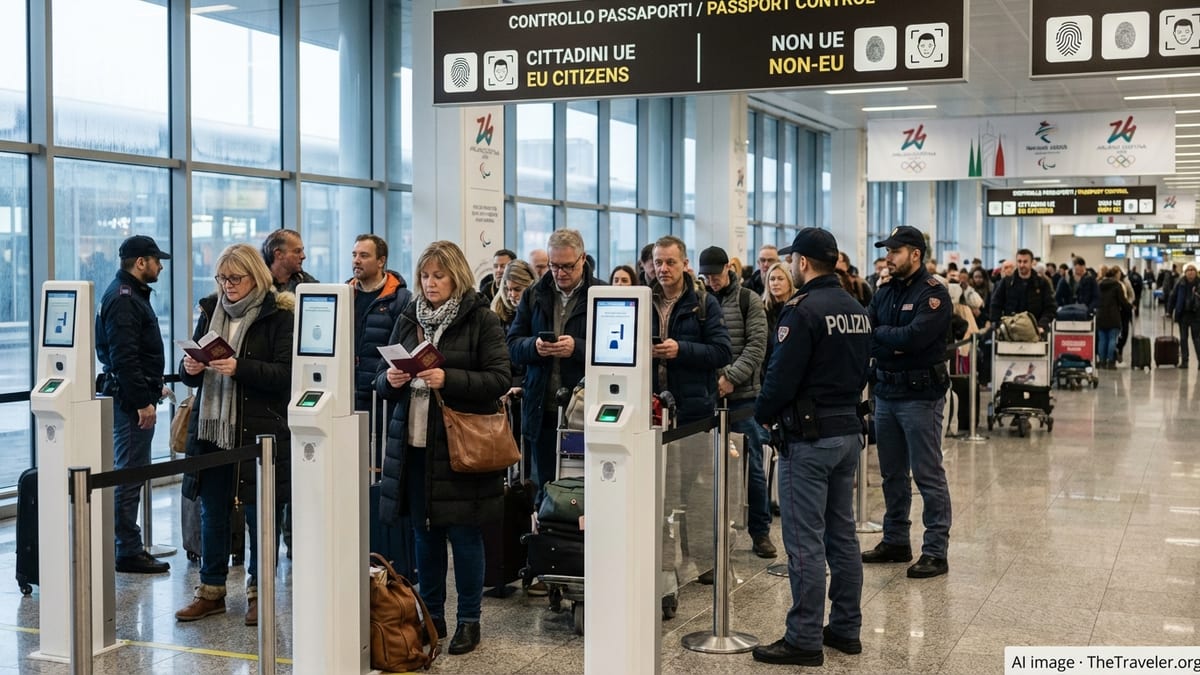
Italy Added to List as UK Stresses Stricter Checks
Italy has formally joined Switzerland, Denmark, Germany, Hungary, Spain, France and other Schengen states in the UK government’s growing roster of destinations where travellers are being urged to expect tighter entry rules and biometric processing. The update reflects the continuing rollout of the European Union’s Entry/Exit System, which has begun replacing manual passport stamping with automated biometric registration for non-EU visitors, including British tourists.
Fresh guidance from the Foreign, Commonwealth & Development Office underscores that travellers to Italy may be asked to provide fingerprints and a facial image at the border, alongside standard passport checks. Officials say this digital record, once created, will be valid for three years or until the passport expires, but warn that initial registration can add several minutes per passenger at busy airports, ferry ports and land crossings.
The advisory sits within a wider UK government campaign to prepare holidaymakers for Europe’s shifting border landscape. Ministers have repeatedly cautioned that although the aim is to make crossings more secure and efficient, the transition period will bring new procedures, variable implementation between countries and the real prospect of queues stretching into hours at peak times.
Biometric Entry/Exit System Expands Across Schengen
The catalyst for the latest warnings is the EU’s Entry/Exit System, which became operational on 12 October 2025 and is being introduced in stages at external Schengen borders. Under the scheme, non-EU nationals making short stays of up to 90 days in any 180-day period have their passport details, biometric data and entry and exit records stored in a central database in place of ink stamps.
By early 2026, EU member states are required to use biometric functionality at at least half of their border crossing points and to register a significant share of third country travellers. The system is due to be fully enforced across external Schengen frontiers by April, a deadline that is concentrating minds in both European capitals and the UK travel industry as the busy summer season approaches.
In practical terms, British travellers will encounter EES the first time they enter the Schengen area through a participating border, whether flying into an Italian airport, arriving at a port such as Genoa or Venice, or crossing at juxtaposed controls where French officers check passports before departure from the UK. Once a traveller has been registered, subsequent trips should involve quicker verification, but officials caution that the technology and staffing are still bedding in.
New Expectations at Italian Borders: Insurance, Funds and Proof of Plans
Alongside biometric registration, Italian border officials continue to enforce existing immigration rules that some British visitors are only now discovering in detail. The UK’s updated advisory for Italy highlights that travellers must be prepared to show proof of travel insurance, a return or onward ticket and evidence of sufficient funds for the duration of their stay. Italian authorities publish indicative minimum daily amounts, which vary depending on whether visitors have prepaid accommodation or are staying privately.
While such powers have long existed under Schengen rules, they are being applied with renewed rigour as border systems digitise and overstay monitoring becomes more precise. British citizens no longer have freedom of movement and instead enter as third country nationals, subject to the 90 days in any 180 rule across the Schengen area. Those who cannot demonstrate that they meet entry conditions can, in principle, be refused admission.
Consular officials say most holidaymakers will continue to pass through Italian border checks with little difficulty, but advise against assuming that proof of a hotel booking on a smartphone is sufficient. Travellers are instead urged to carry clear documentation of their itinerary, accommodation arrangements and insurance cover, especially during the coming months when the combination of biometric kiosks, new staff procedures and high passenger volumes may lead to more detailed questioning.
Queues, Delays and the Risk of Missed Connections
The prospect of longer processing times sits at the heart of UK concern. Since the first phase of EES went live in October, airports in Spain, France, Germany and Italy have reported extended queues for non-EU arrivals, with some passengers waiting up to three hours as officers guide them through fingerprint and photo capture at dedicated booths. Trade bodies representing airports and airlines have warned that, without additional staffing and streamlined procedures, peak summer 2026 could see queues of four or even five hours.
For British travellers, Italy is a particular focus this year due to the Winter Olympics and Paralympics in Milan and Cortina, which are drawing tens of thousands of additional visitors in February and March. UK officials say that while Italian authorities have been expanding infrastructure at key gateways, including Milan Malpensa and Venice, the overlap between major events and a still-evolving border system increases the risk of bottlenecks.
Industry groups on both sides of the Channel are pressing Brussels and national governments for flexibility in how strictly biometric registration targets are enforced during the busiest travel periods. Some member states have temporarily eased EES use during spikes in demand, but application is uneven. Travellers are being urged to build in longer connection times, especially when transiting through another Schengen hub en route to or from Italy.
How Italy Compares to Switzerland, Denmark, Germany and Others
Italy’s inclusion in the UK’s latest round of messaging reflects its status as both a major tourist market and a frontline participant in the EES rollout. However, British travellers will encounter similar rules in most other Schengen states frequently visited from the UK, including Spain, France, Germany, Switzerland, Denmark and Hungary. All are subject to the same EU regulations governing biometric registration, data retention and short-stay limits, though implementation speeds and local practices vary.
At some northern European hubs, such as Copenhagen and Frankfurt, authorities have invested heavily in automated gates and self-service kiosks designed to integrate with EES and, in time, with the upcoming ETIAS travel authorisation scheme. Southern holiday hotspots including Spain and Italy, meanwhile, are racing to retrofit already busy terminals with biometric booths, often in infrastructure that predates the new technology.
UK officials emphasise that the fundamental entry rules for British visitors are consistent across the Schengen zone. Travellers should assume they may be asked to submit biometrics, show proof of insurance and funds, and demonstrate compliance with the 90-day limit whether they land in Rome, Barcelona, Zurich or Berlin. What differs is likely to be the experience on the ground, with some airports and land crossings handling the new processes more smoothly than others.
UK Government Messaging: Prepare, Do Not Panic
In London, the message from ministers and the travel advice service is one of preparation rather than alarm. The Home Office and Foreign Office have jointly urged British travellers to familiarise themselves with the new rules before booking and to allow extra time at departure points and upon arrival in Europe. They stress that there is no need for UK passport holders to pre-register their biometrics or pay a separate fee for EES, as all data capture will occur at the border itself.
Officials also underline that possession of comprehensive travel insurance is now more important than ever. While insurance is not a formal biometric requirement, some EU countries including Italy explicitly reserve the right to ask incoming visitors to show proof of cover, particularly for medical expenses. In an era of more systematic checks and data-driven enforcement, the lack of an adequate policy could complicate entry for those who are questioned in detail.
To support the rollout, the UK government has launched an information drive targeting frequent travellers, tour operators and carriers. Guidance encourages airlines, ferry operators and rail firms to clearly explain to passengers that their first trip to the Schengen area after full EES activation will likely take longer than they are used to. Travel agents are being advised to highlight the need for valid passports with sufficient validity, proof of accommodation and awareness of local immigration rules at the point of sale.
Practical Tips for British Travellers Heading to Italy
Although the latest advisory is framed as a government warning, travel experts insist that most visitors to Italy will still enjoy a largely familiar experience provided they plan ahead. They recommend arriving at the airport earlier than in previous years, allowing extra time not only at departure security but also for potential queues at Italian border control after landing. Passengers connecting onward within the Schengen area are urged to book longer layovers to avoid missed flights if biometric lines move slowly.
Travellers should ensure their travel insurance documents, accommodation confirmations and proof of return travel can be easily produced, either in printed form or as clearly accessible digital files. Those who travel regularly for work or to visit family are encouraged to keep a close eye on the number of days they spend inside the Schengen zone to avoid breaching the 90-day rule, which EES will monitor automatically.
Families, older travellers and those with mobility issues may wish to factor in the physical demands of standing in queues and using biometric kiosks. Border authorities state that staff will be on hand to assist passengers who have difficulty with fingerprints or camera equipment, but experiences so far show that support can be stretched during busy periods. UK consular teams in Italy are advising anyone with specific accessibility needs to contact their airline or tour operator in advance.
Looking Ahead to ETIAS and a Fully Digital Border
The tightening of travel rules currently in focus is only the first stage in a broader transformation of how non-EU nationals enter the Schengen area. Once EES is fully established and operating smoothly, the EU plans to activate ETIAS, a pre-travel authorisation system similar to the United States ESTA scheme. British visitors, along with many other non-EU nationals, will then be required to apply online for permission to travel before boarding transport to Europe, in addition to undergoing biometric checks at the border.
EU officials argue that the combination of advance screening, biometric verification and automated entry records will ultimately make travel safer and more efficient, reducing fraud and streamlining checks for bona fide tourists and business travellers. For now, however, the focus for governments and the travel sector is on managing the transition without paralysing airports, ports and rail terminals during peak periods.
For British holidaymakers planning Italian escapes in 2026 and beyond, the message from the UK’s latest advice is clear: Europe’s borders are changing, procedures are tightening and spontaneous trips now demand a little more preparation. Those who keep documents in order, build in extra time and stay informed about evolving rules should still find their way to the piazzas, ski slopes and beaches with minimal disruption.