

More news on this day
UK travellers heading to Italy and other popular European destinations face a rapidly changing landscape from April 2026, as tighter border security, biometric controls and evolving pre-travel authorisation schemes reshape movement across the Schengen area.
Get the latest news straight to your inbox!
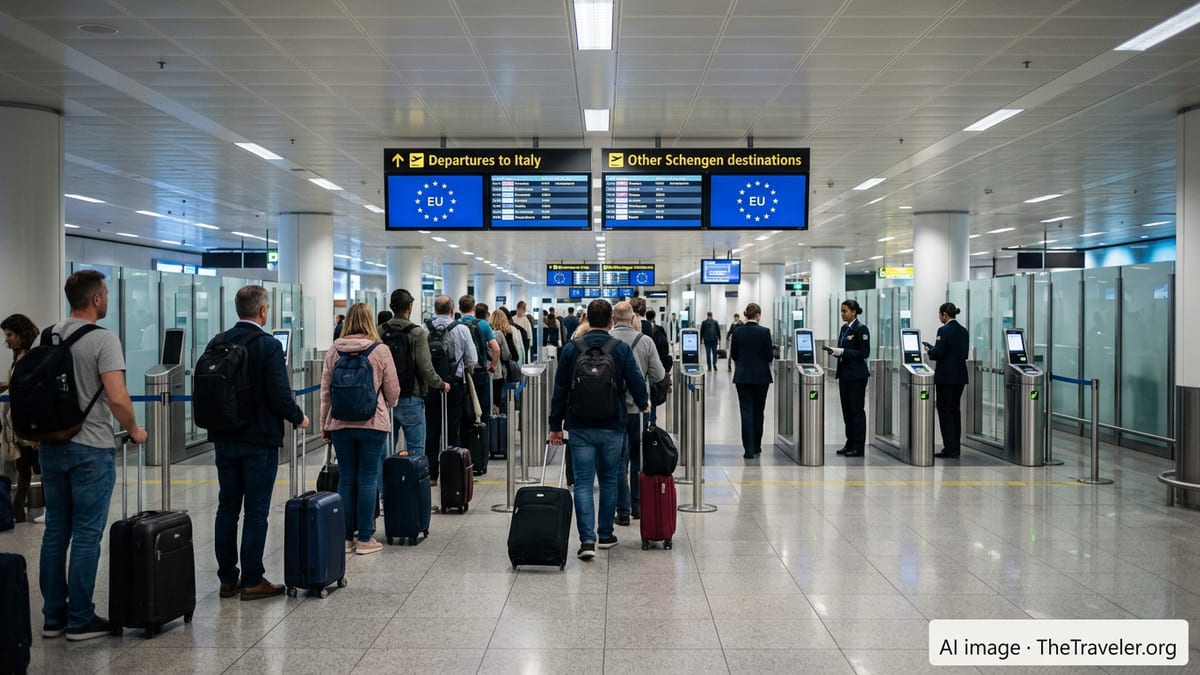
UK Travel Advice Brings Italy Into Focus
Italy has moved more clearly into view for British travellers following updated UK government travel advice and the ongoing rollout of new EU-wide border systems. Publicly available guidance highlights that Italy, like other Schengen states, is adapting security procedures at borders and in major cities in response to a higher focus on crowd protection, sensitive sites and major transport hubs.
Recent updates to the UK government’s foreign travel advice for Italy underline a combination of heightened security presence in urban centres and around key cultural and religious locations, along with more structured checks at border entry points. Reports indicate increased attention to large events and tourist hotspots, adding to a pattern already seen in countries such as Germany, Sweden, Poland, Switzerland, the Netherlands and Hungary.
For UK visitors, the message is that Italy is not an exception but part of a broader Schengen-wide tightening that is expected to become more visible from spring 2026. Travellers are being encouraged, through public guidance, to check the latest entry rules and security information shortly before departure rather than relying on material consulted months in advance.
Entry/Exit System Fully Operational by April 2026
The most immediate turning point for travel in April 2026 is the full deployment of the European Union’s Entry/Exit System, a digital biometric register for non-EU nationals crossing the external borders of the Schengen area. The system began a phased rollout in October 2025 and is scheduled to be fully operational at all relevant border points by 10 April 2026.
Instead of relying on passport stamps, the new platform records each traveller’s biometric data, personal details and exact dates of entry and exit. This allows border authorities to track stays precisely against the 90‑days‑in‑180‑days rule that applies to visitors from the UK and other visa‑exempt countries. Published analysis indicates that UK nationals should be prepared for facial image capture and, in many cases, fingerprinting on first entry after the system becomes fully active.
During the initial months after April 2026, some variation between airports, seaports and land crossings is still expected, following the pattern seen in other Schengen countries as they adapt to the new infrastructure. Advisory notices warn of potential queues and longer processing times, particularly in peak holiday periods, even as the long‑term aim is to make border checks more efficient and less prone to human error.
Passports, Stamps and the End of the Manual 90‑Day Calculation
Italy’s entry rules for UK nationals remain rooted in the Schengen framework, allowing short stays of up to 90 days in any 180‑day period without a visa. The UK government’s entry‑requirements pages for Italy continue to stress that travellers must keep a close eye on both passport validity and time spent in the wider Schengen zone, not just in a single country.
Until the digital Entry/Exit System fully replaces manual stamping, the advice is that UK visitors should still ensure that passports are stamped on both entry and exit at Schengen borders. These stamps remain vital evidence of compliance with the 90‑day limit up to the point when biometric records become the sole reference. Once the system is fully operational across Italy and other Schengen states, the calculation of permitted stay will shift from stamps in a booklet to data stored in a central database.
For many UK travellers used to the freedom of movement that applied before Brexit, this marks a significant practical and psychological change. The combination of biometric checks, automated overstay monitoring and stricter enforcement of day‑counts reduces the room for error and makes last‑minute trip extensions more complicated. Travel commentators note that multi‑country itineraries taking in Italy, Germany, Hungary, the Netherlands, Sweden, Poland and Switzerland will require more careful planning around cumulative days inside Schengen.
ETIAS on the Horizon: Future Pre‑Travel Authorisation
Alongside EES, a further shift is coming in the form of the European Travel Information and Authorisation System, or ETIAS. According to European Union communications and specialist briefings, ETIAS is now expected to start operating in the last quarter of 2026, after EES has been fully deployed and bedded in.
ETIAS will not be a visa in the traditional sense, but a mandatory electronic travel authorisation for visitors from visa‑exempt countries, including the UK, heading to the Schengen area for short stays. The authorisation will be linked electronically to a specific passport and checked automatically at the border, mirroring systems already used by the United States, Canada and the United Kingdom itself for many foreign nationals.
Although ETIAS will not yet be in force in April 2026, current guidance suggests that UK travellers planning trips to Italy and its neighbours later in 2026 or 2027 should monitor developments closely. Once introduced, ETIAS is expected to involve an online application, a modest fee and advance screening against security and migration databases. Travel industry analysis indicates that this could become a standard pre‑departure step, similar in importance to checking that a passport is valid for at least six months beyond the date of entry.
Visa Policies and Security Trends Across Schengen
Behind these procedural changes lies a broader tightening of visa and security policy across the Schengen area. The new biometric Entry/Exit System and forthcoming ETIAS have been presented, in official European documentation and expert commentary, as tools to reduce irregular migration, strengthen external borders and modernise identity checks, without reintroducing routine internal border controls between Schengen states.
For countries frequently visited by UK travellers, including Germany, Sweden, Poland, Switzerland, the Netherlands and Hungary, the next year is expected to be a period of adaptation. Airports and ferry ports are fine‑tuning passenger flows, transport operators are updating check‑in procedures, and national authorities are refining how they apply the EU‑wide systems to their own border posts. Italy’s inclusion in recent UK advisory updates reflects its position as one of the main external entry points to Schengen for British holidaymakers.
At the same time, various European destinations are introducing their own additional security and conduct rules, from stricter behaviour codes in historic centres to tighter crowd‑management rules at festivals and sporting events. In Italy, reports highlight reinforced security measures around major religious sites and high‑profile tourist areas, aligning with steps already visible in other parts of the Schengen zone. When combined with more formalised digital checks at the border, these measures contribute to the sense that travel freedom is still broadly intact but more structured than it was a decade ago.
For UK residents planning European trips from April 2026 onward, the emerging picture is one in which Italy and its Schengen neighbours remain accessible, but spontaneity gives way to preparation. Careful attention to passport validity, awareness of the 90‑day rule, allowance for possible delays at biometric checkpoints and, in time, completion of ETIAS formalities are set to become normal parts of the journey to Rome, Berlin, Stockholm, Budapest, Amsterdam, Zurich or Krakow.