

More news on this day
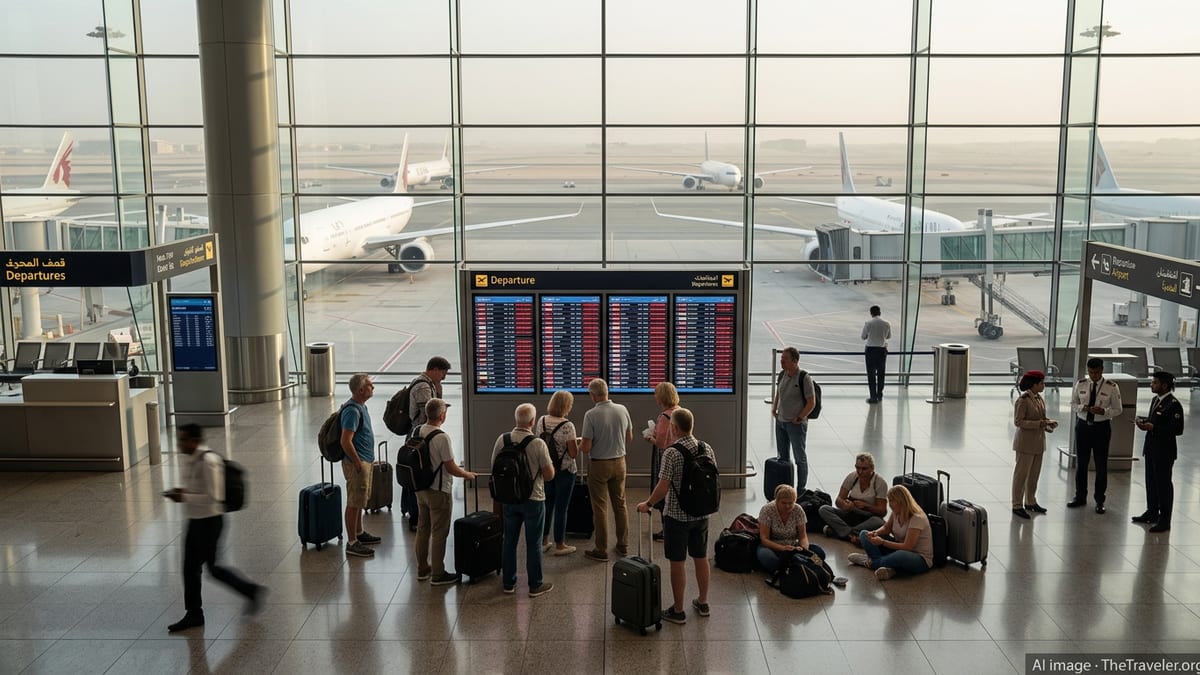
Thousands of British holidaymakers and transit passengers have been left stranded across the Middle East as escalating conflict triggers sweeping airspace closures, tougher UK government travel warnings and the first wave of emergency repatriation flights.
FCDO Tightens Travel Advice Across the Region
The Foreign, Commonwealth and Development Office has rapidly hardened its travel guidance for the Middle East since United States and Israeli strikes on Iran began on 28 February 2026, followed by retaliatory attacks on Gulf states. Updated advisories now warn against all but essential travel to several key hubs and against all travel to the highest-risk states, reflecting the speed with which a leisure corridor has turned into an active conflict zone.
Fresh FCDO notices issued in early March advise against all but essential travel to Qatar and reiterate long-standing warnings against travel to Iraq, Iran, Syria and Yemen, among others. British nationals already in countries such as Qatar, Saudi Arabia and Bahrain are being urged to stay at home or “shelter in place” where possible, monitor local media and be ready to follow instructions from local authorities and British embassies.
Officials stress that FCDO travel advice is rooted in security assessments that consider terrorism threats, military activity and the ability of local authorities and UK consular staff to assist if things go wrong. In practical terms, for UK tourists, the latest changes mean trips booked to affected destinations will now often be at odds with government advice, with implications for travel insurance and refund rights.
While the guidance does not constitute a legal travel ban, it is shaping decisions by airlines and tour operators. Carriers and package providers are closely tracking the FCDO’s evolving risk picture as they decide whether to maintain heavily reduced schedules or halt services entirely along key Middle Eastern routes.
Airspace Closures Leave Holidaymakers Stranded
The most immediate impact for UK travellers has been the near-collapse of normal air connectivity across the region. Airspace closures in Israel, Iran, Qatar and the United Arab Emirates, as well as severe restrictions in neighbouring states, have forced mass cancellations and diversions, cutting off some of the world’s busiest transit hubs used by British holidaymakers en route to Asia, Africa and Australasia.
British Airways has cancelled flights to and from Abu Dhabi, Dubai, Doha, Amman and Bahrain on multiple days, while other European carriers have either suspended operations entirely or are operating skeleton services primarily focused on returning stranded passengers. Low-cost and leisure airlines have also been badly hit, with some temporarily pausing flights to holiday favourites such as Cyprus as military tensions spill over into wider aviation disruption.
Travel industry estimates suggest that as many as 300,000 UK nationals were in the broader Middle East when the conflict escalated, including tourists on beach breaks in the Gulf, city visitors in Istanbul and Amman, religious pilgrims, cruise passengers and those simply transiting through major hubs. Many have found themselves marooned in hotels or airport lounges, unsure when regular commercial flights will resume or whether their insurance will cover extended stays.
With reduced capacity and complex rerouting, even travellers outside the immediate conflict zone are feeling the effects. Flights between the UK and destinations as far apart as India, Southeast Asia and East Africa are experiencing delay and disruption as airlines seek to avoid closed or high-risk airspace and compete for limited alternative routings.
Government Repatriation Flights Under Scrutiny
Amid mounting pressure from families and MPs, the UK government has moved to organise limited repatriation flights for the most vulnerable British nationals. The Foreign Office confirmed that a first government-chartered service from Muscat in Oman was scheduled for the evening of 4 March, prioritising those without safe accommodation, people with medical conditions and travellers who are not residents of the region.
The operation has not been smooth. The inaugural government flight, arranged in partnership with Qatar Airways, faced technical delays before landing in the UK on 5 March, highlighting the logistical challenges of mounting evacuation-style services in a fast-moving conflict with constrained airspace. Ministers have repeatedly warned that only a small number of Britons can be accommodated on each charter and that those who have not been directly contacted should not travel to airports in the hope of securing a seat.
According to recent government statements, around 140,000 British nationals have so far registered their presence in the Middle East with UK authorities, with approximately 4,000 having already returned home on a mix of commercial and special flights. Officials say further repatriation services are under active consideration, but stress that these will remain “limited and targeted,” and cannot substitute for the much larger capacity offered by fully restored commercial schedules.
Travel industry figures and opposition politicians have questioned whether the response has been swift and generous enough, particularly for tourists facing spiralling hotel bills and unclear insurance cover. In parliamentary debates, MPs have pressed ministers on whether emergency hardship funds or government-backed loans will be made available to help stranded families pay for accommodation and alternative routes home.
Advice for UK Travellers Caught in the Crisis
For those currently in the region, the overarching message from British officials is to prioritise safety over speed of departure. Tourists are being urged to remain where they have secure accommodation rather than moving towards airports without confirmed travel plans, especially in cities experiencing air raids, protests or electricity cuts. Embassies are advising citizens to keep phones charged, carry copies of travel documents and maintain a low profile in public spaces.
Registration with the FCDO’s consular systems has become a key step. British nationals are encouraged to submit their contact details, travel plans and location so that officials can send targeted security alerts and notify them if seats become available on government-facilitated flights. Registrants are told to monitor emails and text messages closely, as places on charters are being allocated at short notice and according to vulnerability criteria.
Travel lawyers note that where the FCDO advises against all but essential travel to a destination, many package holidaymakers gain stronger rights to refunds or rebooking under consumer protection rules. Independent travellers, however, may find themselves more exposed, particularly if airlines cancel flights but offer credits instead of cash refunds, or if insurers invoke conflict-related exclusions.
Prospective travellers from the UK are being advised to reconsider non-essential trips that rely on transiting Middle Eastern hubs, even if their final destination is outside the conflict zone. Industry bodies suggest looking for routings that avoid the region entirely, checking policies for war and civil unrest exclusions, and booking flexible tickets that can be changed without large penalties if the security situation deteriorates further.
Outlook for Middle East Travel in the Coming Weeks
With the conflict between the US-Israeli coalition and Iran still evolving, there is little clarity on when full commercial air services across the Middle East will resume. Aviation authorities in Qatar and the UAE have begun cautiously reopening airspace for limited evacuation and cargo flights, but standard passenger operations remain heavily curtailed and subject to rapid change depending on military activity.
Airlines are drawing up phased restart plans, yet executives concede that any return to normal tourist traffic will depend on a sustained reduction in security risks and a corresponding softening of Western government travel warnings. For British travellers, that means the traditional role of Gulf hubs as seamless stopover points is likely to remain disrupted for some time, even if outright closures give way to partial operations.
Tour operators specialising in Middle Eastern beach and city breaks are already pivoting towards Mediterranean, Canary Islands and long-haul Caribbean alternatives for spring and early summer departures. At the same time, infrastructure in countries such as Cyprus and Greece is coming under pressure from diverted capacity and a surge in short-notice bookings by UK residents unwilling to transit the Gulf.
For now, the FCDO continues to review its travel advice daily, and ministers insist that further repatriation flights will be announced as conditions and capacity allow. UK tourists with existing bookings through Middle Eastern hubs are being urged to stay in close contact with airlines and tour companies, and to be prepared for last-minute changes as the region’s complex air and security picture continues to shift.