

More news on this day
UK holidaymakers and business travellers are facing sudden upheaval after Dubai, Abu Dhabi and Doha were effectively placed off limits in updated UK Foreign, Commonwealth and Development Office guidance linked to the escalating Iran conflict, triggering widespread flight cancellations, costly reroutes and deep uncertainty for thousands already in transit.
Get the latest news straight to your inbox!
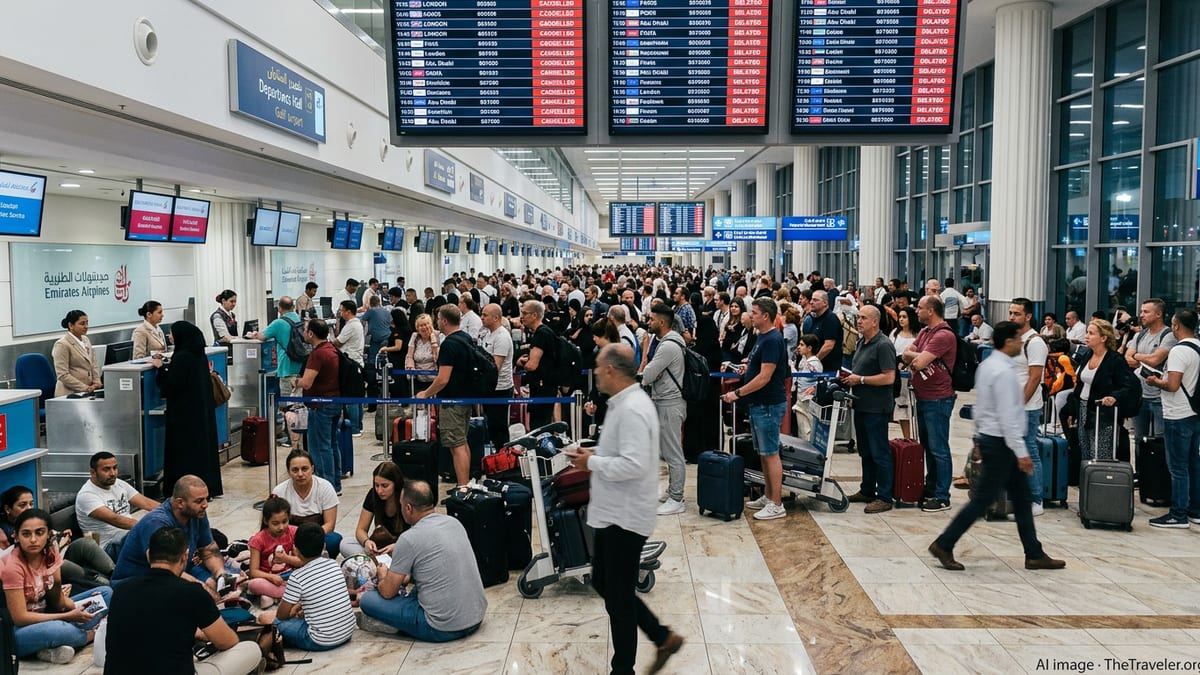
Foreign Office Warnings Tighten Around Key Gulf Transit Hubs
According to the latest official travel advice, the UK government now cautions strongly against trips to several Gulf countries, including the United Arab Emirates and Qatar, as missile and drone activity linked to the Iran conflict continues to affect major cities and transport infrastructure. Publicly available summaries of the guidance indicate that journeys deemed non-essential could fall outside the scope of standard travel insurance, leaving travellers financially exposed if they proceed.
While the wording differs between destinations, recent updates and industry advisories describe Dubai, Abu Dhabi and Doha as locations where the security situation is volatile and subject to rapid change. For many UK travellers, that effectively turns the region’s biggest hubs into no-go zones for new leisure bookings, particularly where policies specify that cover is invalid if a trip goes ahead against Foreign Office advice.
Travel trade alerts and insurer notices highlight the knock-on effect for passengers using the Gulf purely as a connection point. Even those not planning to leave the airport are finding that their plans are being upended by overnight schedule changes, tightened risk thresholds from airlines and complex questions over what remains covered once a route passes through airspace near an active conflict zone.
Industry observers note that the shift marks a stark contrast with the Gulf’s usual status as a highly stable long-haul gateway between the UK, Asia, Africa and Australasia. With the Iran conflict intensifying and regional partners intercepting waves of missiles over the Gulf, the calculus on overflying and transiting these hubs has changed almost overnight.
Flights Cancelled, Rerouted and Lengthened as Airspace Closes
Airlines serving the Middle East have moved quickly to adapt to changing risk assessments and temporary airspace restrictions. British Airways has suspended services to Dubai, Abu Dhabi and Doha on multiple days in March, with aviation trackers and specialist travel outlets reporting blanket cancellations across much of its Gulf schedule through mid-month.
Carrier updates show that flights which would usually pass over or near Iranian airspace are being rerouted via longer, more southerly or northerly corridors. Independent travel analysis suggests that some long-haul journeys are now extending by four to six hours as aircraft skirt conflict-adjacent zones and avoid temporarily closed flight information regions. This is contributing to rolling knock-on delays across networks that rely heavily on tight connections.
Gulf-based airlines such as Emirates, Etihad and Qatar Airways are maintaining skeleton operations but with reduced frequencies, aircraft swaps and last-minute schedule revisions. Aviation news outlets report that departures from Dubai, Abu Dhabi and Doha have at times been halted or heavily curtailed following specific barrages of missiles, leading to banks of grounded aircraft and crowded terminals.
Operational briefings from risk consultancies describe multiple Gulf states experiencing intermittent airspace closures or severe constraints in recent days. These measures are intended to protect civilian aviation amid reports of missile interceptions at high altitude, but they leave airlines juggling crew hours, aircraft positioning and customer rebooking on a near hour-by-hour basis.
Shock and Uncertainty for UK Travellers on the Ground
For UK nationals already in Dubai, Abu Dhabi or Doha when the latest warnings were issued, the impact has been immediate and deeply disruptive. Social media posts and traveller forums are filled with reports of families stranded in hotels, business travellers watching return flights disappear from departure boards and backpackers scrambling to rework complex multi-stop itineraries that depended on Gulf connections.
Accounts shared publicly describe long queues at airline desks as passengers attempt to secure new flights, often to alternative European hubs rather than directly back to the UK. In some cases, travellers report being offered refunds that fall short of the cost of buying new one-way tickets at short notice, while others have been rebooked several days later, extending stays in cities now framed by heightened security alerts.
Advisories circulated by UK officials and airport authorities in the region stress that travellers should not head to the airport unless airlines have explicitly confirmed that their flight is operating. This is a particular challenge for visitors whose accommodation is far from the terminals or who have already checked out, and who now face the choice of waiting in often crowded public areas or paying for additional hotel nights.
Publicly available guidance also emphasises that anyone in affected cities should monitor local announcements and be prepared to follow shelter-in-place instructions if sirens sound or missile interceptions are reported nearby. For visitors more accustomed to the Gulf’s reputation for seamless transit and luxury city breaks, the combination of sudden security messaging and practical travel snags has come as a profound shock.
Spiralling Costs and Confusion Over Passenger Rights
Alongside the human stress, the financial impact on UK travellers is mounting. Consumer-rights commentators and travel-law specialists note that the classification of the Iran conflict as a security event rather than a routine operational problem complicates claims under UK and European passenger compensation rules.
Where flights are cancelled due to airspace closures or official security directives, passengers are generally entitled to refunds or rebooking but not to additional compensation. That leaves many UK travellers out of pocket for extra hotel nights, meals and replacement tickets on alternative carriers, especially when returning home requires buying new journeys via different hubs such as Istanbul or key European cities.
Insurance cover is also under intense scrutiny. Several publicly shared case studies describe insurers refusing claims for trips that proceed against Foreign Office warnings while still providing limited protection for travellers who remain airside in transit. This distinction has caused confusion among policyholders attempting to interpret fine print while stuck overseas, particularly where call centres are overwhelmed by a surge in claims and queries.
Travel trade bodies are urging customers to keep detailed records of all receipts, booking confirmations and airline communications in case disputes arise later. However, with rules varying between airlines, insurers and booking platforms, many travellers report feeling unsure which organisation should cover which costs, especially when journeys involve a mix of UK and non-UK carriers.
What Prospective Travellers Should Consider Now
For travellers in the UK still at home but holding future bookings through Dubai, Abu Dhabi or Doha, the situation remains highly fluid. Independent travel analysts advise that anyone with imminent departures should regularly check Foreign Office advisories, monitor airline updates and be prepared for last-minute cancellations or rerouting, even after online systems initially show flights as operating.
Specialist travel intelligence reports highlight that some carriers are waiving change fees or offering flexible rebooking for journeys touching the Gulf, particularly on departures scheduled for March and early April. However, these waivers are often time-limited and subject to seat availability, making early decisions critical for travellers who want the broadest range of alternatives.
Prospective travellers are also being encouraged to review their insurance policies in detail, paying particular attention to war and terrorism exclusions, the definition of essential versus non-essential travel, and provisions for missed connections caused by airspace closures. Buying new cover after an event has escalated typically will not protect against known risks, which reinforces the importance of checking existing policies before making changes.
With no clear timeline for de-escalation in the Iran conflict, the Gulf’s role as a dependable bridge between the UK and much of the world is under unprecedented strain. For now, UK travellers are being forced to weigh their appetite for disruption and uncertainty against the prospect of deferring trips altogether, as three of the world’s busiest hubs sit at the heart of a fast-moving regional crisis.