

More news on this day
A growing number of UK travel firms are collapsing or closing their doors, cancelling trips and cutting staff in a trend that is unsettling holidaymakers and reshaping the country’s business travel landscape.
Get the latest news straight to your inbox!
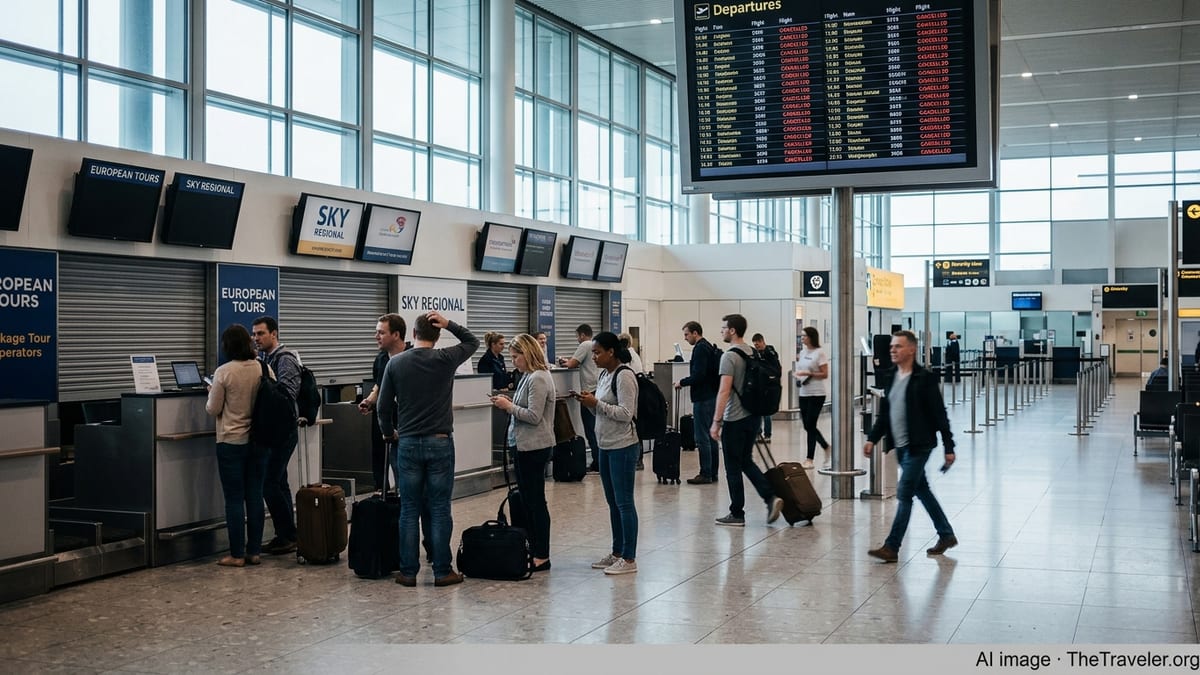
New Wave of Collapses Hits UK Tour Operators
Recent months have seen a succession of UK travel companies cease trading, leaving customers facing cancelled trips and uncertainty over refunds. Publicly available information shows that failures have affected both long-established brands and newer entrants, reflecting pressure across the sector rather than isolated mismanagement.
Coverage of the industry highlights the collapse of firms such as Balkan Holidays’ UK operation in 2025, a company that at its peak carried more than 100,000 holidaymakers a year. More recently, reports indicate that agencies and tour businesses including Great Little Escapes, Jetline Travel and Source Travel Group have joined a growing list of failures, disrupting the plans of thousands of British travellers.
Data published by the UK Civil Aviation Authority on failed Air Travel Organiser’s Licence (Atol) holders points to a steady stream of company failures through 2025 and into early 2026. Names such as Asiara UK, Regal Routes and Ickenham Travel Group appear on official registers of collapsed operators, underlining how financial strain is cutting across leisure and niche specialist businesses alike.
Industry-focused outlets describe the closures as part of a broader pattern of instability. Rising operating costs, tighter credit conditions and the lingering impact of the pandemic on balance sheets are cited as key drivers, while intense price competition has left some firms with little resilience when demand softens or key partners withdraw support.
Holidaymakers Face Cancellations, Claims and Confusion
For tourists, the most immediate impact of a travel firm collapse is the sudden cancellation of holidays, sometimes only days before departure. Reports on recent failures describe customers discovering via email or media coverage that their trips had been withdrawn, with limited guidance available in the first hours after a shutdown is announced.
Where package holidays are Atol protected, customers are generally entitled to refunds or repatriation if already abroad. Consumer advice circulating after recent collapses has urged travellers to check whether their bookings were made as a single, Atol-covered package and to keep documentation to support claims. However, those who booked flights and accommodation separately, or who used agents without relevant protection, may find it harder to recover money.
Travel press coverage notes increasing frustration among affected holidaymakers over the time required to process claims. While Atol and card chargeback systems provide a degree of safety net, administrative backlogs can leave families waiting weeks or months for refunds, tying up household budgets at a time when living costs remain high.
There are also knock-on effects at destinations. Hoteliers and local suppliers in popular European resorts have reported unpaid invoices after UK agencies folded, prompting some to demand payment on arrival from future guests or to be more cautious about working with unfamiliar intermediaries. This has raised fears that more holidaymakers could be asked to pay twice for accommodation if an intermediary fails between booking and travel.
Redundancies Reshape the UK Travel Workforce
The financial strain on operators is feeding directly into the labour market. National labour statistics show potential redundancies rising across the UK economy, and travel and hospitality feature among the sectors reporting pressure. Consultations on job losses have become increasingly common as firms attempt to cut costs or wind down operations.
Travel trade publications have documented closures of high street agencies, consolidations of branch networks and a shift towards homeworking models. In some cases, entire retail networks have shut, with staff attempting to move clients’ bookings to new employers or launch independent agencies under consortium brands to preserve customer relationships.
The collapse of regional airlines and coach operators has further affected travel employment, particularly in areas reliant on tourism and connectivity. Recent examples, including Blue Islands’ suspension of trading and the shutdown of long-running coach tour firms such as Gold Crest Holidays, have removed jobs not only in sales and operations but also in driving, maintenance and support services.
For remaining staff, the environment is volatile. Account managers and corporate travel consultants report increased workloads as teams shrink, while uncertainty over future restructurings discourages long-term career planning. Recruitment specialists cited in sector research note that many experienced agents and travel managers are leaving the industry altogether, raising concerns about a skills gap if demand rebounds strongly.
Business Travel Clients Confront Disruption and Risk
Corporate travel buyers are also feeling the effects of the upheaval. Business travel management relies heavily on specialist intermediaries for ticketing, duty of care and expense control. When a travel management company or airline fails, firms can be left scrambling to rebook essential trips, reroute travellers and ensure compliance with insurance and security policies.
Industry commentary on recent UK agency failures shows that some corporate clients have had to rapidly migrate programmes to alternative suppliers, renegotiating fares and hotel contracts at short notice. For companies with complex global travel needs, especially in sectors such as energy, finance and professional services, a sudden loss of a key supplier can translate into missed meetings, delayed projects and higher last-minute booking costs.
Risk managers are re-examining their exposure to single suppliers and reviewing the financial health of preferred partners. Guidance from business travel associations has encouraged companies to diversify their travel provider base, ensure that tickets and hotel stays are booked under robust contractual terms, and clarify how unused credits or deposits are handled if a provider becomes insolvent.
At the same time, some corporate travellers are encountering a more fragile service environment on the ground. Reports of route cancellations, thinner schedules and reduced staff at airlines and hotels mean fewer options when disruptions occur, increasing the value placed on resilient, well-capitalised partners that can offer 24-hour support.
Regulation, Consumer Protection and the Road Ahead
The recent wave of collapses has renewed focus on the UK’s consumer protection framework for travel. The Atol scheme remains a central safeguard, and official registries of failed Atol holders provide transparency about which firms have ceased trading. However, the growing role of online agents, dynamic packaging and cross-border intermediaries continues to test the limits of traditional rules.
Commentary from consumer groups and travel analysts suggests that many customers still misunderstand the difference between a fully protected package and a collection of separate bookings. The complexity of modern booking chains, where airlines, bed banks and local operators are linked through multiple intermediaries, can make it difficult to determine responsibility when something goes wrong.
Some specialists argue that greater emphasis on financial resilience tests, clearer upfront disclosure of protection status and more robust monitoring of smaller agents could help reduce future shocks. There is also discussion around whether sector-specific support may be needed in the event of a large-scale failure that risks stranding significant numbers of travellers abroad.
For now, travellers and corporate buyers are being urged by industry guidance to check the protection status of any booking, pay with cards that enable chargebacks where possible and consider the trade-off between rock-bottom prices and the stability of their provider. With economic headwinds still evident and insolvency data pointing to ongoing pressures, the UK travel industry appears likely to face further consolidation before a more stable landscape emerges.