

More news on this day
A full-day walkout at Berlin-Brandenburg Airport on March 18 has brought passenger operations to a halt, stranding thousands of travelers and adding the United Kingdom to a growing list of European countries grappling with severe air travel disruption.
Get the latest news straight to your inbox!
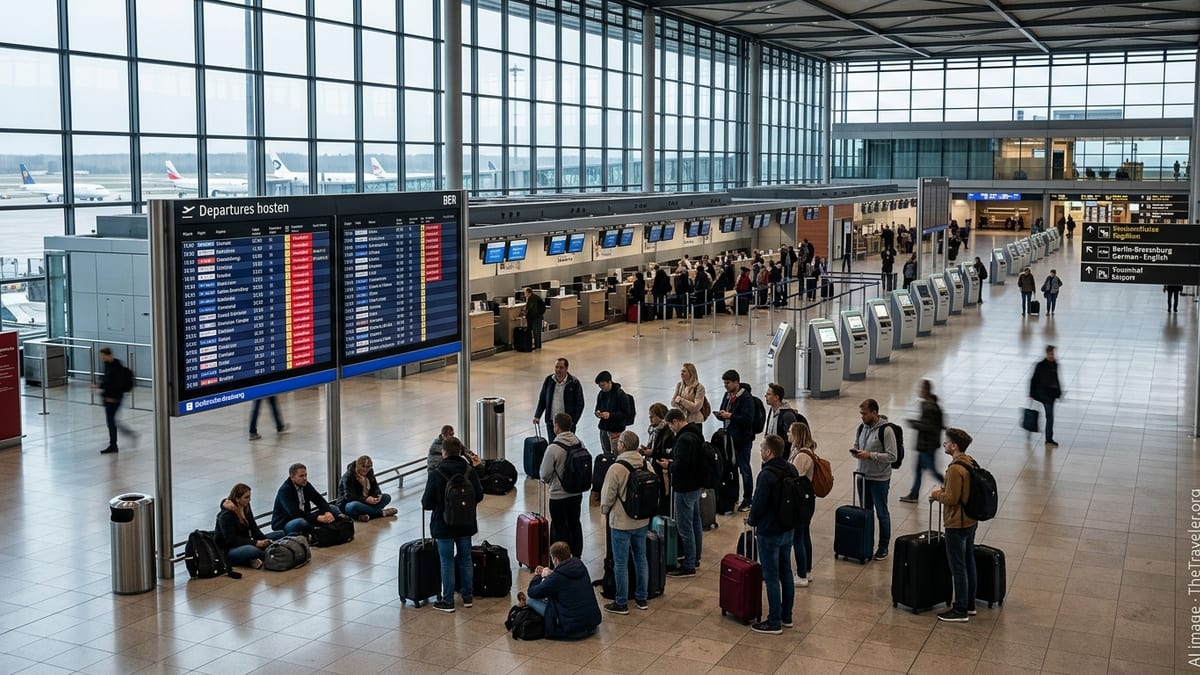
Berlin-Brandenburg Brought to a Standstill by Warning Strike
Passenger flights at Berlin-Brandenburg Airport were suspended for the entire day on March 18 as ground staff and service workers joined a warning strike, effectively shutting down arrivals and departures. Publicly available schedules and airline updates show that carriers preemptively canceled most, if not all, passenger services to and from the German capital, leaving travelers unable to board or land at the city’s main international gateway.
Social media posts and passenger reports from the terminal describe long queues at airline counters, crowded departure halls and confusion among tourists who arrived at the airport only to learn that flight operations had been halted. Many travelers were directed to seek rebooking options for later in the week or to accept refunds where available, while some attempted to reroute via other German hubs such as Frankfurt or Munich in order to continue their journeys.
The industrial action at Berlin-Brandenburg comes amid a broader period of volatility for European aviation, where strikes and operational pressures have triggered repeated waves of cancellations and delays across the continent since the start of 2026. Data aggregated by passenger-rights platforms for January and February already indicated thousands of disrupted flights touching Germany along with neighboring markets, underscoring how sensitive the system has become to local stoppages.
UK Joins Lengthening List of Countries Feeling the Impact
The Berlin stoppage has had a visible knock-on effect in the United Kingdom, with flights between UK airports and Berlin among those grounded or heavily disrupted. Airline schedules show cancellations affecting services from London and regional UK cities to Germany’s capital, placing British travelers among the thousands of passengers forced to change plans at short notice.
This latest disruption adds the UK to a roster of European countries repeatedly hit by air travel interruptions in recent months, including Switzerland, France, Denmark, the Netherlands, Ireland and Spain. Operational statistics from early 2026 highlight that major hubs in these markets have already struggled with waves of delays and cancellations linked to strikes, staffing shortages and winter weather, leaving little spare capacity to absorb fresh shocks from events such as the Berlin strike.
Travel analysts note that the interconnected nature of European aviation means route closures in one city quickly reverberate across others. When an airport such as Berlin-Brandenburg closes for an entire day, aircraft and crews are left out of position, follow-on flights are disrupted and already tight schedules at partner hubs are further compressed. For UK travelers, that has translated into missed connections, unexpected overnight stays and extended journey times on routes that normally see multiple daily frequencies.
Thousands of Tourists Left Stranded Across Europe
The full-day shutdown at Berlin-Brandenburg has created particular difficulties for tourists in the middle of multi-country itineraries. Many visitors use Berlin as a gateway or connecting point for broader trips through Germany, Poland, the Czech Republic and Scandinavia, and a sudden halt to flights has stranded groups who were relying on precise timing to reach rail links or onward connections.
Reports from travel forums and passenger-rights organizations describe travelers forced to sleep in terminal seating, scramble for scarce hotel rooms in Berlin and nearby cities, or shift to long-distance trains and intercity buses with limited remaining capacity. Some long-haul passengers reaching Europe found their final legs into Berlin canceled and were rerouted to airports in other countries, stretching journeys by many hours and complicating baggage handling.
Recent operational data from European monitoring services suggests that episodes like this are no longer isolated. Earlier in the year, large numbers of cancellations and delays were recorded on days when strikes and bad weather converged across Spain, France, the Netherlands, Ireland, Switzerland and the UK, contributing to a sense among travelers that reliability is increasingly uncertain. The Berlin strike fits into this broader pattern of sudden bottlenecks that can leave holidaymakers unexpectedly stuck far from home.
Why Strikes Are Hitting a Fragile Aviation Network
The Berlin walkout reflects underlying tensions in an aviation system still recalibrating after the pandemic and subsequent traffic rebound. Publicly available industry analysis points to a combination of staffing shortages, inflationary pressures and high travel demand as key drivers behind repeated labor disputes at airports and airlines throughout Europe.
At Berlin-Brandenburg, unionized workers have previously used short, concentrated warning strikes to push for improved pay and working conditions, leveraging the fact that even a temporary halt can cause disproportionate disruption. Similar tactics have played out at airports across France, the Netherlands, Denmark and Spain over the past two years, with operators often struggling to maintain service while also controlling costs.
Experts in European aviation trends have warned that the interconnected route network leaves little margin when industrial action overlaps with winter storms, air traffic control constraints or security-related flight caps. On days when multiple countries are affected at once, cancellations and delays can climb quickly, creating a feedback loop in which aircraft rotations are disrupted for days after the initial event. The Berlin strike arrives against this backdrop of heightened sensitivity, magnifying its impact on tourists and business travelers alike.
What Affected Passengers Can Do Next
For those whose flights to or from Berlin have been canceled, airlines operating within Europe are generally required to offer a choice between rebooking at the earliest opportunity, rebooking for a later date or providing a refund, depending on the ticket purchased and applicable regulations. Passenger-rights organizations advise travelers to keep all documentation, including boarding passes and receipts for meals, accommodation and alternative transport, in case they are eligible for reimbursement or compensation under regional rules.
Travel specialists also recommend that passengers expecting to pass through Berlin-Brandenburg in the coming days keep a close eye on their reservations. Even after the formal end of the strike, residual disruption is likely as airlines reposition aircraft and reset schedules. Travelers connecting from the UK, Ireland, Spain or other affected countries may want to allow extra time between flights or consider flexible booking options where possible.
Looking ahead to the busy spring and summer travel periods, industry observers suggest that the latest strike in Berlin is a reminder for tourists to build buffer time into itineraries that involve multiple connections or popular hubs known for congestion. With Switzerland, France, Denmark, the Netherlands, Ireland, Spain, the UK and now Germany all experiencing significant disruption episodes in recent months, Europe’s aviation network is likely to face continued pressure, making advance planning and flexibility increasingly important for international travelers.