

More news on this day
The UK government is urging Britons to avoid travel to large parts of the Middle East after Iranian missile and drone strikes triggered sweeping airspace closures, shutting down flights through major Gulf hubs including Dubai and Doha and leaving tens of thousands of UK travellers stranded.
Foreign Office Tightens Middle East Travel Warnings
The Foreign, Commonwealth and Development Office has sharply escalated its travel advice as the regional security crisis deepens following US and Israeli strikes on Iran and Tehran’s retaliatory attacks. Officials now advise against all travel to Iran, Israel and the Palestinian territories, Syria, Yemen and Afghanistan, and against all but essential travel to key transit states including Qatar and the United Arab Emirates.
The hardened guidance reflects what ministers describe as an unprecedented combination of direct military action, ongoing missile alerts and serious disruption to civil aviation across the Gulf. British nationals already in affected countries are being told to shelter in place where instructed by local authorities, register their presence with the UK government and closely monitor official updates and local media.
Foreign Secretary Yvette Cooper said teams have been deployed across the region to support UK citizens on the ground and to plan for a range of scenarios, including potential overland evacuation routes if airspace closures persist. She stressed that the priority is to keep people safe rather than to move them quickly, warning that conditions can change with little or no notice.
Prime Minister Keir Starmer has been receiving regular briefings on what officials describe as the largest peacetime consular operation the UK has undertaken in the Middle East. Downing Street is coordinating with allies including the United States and European partners, amid expectations that the conflict and its travel impacts could last for weeks rather than days.
Dubai and Doha Brought to a Standstill
The crisis has hit global aviation at one of its most critical choke points. Dubai International and Doha’s Hamad International, two of the world’s busiest long-haul hubs, were forced to close to regular traffic after Iranian strikes and subsequent regional airspace shutdowns. For hours, radar screens showed aircraft diverting around the Gulf or turning back to their points of origin as no-fly zones spread across Iran, Iraq, Kuwait, Bahrain and Qatar.
More than 3,000 flights have been cancelled since the latest wave of attacks began, with the majority of services operated by Emirates, Qatar Airways and Etihad Airways suspended from their home bases. The closures have severed key links between Europe, Asia, Africa and Australasia, stranding passengers as far afield as London, Singapore and Sydney whose journeys depended on seamless Middle East connections.
In Dubai, partial damage at airport facilities and at least one prominent hotel has heightened safety concerns, even as authorities move swiftly to restore limited operations. The UAE’s civil aviation regulator has authorised a small number of special services, focusing on repatriation flights for stranded travellers rather than a full commercial restart.
Qatar Airways has likewise halted most flights to and from Doha while Qatari airspace remains restricted. The airline has promised to issue further updates as it reassesses the risk environment, but for now UK officials are warning that anyone due to transit through Doha should expect prolonged disruption or cancellation.
Tens of Thousands of Britons Stranded Across the Gulf
The sudden loss of Gulf connectivity has left an estimated six-figure number of British nationals scattered across the region, many of them holidaymakers returning from winter sun breaks or long-haul trips routed via Dubai and Doha. The Foreign Office says more than 100,000 of the roughly 300,000 Britons believed to be in the wider Middle East have formally registered for assistance, though the true number affected is likely far higher.
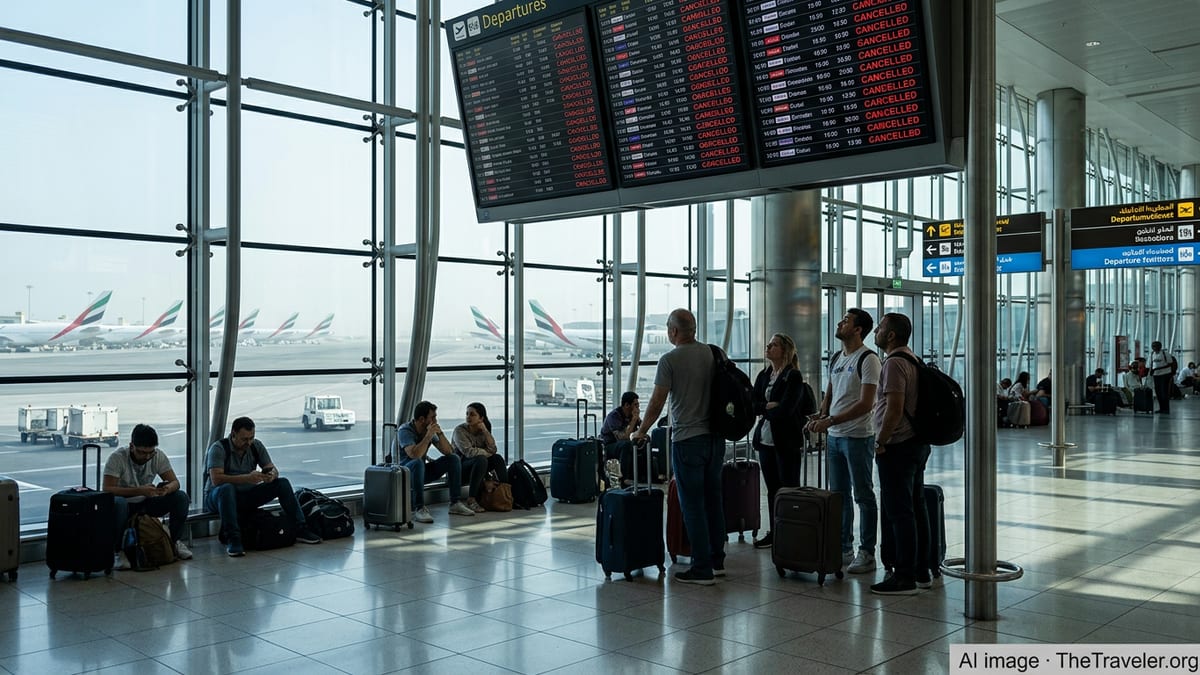
At Dubai and Abu Dhabi airports, scenes of crowded terminals and long queues for information desks have been reported as travellers try to rebook or secure seats on scarce outbound flights. Local authorities in the UAE say they are funding hotel stays for many stranded passengers, but with only a trickle of repatriation services now operating, some visitors face the prospect of days or even weeks of delay.
Elsewhere in the Gulf, British citizens are being advised to stay where they are unless local officials provide safe and clearly organised transport. In the UAE, there are early moves to bus some travellers across the desert to the Omani city of Muscat, where airports remain open and additional services to Europe are being discussed. UK consular staff are working from crisis centres and hotel lobbies to identify vulnerable travellers, including families with young children and those with medical needs.
Although the UK has experience managing large-scale repatriations following airline failures in recent years, officials warn that the current situation is more complex, involving live military operations and a patchwork of rapidly changing airspace rules. Any coordinated evacuation, they say, would depend heavily on regional partners and on the security of routes out of the Gulf.
Advice for UK Travellers With Upcoming Trips
The Foreign Office is urging anyone in the UK with imminent travel plans involving the Middle East, or flights transiting through Dubai, Abu Dhabi or Doha, to contact their airline or tour operator before heading to the airport. With many services already grounded and others under review, carriers are rebooking passengers where possible or offering refunds in line with UK passenger rights regulations.
Under existing rules, travellers whose flights from the UK are cancelled due to the conflict are entitled to a choice between a refund or an alternative journey at the earliest opportunity. However, the war is classed as an extraordinary circumstance, meaning airlines are not obliged to pay additional fixed compensation for delays and disruption. Those with package holidays benefit from separate protections that require tour operators to offer a suitable alternative or full reimbursement if trips cannot go ahead.
Insurance offers only limited extra protection. Many standard policies exclude acts of war or terrorism, reducing the chances of successfully claiming back unrecoverable costs for voluntarily cancelled holidays. Consumer advocates are therefore advising travellers to wait until an airline or tour company cancels their trip before making any decisions, unless official guidance directly advises against travel to their destination.
Officials are also reminding UK nationals to sign up for government travel alerts, check the latest online country advice immediately before departure and factor in that even destinations outside the immediate conflict zone may face knock-on disruption if they rely on Middle East overflight corridors or connections through Gulf hubs.
How Long Could Travel Disruption Last?
Airlines, analysts and officials agree that the duration of the crisis will depend largely on how the conflict between Iran, the US and Israel evolves over the coming days. For now, most carriers are operating on rolling schedules, cancelling or altering flights in 24 to 48 hour blocks as they wait for clarity on airspace restrictions and security guarantees.
Gulf airlines have indicated that they will slowly resume a limited number of services from Dubai and Abu Dhabi, primarily to clear backlogs and repatriate those stranded. Yet full restoration of the pre-crisis wave of daily long-haul departures may be weeks away, especially if further missile alerts force repeated closures.
For British travellers, the immediate message from London is one of caution and patience. Those already in the region are being told to stay in contact with consular teams and to move only when directed, while those still in the UK are advised to consider postponing non-essential trips that rely on Middle East transits. With the situation still volatile, officials warn that the safest journey may, for now, be the one that is delayed.
The evolving travel disruption underlines how deeply global aviation is intertwined with Gulf hubs and how quickly conflict in one part of the Middle East can ripple across holiday plans and business trips worldwide. As governments and airlines attempt to untangle the resulting web of cancellations, diversions and displaced passengers, Britons are being urged to treat all travel into and through the region with exceptional care.