

More news on this day
Europe’s aviation map is being redrawn in 2026, with London Heathrow keeping the United Kingdom at the top of the continent’s busiest-airport rankings even as rivals in France, the Netherlands, Germany, Spain, Italy and Switzerland close in with aggressive capacity growth and record passenger numbers.
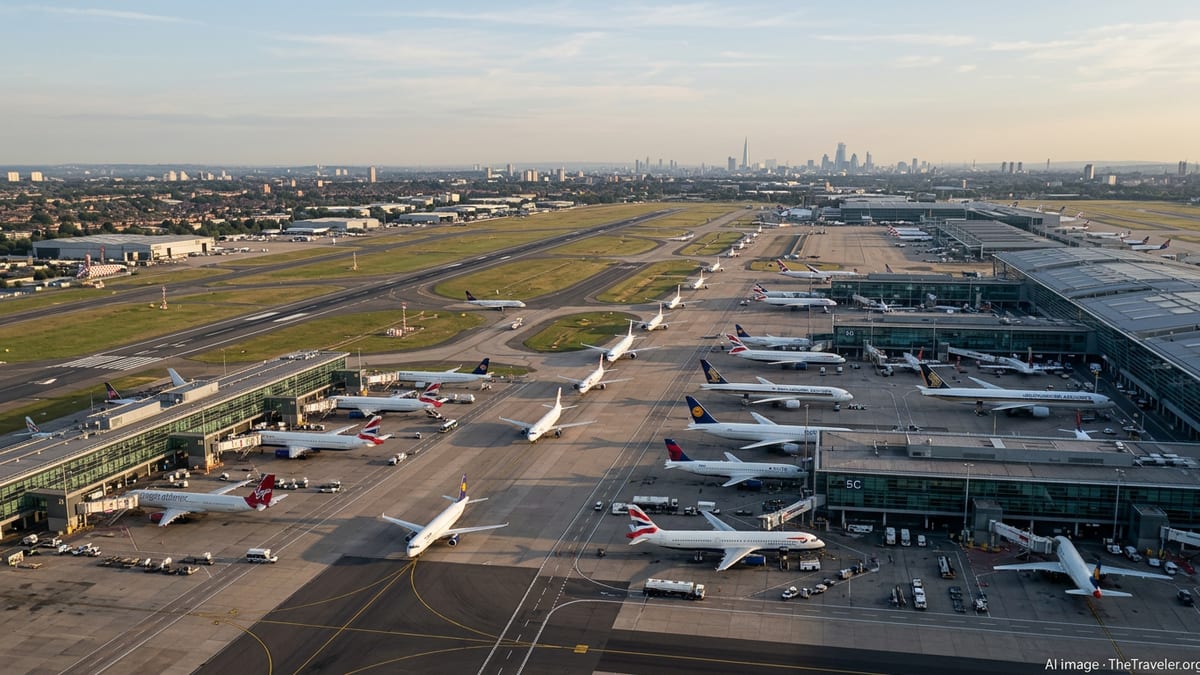
Heathrow Holds the Crown, but the Gap Is Narrowing
London Heathrow enters 2026 as Europe’s busiest airport, capping back-to-back record years in 2024 and 2025 with more than 84 million passengers and its highest-ever single-day throughput during the August holiday peak. Industry data shows Heathrow marginally ahead of Istanbul in total passengers and scheduled seats, reinforcing the UK hub’s role as the region’s primary long-haul gateway and connection point between North America, Europe and emerging markets.
The lead, however, has rarely looked more precarious. Recent figures indicate that Istanbul Airport finished 2025 within tens of thousands of passengers of Heathrow, after posting mid-single-digit growth that far outpaced the British hub. Analysts say that unless Heathrow can unlock further capacity, the UK risked losing its top slot as early as the 2026 summer season.
Heathrow’s management has publicly warned that infrastructure limits, tighter slot constraints and delayed decisions on long-term expansion are squeezing growth prospects just as demand returns to, and in many cases surpasses, pre-pandemic levels. Yet for now, strong transatlantic traffic, robust premium demand and dense short-haul connectivity keep the west London hub at the top of Europe’s busiest-airport league table.
France and the Netherlands Anchor Northern Europe’s Super-Hubs
On the other side of the Channel, Paris Charles de Gaulle and Amsterdam Schiphol remain the heavyweight hubs that ensure France and the Netherlands stay embedded in Europe’s top 10 busiest airports. Paris CDG has largely restored its long-haul network and is steadily rebuilding Asian and North American capacity, even if traffic still hovers just below its 2019 peak. With Air France-KLM focusing more connecting flows through Paris, the French capital’s main airport continues to post solid year-on-year growth in both passengers and available seats.
Amsterdam Schiphol, traditionally one of the continent’s most flight-intense airports, is regaining momentum after several years of political and environmental constraints that capped operations. While the Dutch government has pursued noise and emissions reductions, recent adjustments have allowed airlines to stabilize schedules and rebuild key European feeder routes into the KLM hub. This has kept Schiphol firmly within Europe’s busiest-airport rankings, albeit with a stronger focus on yield and network efficiency rather than pure volume.
Together, Paris and Amsterdam form a northern European backbone that competes directly with Heathrow and Frankfurt for transfer passengers. For travelers, this has translated into a wider choice of routings across the Atlantic and to Africa and Asia, and into growing pressure on hubs to improve punctuality, security processing and baggage performance even as volumes climb.
Germany and Spain Push Capacity, Madrid Closes in on the Leaders
Germany’s major hubs in Frankfurt and Munich continue to play an outsized role in the rankings, keeping Europe’s largest economy squarely in the top-10 airport mix. Frankfurt, home base of Lufthansa, has been rebuilding capacity methodically, adding frequencies on key European and intercontinental routes. While passenger volumes remain slightly below 2019, steady growth through 2024 and 2025 has underpinned its status as one of the busiest airports in Europe by both passengers and movements.
Munich, often seen as Germany’s premium and leisure-oriented hub, has staged a faster recovery, especially on intra-European and holiday traffic. Its growth trajectory places it firmly in the second tier of Europe’s busiest hubs and reinforces Germany’s combined presence in the continental top 10, even as competition from southern Europe intensifies.
Spain’s Madrid Barajas has been one of the standout performers in the post-pandemic rebound. With Iberia and other carriers expanding capacity towards Latin America, Madrid has benefited from its role as the primary bridge between Europe and Spanish-speaking markets. Strong demand from both European and transatlantic passengers has pushed Madrid further up the rankings, bringing it within striking distance of the northern hubs on total passengers and helping Spain consolidate its place among Europe’s busiest-airport nations.
Barcelona El Prat, while not always within the absolute top 10 by annual passengers, adds further weight to Spain’s position by absorbing surging point-to-point leisure and low-cost traffic, particularly during the summer season. Together, the two Spanish gateways ensure the country remains central to Europe’s high-volume aviation network.
Italy and Switzerland Ride Tourism and Premium Demand
Italy’s key airports in Rome Fiumicino and Milan Malpensa are also climbing the ladder, driven by a mix of tourism, new long-haul routes and events-linked capacity boosts. Fiumicino has recently been one of Europe’s fastest-growing large airports, benefiting from both Rome’s enduring tourism appeal and strategic moves by its home carriers and partners to concentrate long-haul services there. This has pushed Italy firmly into the group of nations represented among the continent’s 10 busiest airports.
Milan Malpensa, long seen as a more volatile market, has found new momentum. Expanded intercontinental services and strong demand from northern Italy’s industrial regions and affluent catchment area have helped Malpensa notch double-digit growth in some recent reporting periods. The impending Milan-Cortina 2026 Winter Olympics are also prompting airlines to add capacity, with Malpensa positioning itself as a key gateway for sports fans and winter tourism.
In Switzerland, Zurich Airport remains the undisputed national leader and an important player in Europe’s top-traffic club. Its mix of high-yield business travel, connecting flows through Swiss International Air Lines and resilient inbound tourism to alpine destinations keeps volumes robust even when broader European demand softens. Geneva, though smaller, provides additional throughput that reinforces Switzerland’s role in Europe’s busy-airport map.
Collectively, these Italian and Swiss gateways highlight how premium traffic and tourism-driven demand can sustain high passenger volumes, allowing smaller countries by population to punch above their weight in continental rankings.
Istanbul’s Surge and the Shifting Balance of Power
While London, Paris, Amsterdam, Frankfurt, Madrid, Rome and Zurich keep their countries within Europe’s 10 busiest airports, the real competitive drama of 2026 is playing out between Heathrow and Istanbul. Turkey’s new mega-hub has recorded some of the continent’s strongest medium-term growth, with capacity now significantly above its pre-pandemic levels. Its geographic position between Europe, the Middle East, Africa and Asia, combined with Turkish Airlines’ expansive network, has turned Istanbul into one of the most dynamic transfer hubs in global aviation.
In several recent months, Istanbul has already overtaken other European airports on metrics such as daily flights, even if annual passenger totals still place it just behind Heathrow. Data from aviation agencies and industry groups show Istanbul consistently posting higher growth rates than its western European rivals, narrowing the gap year after year and prompting speculation that it could claim the title of Europe’s busiest airport on a full-year basis within the next traffic cycle.
For 2026, that sets up a closely watched race. Heathrow is banking on sustained transatlantic strength, improved punctuality and operational efficiencies to defend its crown, even as its leadership warns about structural capacity limits. Istanbul, by contrast, is leveraging a still-expanding terminal complex and aggressive network expansion to absorb new demand across multiple regions.
For travelers, the intensifying contest translates into more route options, competitive fares and increasingly crowded terminals across Europe’s top hubs. For governments and regulators in the United Kingdom, France, the Netherlands, Germany, Spain, Italy, Switzerland and Turkey, it is sharpening debates about infrastructure, environmental constraints and the long-term shape of the continent’s aviation map, as Europe’s ten busiest airports set the pace for a record-breaking 2026.