

Wedged between the monumental rock of the Acropolis and the tourist bustle of Plaka, Anafiotika feels like a mirage. This pocket-sized neighborhood, with its whitewashed walls, blue shutters and flower-draped alleys, looks as if it has drifted in from a Cycladic island and somehow anchored itself in the heart of Athens.
For travelers willing to leave the main streets and climb a little, Anafiotika offers one of the city’s most atmospheric detours: a quiet, lived-in enclave where history, architecture and everyday Athenian life intersect in the shadow of ancient stone.
The Story Behind Athens’ Hidden Island Village
Anafiotika did not appear here by accident. Its story begins in the mid 19th century, when Greece’s first king, Otto, set out to reshape Athens into a European-style capital. Skilled builders, stonemasons and carpenters were summoned from across the Cyclades, including the tiny island of Anafi, to work on the royal palace and restoration projects around the Acropolis. Far from home for months at a time, they needed a place to live that felt familiar, and they found it on the steep northeastern slopes of the Acropolis hill.
Working at night and taking advantage of a property law that favored those who built quickly, these island craftsmen raised modest homes in the style they knew best. Small cubic volumes, flat roofs, minimal decoration and dazzling white limewash recreated the forms of their island villages. They named the settlement Anafiotika, literally “the place of the Anafiots.” What began as a practical solution to housing soon developed into a distinctive micro-neighborhood that looked nothing like the neoclassical Athens taking shape below.
Over the decades, Anafiotika evolved but never lost its character. After the Asia Minor catastrophe in 1922, Greek refugees also settled here, folding another layer of memory into the area’s social fabric. Later, extensive archaeological excavations around the Acropolis led to the demolition of many houses in the 1950s and 1970s, shrinking the neighborhood’s footprint dramatically. Today only around 45 houses remain, many still in the hands of descendants of the original families, protected by strict regulations that limit sales and alterations.
This unusual history explains the aura that visitors sense almost immediately in Anafiotika. It is not a planned museum quarter nor a recreated village for tourists. It is a fragile survivor of a particular moment in Athens’ growth, preserved in part by accident, in part by law and in part by the quiet determination of residents who continue to live their lives on these sunlit terraces beneath the Acropolis walls.
What Anafiotika Feels Like Today
Arriving in Anafiotika is a study in contrasts. Within minutes you step from souvenir-filled streets and busy tavernas into a human-scaled warren of footpaths that cars cannot reach. The hum of traffic fades. The sounds that replace it are softer: a radio drifting from an open window, the clink of plates in a courtyard kitchen, the rustle of bougainvillea in the breeze, the quick patter of a cat leaping along a fence.
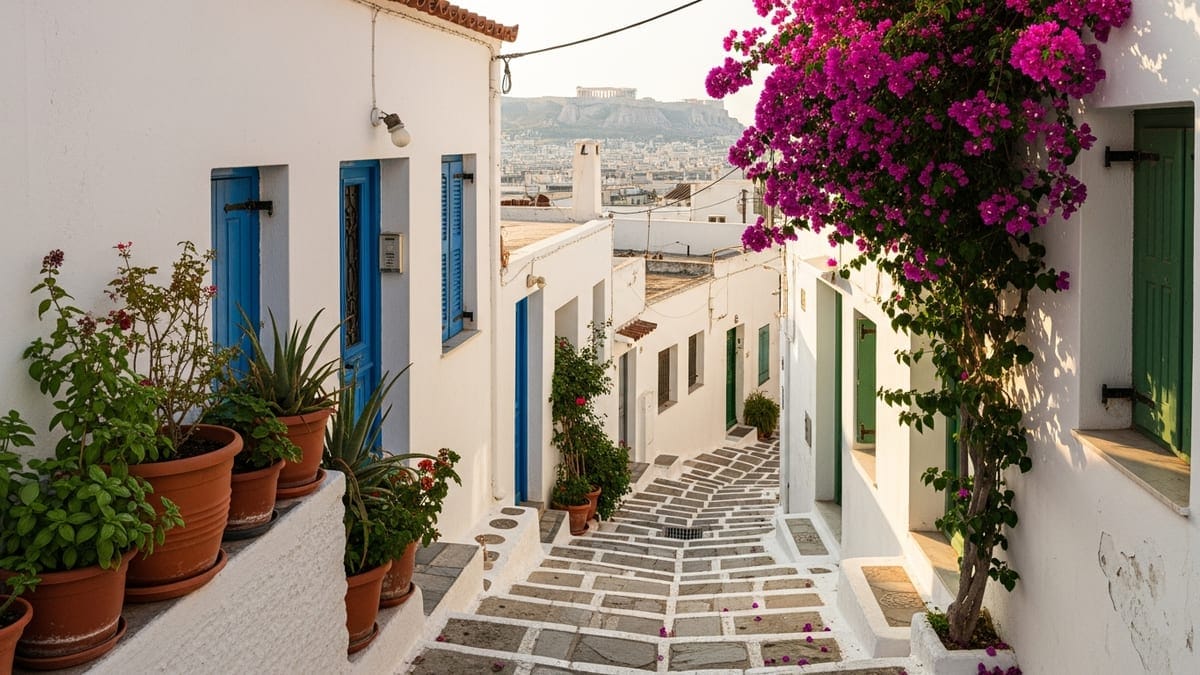
The first impression is visual. Walls are whitewashed so thoroughly that they catch and reflect the Attic light, creating a luminosity that feels closer to Santorini or Naxos than to a European capital. Doors and shutters pop in shades of cobalt, green or rust red. Narrow staircases twist between houses that seem almost to lean on one another for support. Many lanes are barely wide enough for two people to pass; some end abruptly in a terrace overlooking the city, others dissolve into stairs that climb toward the Acropolis fortifications above.
Despite its popularity in guidebooks and travel magazines, Anafiotika remains primarily residential. You will not find souvenir stands, fashion boutiques or chains here. There are no commercial signs, and no taxis or buses can enter. What you will find are plant pots lined up on window sills, laundry strung between walls, tidy vegetable patches and improvised sitting corners where neighbors chat in the evenings. For visitors coming from the high-traffic areas of Monastiraki and Syntagma, the quiet is striking, sometimes even disorienting.
It is this sense of an ordinary neighborhood existing just out of sight of the main tourist current that is Anafiotika’s real luxury. As you wander, the Acropolis rises above you in massive blocks, while below glimpses of modern Athens unfurl toward Lycabettus Hill. Yet in the alleys themselves, life moves slowly. Residents greet each other by name. Cats, clearly well-fed, claim sunny steps as their own. Even on busy summer days, you can still turn a corner and find yourself entirely alone between white walls and sky.
Architecture and Atmosphere: A Cycladic Pocket in the City
Anafiotika is often described as “a Cycladic village in Athens,” and the comparison is not lazy shorthand. The builders from Anafi imported their vernacular architecture almost detail for detail. Houses are small and usually one or two stories high, often arranged in irregular clusters rather than neat city blocks. Their cubic forms create a play of shadows throughout the day as sun strikes different planes, while flat roofs offer precious outdoor space on a hillside too steep for gardens.
Most structures are plastered and painted white with lime-based washes. Beyond reflecting heat, this white envelope visually knits the neighborhood together. Set against it, wooden shutters and doors painted deep blue or earthy green stand out cleanly. Many doorways are framed by climbing geraniums, jasmine or bougainvillea, while aloe and succulents thrive in planters set along stairs. The result is a palette of white, blue, pink and terracotta that photographers find irresistible.
There is little ornamentation in the classical sense. Instead, character emerges from practical adaptations to the terrain. Lanes kink sharply to follow rock contours. Stairs may double as informal terraces where residents place chairs to catch the evening light. Tiny landings become micro-plazas with just enough space for a bench and two pots of basil. The informality of the layout makes the neighborhood feel organic, as if it has grown rather than been designed.
Religious structures are woven unobtrusively into this fabric. Small chapels and older Byzantine churches nearby, such as those dedicated to Saint George and the Transfiguration, anchor local religious life and carry a sense of continuity across centuries. Their stone walls and modest bell towers remind visitors that, though Anafiotika dates to the 19th century, it stands on ground layered with much older histories that archaeology around the Acropolis continues to uncover.
How to Find Anafiotika (Without Getting Lost)
Part of Anafiotika’s charm is that it never quite announces itself. There are no triumphant entry gates, and its network of alleys remains officially unnamed. Most houses are listed simply as Anafiotika followed by a number, a bureaucratic quirk that reinforces the sense of being in a village rather than a district of a capital city. Yet for first-time visitors, this can make navigation confusing, especially when relying on digital maps that often show only fragments of paths.
The easiest orientation point is the neighborhood of Plaka, the historic quarter on the northeastern side of the Acropolis. From central Syntagma Square, you walk downhill toward the cathedral and into the old streets of Plaka, gradually angling upward until they begin to climb in earnest. Streets such as Mnisikleous, Thrasivoulou and Stratonos act as informal gateways. As outdoor restaurant terraces thin out and the steps grow steeper, you are moving in the right direction.
From the direction of Monastiraki or the Acropolis Museum, aim for the upper reaches of Plaka and then look for staircases that ascend toward the rock. In practice, this might mean following Stratonos Street until residential houses close in on both sides, then turning onto one of the narrower steps that veer upward. Signs to the Acropolis can be helpful, but you will often need to ignore the larger walkways meant for the archaeological site and choose the smaller, more intimate paths that peel off to the side.
There are no vehicular access points; taxis and ride shares will leave you at the edges of Plaka. Once you begin climbing, give yourself permission to wander a bit. The area is compact, and you can traverse it in 30 to 45 minutes at a leisurely pace. When in doubt, follow the white. Walls become consistently whitewashed as you enter Anafiotika, and the appearance of houses tucked closely into the hillside is a good indication that you have arrived.
When to Visit, How Long to Stay and What to Expect
Anafiotika is open at all hours, with no gates or ticket booths. That said, the experience differs dramatically depending on when you come. Early mornings, particularly between 8 and 10 a.m., are ideal for travelers who value quiet streets and soft, directional light. At this time, many residents are beginning their day and a few other early visitors may be exploring, but the lanes often feel peaceful and uncluttered. Photographers will find that the low sun creates appealing shadows and a pleasant glow on white surfaces.
By late morning and early afternoon in peak season, more people arrive, often in small groups who have heard of the “hidden village” and climb up after seeing the Acropolis. The alleys are narrow, so even moderate foot traffic can make the area feel busy. Midday light also tends to be harsh and flat, with strong contrast on white walls. The sense of escape from the city is still present, but less intense. Late afternoon and the hour before sunset can be beautiful, with warm tones slanting across the roofs and views opening over the city below.
As for duration, allow at least 30 minutes to slowly wander the main cluster of houses, take a few photographs and soak in the atmosphere. Travelers who enjoy exploring urban details, sketching or photography will easily spend an hour or more tracing paths up and down the hillside, pausing by chapels, watching resident cats or simply sitting on a low wall to gaze at the skyline. Because there are no cafés or shops within the settlement itself, many visitors combine Anafiotika with nearby activities such as a tour of the Acropolis or a stroll through Plaka’s shops and tavernas.
Practical expectations are straightforward. Pathways are narrow, sometimes uneven and almost entirely stepped, which can be challenging for those with mobility issues. There are no public restrooms in the immediate neighborhood, and shade can be limited in the heat of the day. Sturdy footwear, water and a hat in summer months are sensible. Anafiotika is fundamentally a residential enclave, so services cater to those who live here, not to travelers passing through, and that is precisely why it continues to feel authentic.
Experiencing Anafiotika Respectfully
As word of Anafiotika has spread on social media and in travel coverage, visitor numbers have risen, especially during the high season from late spring through early autumn. This visibility brings both appreciation and pressure to a neighborhood that was never designed to absorb large numbers of outsiders. Walking its lanes today, you are not just moving through an atmospheric backdrop for photographs; you are stepping into a living community whose residents cook, sleep, work and raise families behind those white walls.
Respect begins with behavior. Keep voices low, especially in the early morning and evening when sound carries easily through the close-set houses. Avoid playing music out loud or conducting extended phone calls in narrow alleys. When taking photographs, focus on architectural features and street scenes rather than shooting directly through open windows or into private courtyards. Many residents are understandably sensitive to feeling as though their homes have become a public exhibit.
Stick to the established paths and stairways. While it can be tempting to wander onto seemingly unused terraces or to cut through small openings between buildings, many of these areas are private property even if not obviously marked. Gates and doors, no matter how picturesque, should remain closed unless clearly open to visitors, such as the entrance to a church during services or posted opening hours. Climbing onto roofs or walls for better viewpoints is both unsafe and intrusive.
Simple gestures help preserve the neighborhood. Take any trash with you when you leave, including water bottles and snack wrappers. Refrain from drawing on walls, carving initials or moving plant pots and furniture for the sake of a photograph. Support nearby small businesses on the edges of Anafiotika and in Plaka rather than treating the district as a backdrop alone. By approaching the neighborhood as a guest in someone’s home rather than a consumer of scenery, you help ensure that this fragile Cycladic pocket can remain both livable for residents and magical for future visitors.
Combining Anafiotika with a Day in Central Athens
Because of its location just beneath the Acropolis crown and above the streets of Plaka, Anafiotika fits naturally into many different itineraries. One of the most rewarding combinations is to visit early in the day, then continue upward to the Acropolis archaeological site as it opens, avoiding some of the midday heat and crowds. From the upper edges of Anafiotika, you are only a short walk from the official entrances to the ancient citadel, giving you an easy transition from village-scale intimacy to monumental history.
Alternatively, you might explore the Acropolis and its museum first, then descend through the landscaped pedestrian walkways that encircle the hill and detour up into Anafiotika in late afternoon, when the light softens and the day’s heat begins to ebb. After wandering its alleys, you can drop back down into Plaka to find dinner at a traditional taverna, sample meze plates or simply sit with a coffee as street life unfolds around you. This sequence turns a standard sightseeing day into a more layered experience of Athens, moving between ancient, 19th-century and contemporary cityscapes within a few hours.
Anafiotika also pairs well with explorations of nearby neighborhoods such as Monastiraki, with its flea market and Ottoman-era buildings, or the quieter residential streets above the Roman Agora. Those interested in urban photography or architecture will find fascinating contrasts in the way different periods of Athenian history coexist within walking distance. From certain corners of Anafiotika, for instance, you can frame views that juxtapose Cycladic-style houses, Byzantine domes, neoclassical facades and modern apartment blocks in a single line of sight.
Whatever route you choose, try to allow moments of unstructured time in your day. Anafiotika is not a checklist sight with must-see interiors or timed entries; its value lies in atmosphere. Give yourself permission to follow whichever staircase looks appealing, to stop when a view catches your eye, or to linger when the neighborhood is particularly quiet. These unscripted pauses often become the memories travelers cherish most when they think back on Athens.
The Takeaway
In a capital filled with commanding monuments and headline sights, Anafiotika is a reminder that some of the most resonant travel experiences happen at a smaller scale. This tiny hillside neighborhood offers no grand squares, no designer boutiques, no sweeping boulevards. What it does offer is a rare blend of island aesthetics and urban intimacy: a Cycladic village translated to stone above the city, its lanes worn smooth by generations of footsteps, its walls absorbing the same golden light that falls on the Parthenon overhead.
To walk Anafiotika is to move through several stories at once: the ambitions of a young nation building its capital in the 19th century, the resourcefulness of island craftsmen creating a home away from home, the disruptions of archaeology and urban change, and the quieter, ongoing life of families who still water their plants, sweep their steps and call their neighbors by name. By approaching the area gently and attentively, travelers can share in that story without overwhelming it.
For visitors to Athens, Anafiotika is not just a photo opportunity, though it provides many; it is a chance to feel the city’s layers on a human scale. Come with comfortable shoes, a sense of curiosity and a willingness to tread lightly. Leave with the memory of white walls against blue sky, the echo of your footsteps on stone and the realization that in Athens, even the smallest corners can hold entire worlds.
FAQ
Q1: Where exactly is Anafiotika located in Athens?
Anafiotika lies on the northeastern slope of the Acropolis hill, directly above the Plaka neighborhood. It is within the historic center of Athens, a short uphill walk from Syntagma Square, Monastiraki and the main streets of Plaka.
Q2: How do I get to Anafiotika using public transport?
The closest metro stops are Acropoli on Line 2 and Monastiraki on Lines 1 and 3. From either station, walk toward Plaka and then follow the streets uphill. Once you reach the steeper stairways of upper Plaka, continue ascending on smaller lanes until you begin to see closely packed whitewashed houses, which indicates you have entered Anafiotika.
Q3: Is there an entrance fee or opening hours for Anafiotika?
No, Anafiotika is a residential neighborhood, not a formal attraction, so there is no entrance fee or ticket. The area is accessible at all hours, although early morning and late afternoon are generally the most pleasant times to visit due to cooler temperatures and softer light.
Q4: How much time should I plan to spend in Anafiotika?
Most visitors find that 30 to 60 minutes is enough for an unhurried walk through the lanes, stopping for photos and views over the city. Travelers interested in architecture, sketching or photography may choose to stay longer, especially if combining a visit with nearby Plaka or the Acropolis.
Q5: Are there cafés, shops or restaurants inside Anafiotika?
There are no commercial establishments within the core of Anafiotika itself. The neighborhood consists primarily of houses, small chapels and narrow pedestrian alleys. However, just below in Plaka you will find many cafés, tavernas and shops where you can eat, drink and rest before or after exploring the area.
Q6: Is Anafiotika suitable for travelers with limited mobility?
Anafiotika can be challenging for travelers with limited mobility. The paths are steep, narrow and mostly made up of uneven steps, with no vehicle access and few handrails. There are no ramps or lifts. Those who have difficulty with stairs may prefer to enjoy views of the neighborhood from lower vantage points in Plaka instead of entering the alley network itself.
Q7: Is it safe to visit Anafiotika, especially if I am traveling alone?
During daylight hours, Anafiotika is generally considered safe, and many solo travelers visit without issues. As in any urban area, it is sensible to keep an eye on personal belongings and avoid flashing valuables. At night, the lanes can be very quiet and poorly lit, so some visitors may feel more comfortable exploring during the day or early evening.
Q8: Can I go inside the houses or courtyards in Anafiotika?
No, the houses and most courtyards in Anafiotika are private homes. Visitors should not enter, open gates or lean into windows, even if an area looks picturesque or seems unoccupied. Respecting residents’ privacy is essential to maintaining good relations between locals and visitors in this small community.
Q9: Are there guided tours that include Anafiotika?
Several walking tours of Athens and the Acropolis area include a brief visit to or viewpoint over Anafiotika, often combined with Plaka and other historic districts. These tours can provide useful historical context and local insight, though the alleys themselves are easy to explore independently if you prefer to wander at your own pace.
Q10: What should I bring with me when visiting Anafiotika?
Comfortable walking shoes with good grip are essential due to the steep, stepped paths. In warmer months, bring water, a hat and sunscreen, as shade can be limited. A camera or smartphone is useful for capturing the architecture and views, but remember to be discreet and respectful when photographing in this residential setting.