

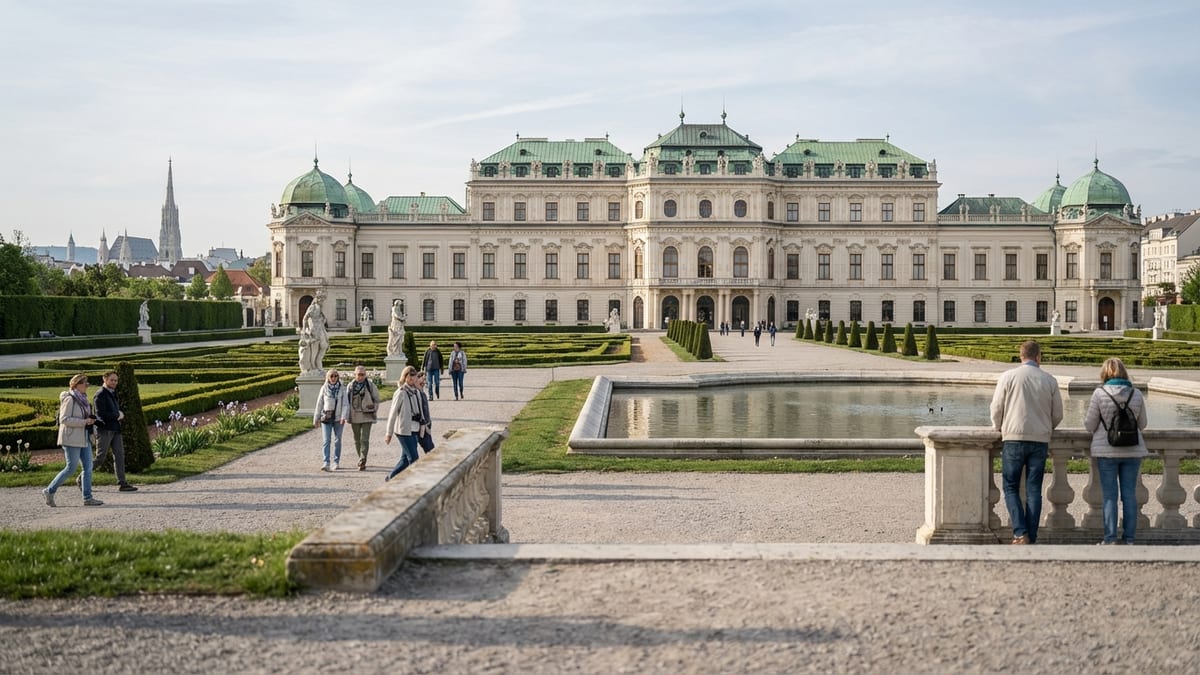
Belvedere Palace in Vienna is more than a single building. It is a hillside of baroque palaces, formal gardens, and modern galleries that together trace 800 years of art history, from medieval icons to Gustav Klimt and contemporary installations. For many travelers it is a nonnegotiable stop for seeing Klimt’s The Kiss, but the Belvedere is also a place to walk, to look back across the city skyline, and to understand how Vienna has staged power and culture over three centuries.
Belvedere in Context: A Baroque Vision Above Vienna
The Belvedere began as the summer residence of Prince Eugene of Savoy, the Habsburg Empire’s most famous general. In the early 18th century he commissioned the architect Johann Lukas von Hildebrandt to create a baroque complex on a gentle slope south of the old city walls. The result was a pair of palaces, Lower Belvedere at the bottom of the hill and Upper Belvedere at the top, linked by terraces, fountains, and manicured parterres that frame long views over Vienna. Completed in 1723, the estate quickly became one of the city’s showpieces of aristocratic ambition.
In the centuries that followed, the Belvedere’s role shifted repeatedly. It hosted court festivities, briefly served as an imperial residence, and eventually became a public museum. The complex also witnessed defining political moments. In May 1955, the Austrian State Treaty was signed in the Upper Belvedere, formally restoring Austria’s sovereignty after the Second World War. Today the Belvedere operates as a major national museum, its palaces and gardens open to visitors while continuing to provide a ceremonial backdrop for cultural events and official receptions.
For travelers, that layered history is visible at every turn. The lower palace still feels closest to Prince Eugene’s residential world, with stuccoed ceilings and intimate chambers, while the upper palace expresses full baroque theater, designed to impress visiting dignitaries with painted ceilings, grand staircases, and carefully orchestrated perspectives through enfilades of rooms. Step outside, and the geometry of the gardens leads your gaze up, down, and outward, tying the whole ensemble to the wider city beyond its gates.
Upper Belvedere: Klimt, The Kiss, and Iconic Austrian Art
The Upper Belvedere is the museum’s main magnet and the home of the world’s largest collection of paintings by Gustav Klimt. For many visitors, the journey through the palace culminates in front of The Kiss, Klimt’s gold-sheathed depiction of two lovers poised on the edge of a flowery precipice. Encountering it in person is very different from seeing reproductions: the subtle relief of the gold leaf, the shimmering surface, and the quiet scale of the room create an almost chapel-like focus, especially in the early morning when crowds are thinnest.
Yet the Klimt rooms are only one part of a broader narrative. The Upper Belvedere presents Austrian art across several centuries, from medieval altarpieces to baroque portraiture, Biedermeier interiors, and the radical innovations of the Vienna Secession. Works by Egon Schiele, Oskar Kokoschka, and other modernists reveal a more fractured, psychological vision of the human figure compared with Klimt’s ornamental idealism. Alongside them you will find landscapes by Ferdinand Georg Waldmüller and later by artists such as Claude Monet and Vincent van Gogh, which place Austrian developments in dialogue with European trends.
The building itself acts as an immersive frame. As you climb the grand staircase, frescoes and stucco guide your eye upward, a deliberate baroque strategy meant to suggest ascent toward power and enlightenment. Many galleries retain their historical decoration, so that you move between richly carved doorways and painted ceilings while looking at modernist works on the walls. The juxtaposition is part of the Belvedere’s appeal: this is not a neutral white-cube museum but an artwork of architecture containing other artworks, each modifying your experience of the rest.
Plan to give the Upper Belvedere at least two hours if you want to move beyond the headline Klimt canvases. Audio guides and smartphone-based tours are available in multiple languages and can be a useful way to delve deeper into specific rooms or artists without feeling rushed. If you are visiting in peak season, timed tickets help regulate the flow of visitors into the Klimt rooms, limiting overcrowding and allowing more space for contemplation.
Lower Belvedere, Orangery & Palace Stables: From Prince’s Home to Exhibition Space
Lower Belvedere sits at the base of the gardens and was originally designed as Prince Eugene’s residential palace. It retains a more intimate, almost domestic scale compared with the upper palace, though its interiors are still richly decorated with stucco reliefs, mirrors, and ceiling paintings. Today these spaces host a changing program of temporary exhibitions that range across periods and themes, from focused monographic shows to cross-cultural dialogues.
The Orangery and the former Palace Stables form part of this lower complex. The Orangery, once a winter shelter for citrus trees, is now an exhibition hall where contemporary installations or thematic shows often interact with the long, light-filled volume of the space. The Palace Stables, meanwhile, house a permanent presentation of medieval art, including sculptures and panel paintings that offer a striking contrast to the modernist and contemporary works seen elsewhere on the site. Shifting between these areas can feel like moving back and forth through time, mirroring the breadth of the Belvedere’s collection.
Because the Lower Belvedere focuses on rotating exhibitions, what you see here will depend on when you visit. It is worth checking in advance which shows are on during your travel dates, especially if you have a particular interest in French Impressionism, Austrian baroque painting, or specific artists whom the museum frequently revisits. Even if the current exhibition is not your primary draw, the opportunity to walk through Prince Eugene’s residential rooms and the Orangery’s long gallery offers another angle on the baroque ensemble.
The atmosphere in the Lower Belvedere is often calmer than in the Upper Belvedere. Many groups focus solely on Klimt, which means that the lower palace can feel more spacious and less hurried. If you purchase a combination ticket that includes both palaces, consider starting at the lower one, where you can absorb the historical setting and current exhibitions before climbing through the gardens to the upper palace for Klimt and the grand state rooms.
Belvedere 21 and the Gardens: Linking Baroque Grandeur with Contemporary Voices
A short walk from the historic palaces brings you to Belvedere 21, the museum’s hub for modern and contemporary art. Housed in a piece of postwar modernist architecture originally built as the Austrian pavilion for the 1958 World Expo, the building is all glass, steel, and clear lines. Inside, rotating exhibitions showcase Austrian and international artists working across media, from painting and sculpture to video, immersive installations, and performance.
Belvedere 21 extends the story told in the historic palaces into the late 20th and 21st centuries. Where the Upper Belvedere presents Klimt and his contemporaries as the pinnacle of Viennese modernism, the contemporary venue picks up the thread, exploring how artists have responded to shifting political, social, and technological landscapes. The contrast in architecture is intentional. After the stucco and fresco of the baroque rooms, the clarity and openness of the modern building reset your visual senses and prepare you for a different kind of looking.
Between these venues lie the Belvedere gardens, the connective tissue of the entire complex. Designed in the formal French style, the gardens are laid out across several terraces that step down the hillside from the Upper to the Lower Belvedere. Symmetrical flowerbeds, sculpted hedges, and carefully positioned statuary line the central axis, while fountains and pools reflect the facades of the palaces. From the upper terrace, the view across the gardens toward the city center and the distant spires of St. Stephen’s Cathedral is one of Vienna’s classic panoramas.
The gardens are free to enter and open outside the core museum spaces, making them popular with both locals and visitors. They are particularly atmospheric in the early morning and late afternoon, when the light softens and the crowds thin. In spring and summer, flowerbeds brim with seasonal plantings, while in winter the bare geometry of the terraces and the crisp silhouette of the palaces take center stage. If you have limited time, a walk through the gardens at least allows you to experience the architectural choreography of the site, even if you cannot enter every museum building.
Planning Your Visit: Tickets, Opening Hours and Practical Tips
Belvedere operates as a multi-venue museum, so thinking through your ticket and timing in advance will make your visit smoother. For the Upper Belvedere, where Klimt’s The Kiss is displayed, standard tickets currently require a timed entry slot. Buying online ahead of your visit often costs slightly less than purchasing on-site and helps you avoid ticket-office queues. At the time of writing, a single ticket to the Upper Belvedere is typically in the high teens of euros, with reduced rates for seniors, students under 26, visitors with disabilities, and free admission for children and young people under 19.
If you plan to explore more than one site, combination day tickets can be good value. A two-in-one ticket usually covers Upper and Lower Belvedere on the same day, while a three-in-one option adds Belvedere 21. These tickets allow you to visit the additional venues before or after your timed slot at the Upper Belvedere, provided it is all within the same day and during regular opening hours. Annual passes and national museum cards offer further options for repeat visitors or residents, and holders of certain city passes may enter directly without booking a time slot.
Opening hours vary slightly by location. As of early 2026, the Upper Belvedere generally opens daily from morning until early evening, while the Lower Belvedere operates on a similar but slightly later schedule. Belvedere 21 usually opens Tuesday to Sunday, with extended evening hours on Thursdays for late-night visits. Seasonal adjustments occur at peak times, such as extended evening openings during the summer and winter holiday period. It is wise to double-check exact hours and any special closures close to your visit date, especially during exhibition changeovers or public holidays.
On a practical level, plan for airport-style museum routines. Allow a buffer for cloakroom lines, which are mandatory for larger bags, and avoid arriving too close to last admission if you want an unhurried experience. Audio guides are available at the Upper and Lower Belvedere for an additional fee, and you are encouraged to use your own headphones with a standard jack. All venues aim to be accessible, with elevators, ramps, and gender-neutral restrooms. Visitors with disability cards typically receive discounted admission, and a registered companion may often enter free of charge.
When to Go and How to Experience Belvedere at Its Best
The Belvedere can feel very different depending on the time of day and season. For a quieter encounter with Klimt’s The Kiss and the main galleries of the Upper Belvedere, early morning time slots are usually the most serene, particularly on weekdays outside school holidays. Late afternoon can also be calmer, as group tours thin out, and the low light filtering through the windows adds a soft, reflective atmosphere to the rooms.
In terms of seasons, Vienna’s shoulder months are ideal. April through June brings mild weather and fresh greenery in the gardens, while September and October offer stable temperatures and shifting autumn colors. High summer is beautiful but busier, and you should book tickets well in advance if you are traveling in July or August. Winter visits have their own appeal: the stark forms of the gardens, fewer tourists, and the possibility of combining an indoor art day with the city’s Christmas markets if you are visiting from late November into December.
How you structure your time on-site will depend on your interests. Art-focused travelers may devote half a day to the Upper Belvedere alone, taking in not only the Klimt galleries but also the medieval, baroque, and 19th-century sections. Others might opt for a lighter approach, pairing a focused Klimt visit with a relaxed garden stroll and a temporary exhibition at the Lower Belvedere. Those interested in contemporary culture should add Belvedere 21 to the itinerary, ideally on a Thursday evening when the building often stays open later and hosts talks, screenings, or performances.
To avoid museum fatigue, build in breaks. The cafés at the Belvedere serve drinks and light meals, and the gardens offer benches with views where you can rest and absorb what you have seen. In warm weather, many visitors bring a book or simply sit on the edge of the fountains between visiting the.upper and lower palaces. Taking time to pause will deepen your appreciation of the collection and the site, rather than treating it as a hurried checklist stop before moving on to the next attraction.
Highlights Not to Miss: From The Kiss to the State Treaty Room
While part of the pleasure of the Belvedere is wandering without a rigid plan, certain works and spaces are especially worth seeking out. At the top of most lists sits Gustav Klimt’s The Kiss, painted between 1907 and 1908. The painting anchors a broader presentation of Klimt’s work, including other major canvases from his so-called Golden Period and later, more introspective portraits and landscapes. Standing close to The Kiss, notice the interplay between the flat, patterned cloaks and the delicately modeled faces and hands, which bridge decorative abstraction and emotional realism.
Other masterpieces in the Upper Belvedere include Egon Schiele’s intense self-portraits and figurative works, Oskar Kokoschka’s psychologically charged portraits, and important pieces by artists such as Ferdinand Georg Waldmüller and Richard Gerstl. In the earlier sections, medieval altarpieces and baroque paintings provide context for Austria’s religious and dynastic imagery, while 19th-century rooms introduce Biedermeier domestic scenes and romantic landscapes. These shifts in style and subject offer a condensed visual history of how Austrians have seen themselves and their surroundings over time.
Architecture fans should also make time for key spaces within the palaces. The Marble Hall in the Upper Belvedere is among the finest baroque interiors in Vienna, with tall windows, polychrome columns, and a ceiling painting that draws the eye upward. This is also the room where the Austrian State Treaty was signed in 1955, a fact commemorated by photographs and displays that link the artistic splendor of the hall with its modern political significance. The grand staircase, with its sculpted balustrades and allegorical figures, offers another essential perspective on Hildebrandt’s architectural vision.
In the Lower Belvedere, the Gold Cabinet and Marble Gallery showcase some of the most richly decorated baroque interiors of the complex, while the Orangery’s elongated hall provides a striking venue for large-scale contemporary or thematic exhibitions. At Belvedere 21, the highlight is often as much the building itself as any particular artwork: look for the way the glass facade connects the galleries with the surrounding parkland and how the modular interior can be reshaped to suit different curatorial needs.
The Takeaway
Belvedere Palace is not a single destination but a constellation of experiences. You can come for an hour, see The Kiss, and admire one of Europe’s great baroque views across Vienna, and it will be worth the detour. Yet the site rewards a slower approach, one that follows the arc from Prince Eugene’s 18th-century summer residence to a 21st-century museum campus encompassing historical, modern, and contemporary art.
Whether you are tracing Klimt’s gold shimmer in the Upper Belvedere, exploring an experimental installation at Belvedere 21, or simply watching the light shift across the gardens, the complex invites you to think about how places hold memory. Art here is not isolated from history or politics; it is embedded in a built environment that has witnessed imperial festivities, war, reconstruction, and the everyday rhythms of city life. As you leave, that layered sense of time is likely to stay with you, making the Belvedere one of Vienna’s most resonant encounters with the past and present.
FAQ
Q1. Where is Belvedere Palace located in Vienna?
Belvedere Palace sits in the 3rd district of Vienna, southeast of the historic city center, with the main entrance to the Upper Belvedere on Prinz-Eugen-Straße and the Lower Belvedere facing Rennweg. It is within walking distance of Vienna’s central train station and well connected by tram and bus.
Q2. What are the current opening hours for the Belvedere museums?
As of early 2026, the Upper Belvedere generally opens daily from morning until early evening, the Lower Belvedere operates on similar daily hours starting slightly later in the morning, and Belvedere 21 usually opens Tuesday to Sunday with extended hours on Thursday evenings. Exact times and any seasonal changes should be checked shortly before your visit, as schedules can shift for holidays or special events.
Q3. Do I need to book tickets in advance?
Booking in advance is strongly recommended, especially for the Upper Belvedere. Timed-entry tickets help regulate crowds in the Klimt galleries, and buying online often saves a small amount compared with on-site prices. Combination tickets for multiple venues can also be reserved ahead, ensuring you have a confirmed slot during busy seasons.
Q4. How much time should I allow for a visit?
If you plan to see only the Upper Belvedere and Klimt’s The Kiss, you can cover the essentials in about 90 minutes. To explore both Upper and Lower Belvedere, plus some time in the gardens, three to four hours is comfortable. Adding Belvedere 21 and a more in-depth look at the collections can easily turn the experience into a full day.
Q5. What is the best time of day to see Klimt’s The Kiss?
Early morning time slots are usually the most relaxed, especially on weekdays, allowing you to approach The Kiss with fewer people jostling for a view. Late afternoon can also be calmer than late morning and early afternoon, though this varies by season and day. Whenever possible, avoid the peak late-morning windows on weekends and holidays.
Q6. Are the Belvedere museums suitable for children?
Yes. While the Belvedere is not a hands-on science museum, many children enjoy the grand staircases, painted ceilings, and the visual drama of Klimt’s gold-leaf works. The gardens provide space to move between museum visits, and family-focused audio content or activity sheets may be available during certain exhibitions. Strollers are generally allowed, though large prams might need to be left in the cloakroom.
Q7. Is Belvedere accessible for visitors with limited mobility?
The Belvedere aims to be accessible across its venues, with elevators, ramps, and adapted restrooms where possible. Visitors with disability cards typically receive discounted admission, and a registered companion may enter free of charge. Because access routes in historic buildings can be complex, it is advisable to ask staff at the entrance for the best paths to specific galleries or to consult the latest accessibility information before arrival.
Q8. Can I visit the gardens without buying a museum ticket?
Yes. The formal gardens between the Upper and Lower Belvedere are generally open to the public without charge during standard opening hours. You can walk the terraces, enjoy the fountains, and take in the city views even if you do not enter the museum interiors. However, access to indoor exhibitions and historic rooms requires a valid ticket.
Q9. Are audio guides or guided tours available?
Audio guides are available for the Upper Belvedere’s permanent collection and for many exhibitions in the Lower Belvedere, usually for a small rental fee. Content is offered in multiple languages, and visitors are encouraged to bring their own headphones. Guided tours, both group and private, can be booked through the museum or external operators and provide expert context on Klimt, baroque architecture, and Austrian art history.
Q10. What should I wear and are there any visitor rules to know?
There is no formal dress code, but comfortable shoes are essential, as you will be walking and standing on hard floors and garden paths. Large bags, umbrellas, and backpacks usually must be checked at the cloakroom. Photography without flash is typically allowed in many areas, though restrictions may apply to certain temporary exhibitions. As in most museums, touching artworks or leaning on display cases is not permitted, and food and drink should be consumed only in designated café areas.