

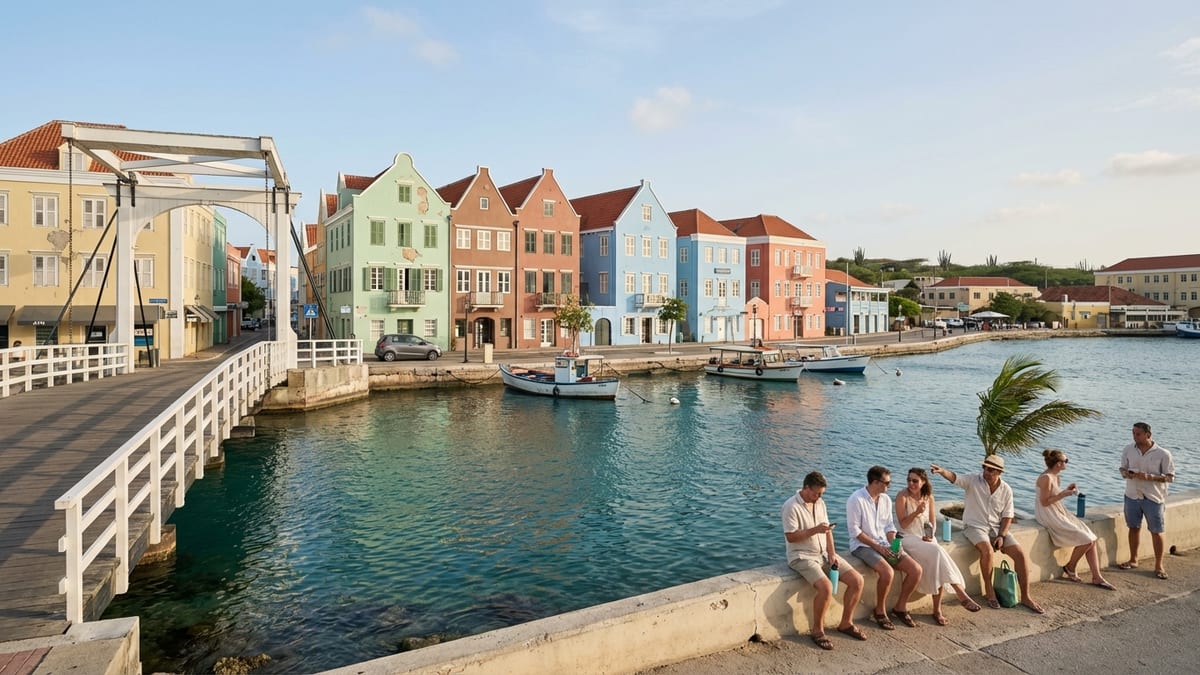
Curaçao is the kind of Caribbean island that quietly wins people over. It combines Dutch-Caribbean architecture and cosmopolitan dining with sheltered coves, clear water and consistently warm, dry weather. It also sits south of the traditional hurricane belt, which gives it a different rhythm from many of its more storm-prone neighbors. This guide walks you through where to go, what to do and what to expect on the island now, from entry rules and money to beaches, neighborhoods, safety and on-the-ground logistics.
Getting Oriented: Island Overview & When to Go
Curaçao lies in the southern Caribbean Sea, just off the coast of Venezuela, and is part of the Kingdom of the Netherlands. The island is relatively compact, around 40 miles long, with most of the population and services concentrated in and around the capital, Willemstad, on the southern coast. Beyond the city, the western side of the island is dotted with small fishing villages and protected coves, while the east is drier and more rugged, with former plantations and windswept coastline.
The climate is warm and semi-arid year-round, with average daytime temperatures hovering around 86 to 89 degrees Fahrenheit (about 30 to 32 degrees Celsius) and only modest variation between seasons. Passat trade winds take the edge off the heat most of the year. The island’s rainy period typically falls from roughly October to December, but showers are often brief and many occur at night, leaving days largely sunny.
Curaçao’s location outside the main Atlantic hurricane belt means it is rarely affected directly by hurricanes. The broader Caribbean hurricane season officially runs from June 1 to November 30, but on Curaçao this usually translates into slightly warmer and less breezy conditions and the possibility of occasional heavy rain rather than frequent destructive storms. That makes it a viable year-round destination, especially for travelers looking to avoid the riskier months elsewhere in the region.
Peak tourist season runs from about December through April, when visitors from North America and Europe arrive for winter sun. During this period, accommodation prices are higher and popular beaches and restaurants are busier. May through November tends to be less crowded and often more affordable, with May and June particularly appealing for a balance of dry weather, warm seas and lower prices. If you want to experience Curaçao’s cultural side, consider aligning a visit with Carnival season in late winter, when the island’s streets fill with music, costumes and parades.
Entry Requirements, Health & Practical Basics
Entry requirements can change, so you should always verify details with official sources close to your departure. As of early 2024, visitors generally need a passport that is valid for the entirety of their stay and is not more than 10 years old. Travelers may also be asked to show proof of onward or return travel, proof of sufficient funds and a reason for stay, such as a hotel booking or invitation from friends or family.
All travelers must fill out a Digital Immigration Card prior to arrival, which speeds up processing on landing. Some nationalities are visa-exempt for short tourist stays, while others require a visa in advance; eligibility depends on your passport and current bilateral arrangements. Regardless of visa status, authorities recommend that travelers carry travel insurance that covers medical expenses, emergency treatment, hospitalization and medical repatriation.
On the health side, Curaçao is generally considered a low-risk destination for most travelers. The island may require proof of yellow fever vaccination for passengers arriving from countries where yellow fever is endemic. Routine travel vaccinations and standard health precautions remain advisable. The tap water is desalinated, strictly monitored and widely regarded as safe to drink, which reduces the likelihood of stomach upsets and cuts down the need to purchase bottled water.
In terms of money, Curaçao is in the middle of a currency transition. Historically, the local currency has been the Netherlands Antillean guilder (often abbreviated ANG or NAf), which is pegged to the US dollar. Authorities have been preparing to introduce a new Caribbean guilder to replace it at a one-to-one rate. US dollars are widely accepted in shops, restaurants and hotels, and major credit cards are common, especially in tourist areas. That said, it remains wise to carry some local currency for small purchases, parking or vendors who do not accept cards. ATMs are easy to find in Willemstad and at major resorts but are less common in remote western parts of the island.
Willemstad & Beyond: Key Areas and Neighborhoods
Most visitors base themselves in or around Willemstad, a capital city recognized for its pastel-colored colonial architecture and protected harbor. The downtown area is split by the St. Anna Bay into two main districts: Punda on the east side and Otrobanda on the west, connected by the Queen Emma pedestrian pontoon bridge. Punda is home to many of the city’s most photographed waterfront buildings as well as shopping streets and cafes, while Otrobanda has a more lived-in feel, with street art, small bars and residential streets radiating out from the waterfront.
Just north of Punda and Otrobanda is the Scharloo district, once the preserve of wealthy merchants. You can still see grand mansions and townhouses here, some restored as offices or boutique accommodations. Nearby Pietermaai has emerged as a fashionable neighborhood, with historic houses converted into boutique hotels, cocktail bars and restaurants. This area is popular with travelers who want to be in the city but slightly removed from the busiest shopping streets.
East of Willemstad, the Jan Thiel and Mambo Beach (Seaquarium Beach) areas form the island’s main resort clusters. Jan Thiel Bay is known for its man-made beach areas, pool clubs and self-catering apartments, with easy access to restaurants and watersports. Mambo Beach offers a similar atmosphere, with beach clubs lined along a protected stretch of sand, a lively evening scene and proximity to the Curaçao Sea Aquarium and dolphin encounters.
To experience a quieter, more rural side of Curaçao, many travelers head west. The Banda Abou region, stretching toward the island’s western tip, is less built up and characterized by small villages, cactus-dotted hills and a string of natural coves and beaches. Westpunt, at the far western end, acts as a base for some of the island’s best snorkeling and diving sites. Elsewhere inland, former plantations known as landhuizen have been converted into inns, restaurants and cultural sites, offering insight into the island’s colonial history.
Beaches, Snorkeling & Diving Highlights
Curaçao’s coastline is indentated with dozens of small bays, coves and pocket beaches, many of them protected by offshore reefs. The result is clear water and good visibility much of the year, with conditions that typically favor both beachgoers and divers. In contrast to long open beaches in some Caribbean islands, Curaçao’s strands are often intimate and framed by limestone cliffs, lending each one distinct character.
On the central south coast, near Willemstad and the main resort areas, you will find urban and semi-urban beaches with full-service facilities. These include popular stretches where beach clubs line artificial or enhanced bays, offering loungers, shaded palapas, bars, restaurants and often live music at night. These beaches are convenient for visitors who want a social scene and easy logistics, and they are usually family-friendly, with calm waters and gentle entry points.
Further west, the beaches become more natural and often more dramatic. Spots like Playa Porto Marie, Cas Abao, Grote Knip and Kleine Knip are among the best-known on the island for turquoise water and white sand, and they tend to offer excellent snorkeling close to shore. At some of these coves you can swim right off the beach over coral formations and reef fish, making them appealing even if you are not a certified diver. Facilities range from basic snack shacks and restrooms to more developed setups with rental equipment and small beach bars.
For divers, Curaçao is considered one of the Caribbean’s standout shore-diving destinations. Many dive sites begin just offshore, reachable from designated entry points without a boat. Visibility is commonly around 100 feet or more, depending on conditions, and the reefs host a mix of hard and soft corals, sponges, turtles and schooling fish. Dive operators are concentrated around Willemstad, Jan Thiel, Mambo and Westpunt, offering guided dives, certification courses and gear rental. Night dives, wreck dives and multi-day packages are widely available for those looking to build a trip around underwater exploration.
Culture, Food & Local Experiences
Curaçao’s cultural landscape reflects centuries of interaction between Indigenous peoples, European colonizers, enslaved Africans and later immigrants from Latin America and Asia. The official languages are Dutch, English and Papiamentu, a Creole that blends elements of Portuguese, Spanish, Dutch and African languages. Spanish is also widely understood, and in tourist-facing businesses it is common to find staff switching easily among multiple languages.
Willemstad’s streets themselves are a major cultural draw. Walking through Punda, Otrobanda and Pietermaai, you can see a mix of Dutch gabled facades, Caribbean color palettes and contemporary murals. Museums and restored historic buildings interpret the island’s past, including its role in the transatlantic slave trade and its political evolution within the Kingdom of the Netherlands. Self-guided walking tours and locally led neighborhood walks are an effective way to explore, especially in the early morning or late afternoon when the light is softer and temperatures are more comfortable.
The island’s food scene is equally reflective of its mixed heritage. Traditional dishes draw on Caribbean stews, fresh fish and local produce, often accompanied by funchi (a cornmeal side), rice and beans or plantains. In addition to local restaurants and snack bars known as “truki pan,” Curaçao offers a broad choice of international dining, with Dutch, Mediterranean, Latin American and Asian influences well represented. Waterfront and beach clubs specialize in grilled seafood and shareable plates, while inland landhuis restaurants put a contemporary spin on regional recipes.
Festivals and events add another layer to the experience. Carnival season, usually peaking between February and early March, brings parades, costumes and late-night music to Willemstad and surrounding neighborhoods. Throughout the year, the island hosts smaller cultural events, food festivals and occasional music or art gatherings, some aimed at visitors and others more locally focused. Even outside official events, nightlife in areas like Pietermaai, Mambo Beach and parts of Otrobanda ranges from laid-back bars with live music to more polished cocktail lounges.
Getting Around, Safety & Daily Costs
Curaçao does have public buses, but services are limited in frequency and route coverage, especially in the evenings and on weekends. For most visitors, renting a car is the most practical way to explore the island, particularly if you plan to visit multiple beaches, dive sites or inland attractions beyond Willemstad. Major international rental brands and local firms operate at the airport and in resort areas. Roads are generally paved and in acceptable condition, though signage outside town can be inconsistent and some minor roads are narrow or potholed. Driving is on the right-hand side.
Taxis are available around the airport, cruise terminal and major hotels but are not usually hailed on the street outside tourist zones. Fares are often based on set routes rather than meters, and it is best to confirm the price for your journey before getting in. Ride-hailing apps have had a limited presence; availability may change, but you should not rely on them as your primary mode of transport. Organized excursions and shuttle services fill some gaps, especially for cruise passengers and guests of larger hotels.
Curaçao has a reputation as a relatively safe Caribbean destination, but basic urban precautions still apply. Petty theft, such as bag snatching from beaches or theft from parked cars, is the most commonly reported issue. Travelers are advised not to leave valuables unattended on the sand or visible inside vehicles and to use hotel safes when available. At night, stick to well-lit areas, especially in parts of the city you do not know well. Violent crime against tourists is uncommon, but awareness and common sense remain important.
Daily costs vary widely depending on where you stay and how you spend your time. Government guidelines for entry suggest that visitors should be able to demonstrate access to roughly 100 to 150 US dollars per person per day for basic expenses, with the higher figure applying to hotel stays. Accommodation spans from basic guesthouses and apartments to high-end resorts, with prices climbing sharply in peak season. Eating at local snack trucks, simple cafes and supermarkets helps moderate your budget; regular restaurant dinners and imported drinks will push it upward quickly. Beach access sometimes involves a small entry fee or chair rental, while natural coves farther west may be free or ask for a modest parking contribution.
Weather, Sea Conditions & What to Pack
Because temperatures are so consistent, what matters most for many travelers is the interplay of sun, wind and rain. From roughly February through August and again in parts of October and January, easterly trade winds tend to blow steadily, cooling the island and keeping humidity manageable. During the broader June to November hurricane season, those winds can slacken when storms pass elsewhere in the region, making it feel hotter and more still, even if the storms never come close to Curaçao.
The rainy period clusters mostly between October and December. Even then, showers are often short-lived and many occur overnight, clearing by morning. Rainfall over the entire year averages around 22 inches, making Curaçao significantly drier than many Caribbean islands. Sea surface temperatures remain warm throughout the year, typically hovering around 81 to 83 degrees Fahrenheit, marginally cooler in late winter and slightly warmer in early autumn. That means snorkeling and diving are comfortable year-round, with only light exposure protection needed for most people.
For packing, light, breathable clothing is essential: cotton or linen shirts, shorts, sundresses and swimwear. A wide-brimmed hat, sunglasses and high-SPF reef-conscious sunscreen are important for sun protection, as UV levels are strong even on hazy days. Comfortable walking shoes or sandals will serve you well in Willemstad and for short hikes, while water shoes can be helpful on beaches with pebbles or coral rubble. A light sweater or long-sleeved layer is useful for breezy evenings or air-conditioned interiors.
Although Curaçao is casual, some restaurants and bars in resort and urban areas prefer guests not to arrive in beachwear at night, so pack at least one or two smart-casual outfits. If you plan to hike in Christoffel National Park or explore more rugged coastal areas, bring closed-toe shoes, a reusable water bottle and sun protection gear that will keep you comfortable in exposed, semi-arid terrain. A small dry bag can be handy for boat trips and snorkeling excursions, especially if you are carrying a camera or phone.
The Takeaway
Curaçao offers a compelling blend of Caribbean sea and Dutch-Caribbean city, with a climate that favors year-round travel and an infrastructure developed enough to be comfortable without feeling overrun. Its compact size makes it easy to combine several experiences in a single trip: urban walks and heritage in Willemstad, laid-back afternoons on hidden coves in the west, shore diving on healthy reefs and leisurely meals in historic neighborhoods or on the sand.
Planning ahead on basics such as entry documentation, car rental and accommodation pays off, particularly in the December to April high season. From there, leaving some room in your schedule for unplanned discoveries is part of the island’s appeal. Whether you are drawn by Carnival, coral reefs, colorful streets or a straightforward dose of warm weather, Curaçao rewards travelers who take the time to move beyond their resort and let the island’s quiet confidence reveal itself.
FAQ
Q1. Do I need a visa to visit Curaçao as a tourist?
Visa requirements depend on your nationality and length of stay. Many travelers from Europe, North America and parts of Latin America can enter visa-free for short tourist visits, provided they have a valid passport, return or onward ticket and proof of sufficient funds. Others may need to apply in advance. Always check the latest rules from official Curaçao or Kingdom of the Netherlands sources well before departure.
Q2. Is Curaçao safe for solo travelers and families?
Curaçao is generally regarded as a safe destination for both solo travelers and families. Most visitors experience no serious problems beyond minor inconveniences. The main risks involve petty theft, especially unattended belongings on beaches or visible valuables left in vehicles. By following common-sense precautions, such as securing valuables, staying in well-lit areas at night and using reputable transportation, most travelers feel comfortable exploring the island.
Q3. When is the best time of year to visit Curaçao?
Weather is warm throughout the year, so the best time depends on your priorities. December through April offers excellent conditions but also the highest prices and biggest crowds. May through June and September through early November can be attractive shoulder periods, with fewer visitors and often lower accommodation rates. Curaçao sits outside the main hurricane belt, so even in the wider June to November hurricane season, the island is less affected by major storms than many Caribbean destinations.
Q4. Do I need to rent a car, or can I rely on public transport?
Public buses serve some routes between Willemstad and larger districts, but services are infrequent and do not cover all beaches or run late into the evening. If you want to explore beyond your immediate area, especially to reach western beaches and national parks, renting a car is strongly recommended. Taxis and organized tours can work for travelers who prefer not to drive, but they often cost more over the course of a week than a small rental car.
Q5. Is the tap water in Curaçao safe to drink?
Yes. Curaçao’s tap water is produced by modern desalination and purification systems, and it meets strict quality standards. Locals routinely drink it, and visitors are encouraged to do the same. Bringing a reusable bottle and refilling it from the tap is a practical way to stay hydrated and cut down on plastic waste during your stay.
Q6. What currency should I bring, and are cards widely accepted?
The local currency is in transition from the Netherlands Antillean guilder to a new Caribbean guilder, but both are pegged to the US dollar at a fixed rate. US dollars are widely accepted in shops, restaurants and hotels, especially in tourist areas, and change is often given in local currency. Major credit cards are also commonly accepted, though small vendors, rural shops and some beach facilities may prefer cash. It is wise to carry a mix of cash and cards and to notify your bank of your travel plans.
Q7. How good is the snorkeling and diving in Curaçao?
Curaçao is considered one of the Caribbean’s top islands for accessible snorkeling and shore diving. Reefs often begin close to shore, and visibility is usually excellent. Many beaches have house reefs that you can reach in a short swim, with opportunities to see coral formations, colorful reef fish and sometimes turtles. Dive operators around the island offer guided dives, certification courses and rental gear, catering to both beginners and experienced divers.
Q8. What should I wear on the island, and is there a dress code?
Daytime dress is casual and geared toward the heat: lightweight clothing and swimwear at the beach. In town and at restaurants, beachwear alone is generally not appropriate, so a cover-up, shorts and shirt or casual dress are standard. In the evenings, smart-casual attire is ideal for nicer restaurants and bars. There is no strict dress code in most places, but packing at least one more polished outfit is useful if you plan a special night out.
Q9. Can I drink alcohol on the beach and in public places?
Rules on public alcohol consumption may vary by area and event, but it is common to purchase and consume drinks at licensed beach clubs and bars directly on the sand. Bringing your own alcohol to public spaces is sometimes tolerated, provided behavior stays respectful and you comply with any posted regulations. Glass bottles on the beach are discouraged because of breakage risks, and it is always best to follow local guidance from authorities or venue staff.
Q10. Is Curaçao a good destination for travelers who do not speak Dutch?
Yes. While Dutch is an official language, English and Papiamentu are also official, and Spanish is widely spoken. In most hotels, restaurants and tourism services, staff speak fluent English and often at least one additional language. Visitors who speak only English generally have no difficulty navigating the island, though learning a few basic phrases in Papiamentu is a welcome gesture that locals often appreciate.