

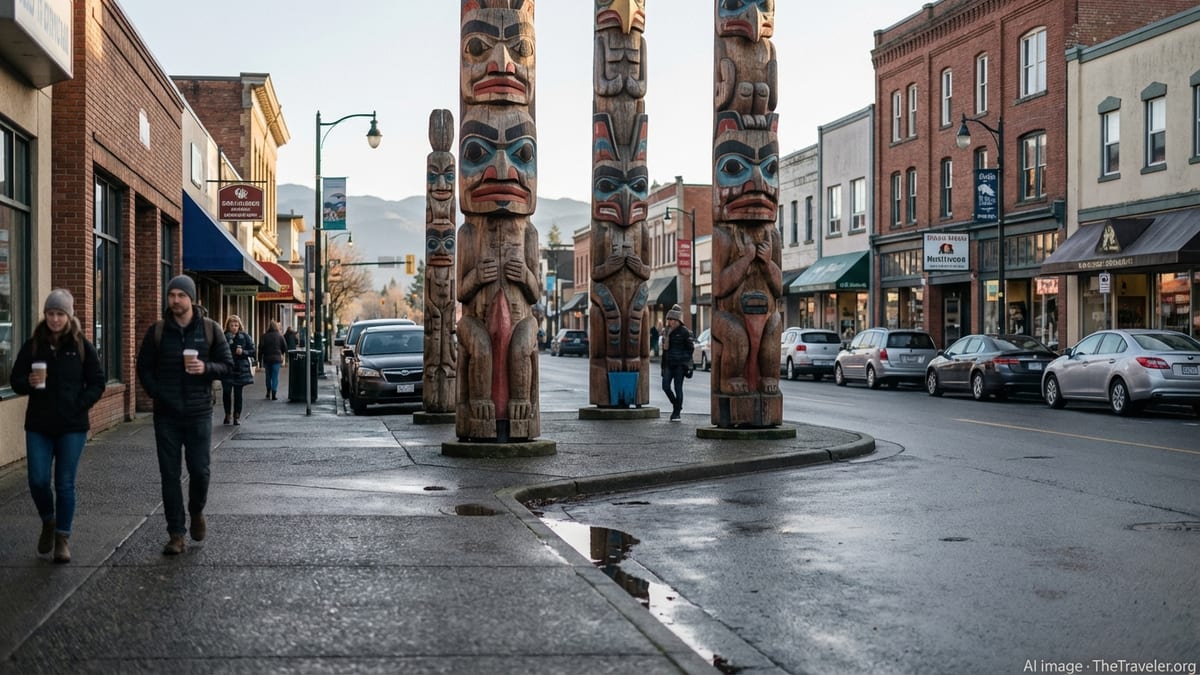
Duncan, British Columbia may be one of Canada’s smallest cities by area, but its cultural and historical footprint is remarkably large. Known as the City of Totems, this Cowichan Valley hub on southern Vancouver Island weaves together Coast Salish traditions, early settler history, public art and a lively contemporary downtown.
For travelers seeking a deeper sense of place, Duncan offers a rich introduction to Quw’utsun (Cowichan) territory and a walkable city center filled with stories carved in cedar.
Duncan at a Glance: Setting and Origins
Duncan sits in the heart of the Cowichan Valley on Vancouver Island, roughly midway between Victoria and Nanaimo. Sheltered by low mountains and fed by the Cowichan and Koksilah rivers, the region is known for its comparatively warm climate, fertile farmlands and sheltered inlets. Today, Duncan functions as the commercial and cultural center for the broader valley, drawing people from nearby communities and reserves into its compact downtown.
The city’s roots are closely tied to transportation and resource development. A settlement began to coalesce in the late 19th century around a railway station on the Esquimalt & Nanaimo line, named after William Chalmers Duncan, a Scottish farmer who had settled in the area. As logging, milling and agriculture expanded, so did the town. In 1912, the more urbanized core formally separated from the surrounding rural municipality of North Cowichan and incorporated as the City of Duncan, cementing its role as an independent urban center.
Despite its modest size, Duncan quickly became a crossroads community. Trains, steamships and, later, the Trans Canada Highway brought workers, merchants and travelers through this small but strategic hub. Over time, the local economy diversified beyond resource extraction to include services, government offices, education and tourism, reflecting the wider shift across Vancouver Island.
Through all these changes, Duncan has remained closely entwined with the Indigenous communities whose territory it occupies. Cowichan Tribes, whose main offices lie just south of the city, are intrinsic to the region’s identity, and any understanding of Duncan begins with the much older Quw’utsun presence on this land.
On Quw’utsun Territory: Indigenous Roots and Living Culture
Long before tracks, highways and storefronts, the Cowichan Valley was home to the Quw’utsun people, part of the broader Coast Salish world. Villages extended along riverbanks and shorelines, including the lower valley stretching from what is now Duncan to Cowichan Bay. Rich salmon runs, shellfish beds, cedar forests and arable land supported complex societies with sophisticated governance, art, spiritual practices and trade networks.
Today, Cowichan Tribes is recognized as the largest First Nation band in British Columbia by population, with multiple reserve parcels and a core traditional territory that spans thousands of square kilometers across the valley, nearby lakes and Gulf Islands. The city of Duncan lies within this unceded territory, and visitors are increasingly invited to understand the area through that lens: as a contemporary urban center nested inside an ancient and ongoing Indigenous homeland.
Cowichan culture remains highly visible and influential in and around Duncan. Traditional Coast Salish weaving and the world‑famous Cowichan sweaters, language revitalization efforts in Hul’q’umi’num’, and community events rooted in song, dance and ceremony all contribute to a living cultural landscape. Local signage, public art and territorial acknowledgements are gradually reflecting this reality more clearly, although there is still active dialogue about representation and reconciliation.
For travelers, recognizing that the City of Totems exists on Quw’utsun land is more than a formality. It shapes how you walk the streets, view the artwork and engage with cultural attractions. Taking time to learn about Coast Salish worldviews and protocols, and seeking out Indigenous‑led experiences, allows a visit to Duncan to become an opportunity for respectful learning rather than passive sightseeing.
Becoming the City of Totems
Duncan’s identity as the City of Totems is relatively recent, emerging in the late 20th century as part of a conscious effort to both revitalize the downtown core and celebrate local Indigenous art. The city began commissioning large totem poles carved by Indigenous artists, many of them Coast Salish, and placing them on public streets, in small squares and beside civic buildings. By the mid‑1980s, Duncan formally adopted the moniker City of Totems, marking a new phase in its public story.
Today, there are more than 40 totem poles in the municipal collection, with a few more carved works and related sculptures nearby. Each pole is distinct, representing the vision of a specific artist and the stories granted or created for that carving. Some reference family histories and ancient legends, while others speak to modern themes such as community resilience, the environment or intercultural relationships. Many are accompanied by plaques that acknowledge the carver, explain key figures and summarize the narrative in accessible language.
The totems transformed Duncan’s downtown into a kind of open‑air gallery, inviting both residents and visitors to experience public space differently. Instead of simply passing storefronts and offices, people encounter bears, thunderbirds, killer whales and human figures rising out of cedar. The effect is simultaneously aesthetic and educational, and it has given Duncan a recognizable visual identity across British Columbia and beyond.
At the same time, the City of Totems project raises important questions about ownership, representation and cultural authority. Duncan owns and manages the collection and has a policy governing image use to ensure proper credit to artists and carvers. In recent years, collaboration with Cowichan Tribes and individual artists has become increasingly central, reflecting a broader shift toward Indigenous governance over cultural expressions and interpretation.
Walking the Totem Tour: How to Experience the Poles
For most visitors, the best way to encounter Duncan’s totem poles is on foot. The compact downtown makes it easy to complete a self‑guided Totem Tour in an hour or two, although those who linger to read plaques, take photographs and reflect on the stories often spend more time. Yellow footprints painted on sidewalks help mark the suggested route, beginning near the Cowichan Valley Museum and weaving through side streets, plazas and civic spaces.
Each totem is placed to be approachable at eye level, allowing you to lean in close and see tool marks, paint textures and the subtle curvature of carved forms. Many travelers are struck by the range of styles: some poles are left largely unpainted in keeping with Coast Salish carving traditions, while others feature bold reds, blacks and blues familiar from northern Northwest Coast art. Names like Chief’s Pole, Transformation of Man or Clan Totem of our Nations hint at the narratives embedded in each work.
Interpretive panels are an important part of the tour. They usually include the name of the pole, the artist’s Indigenous name where shared, a short biography, and a description of the figures and their meaning. Because these are artist‑authored or artist‑approved, they offer rare glimpses into personal creative processes, teachings from elders and the responsibilities that come with telling particular stories in public.
Recently, the city and Cowichan Tribes have supported a digital layer to the experience, using QR codes attached to many totem bases. When scanned with a phone, these codes can open videos, historical photographs or extended commentary, deepening the visit without overwhelming the streetscape with text. For travelers accustomed to quick photos, this digital tour is a gentle nudge toward slower, more informed engagement.
Beyond the Totems: Museums, Culture and Everyday Life
Although the totem poles are Duncan’s signature, they are only one facet of a broader cultural landscape. The Cowichan Valley Museum, housed in the historic railway station, is a logical starting point. Exhibits typically explore the intertwined histories of Quw’utsun families, early settlers, logging and rail development, and the evolution of the modern city. Archival photographs and artifacts help bring to life eras when steam locomotives, logging trucks and riverboats defined daily rhythms.
Nearby cultural attractions offer complementary perspectives. The BC Forest Discovery Centre, a short drive north along the highway, interprets the region’s forestry heritage through outdoor exhibits, heritage buildings and a narrow‑gauge train that circles the site. While its primary focus is industrial history, there is increasing attention to environmental change, Indigenous perspectives on land stewardship and the complex legacy of resource extraction in coastal British Columbia.
Within the city and on adjacent Indigenous lands, travelers can look for opportunities to experience Coast Salish culture in more immersive ways. Depending on the season, this may include attending public cultural events, visiting Indigenous‑owned galleries showcasing carving, weaving and jewelry, or taking part in guided experiences centered on traditional foods and medicines. These offerings change over time and are often community‑led, so it is worth checking current visitor information sources and respecting that some ceremonies and gatherings are not open to the public.
Equally important is everyday culture. Duncan’s downtown has an easygoing, small‑city atmosphere, with independent shops, cafes, bookstores and weekly markets serving locals as much as visitors. Sidewalk tables fill on mild days, and it is common to hear a mix of English and Hul’q’umi’num’, along with the cadences of people who have moved here from other parts of Canada and the world. Spending time in these ordinary spaces offers its own glimpse into contemporary Cowichan Valley life.
Landscape, Seasons and the Sense of Place
The landscape surrounding Duncan is integral to what defines the city. To the west, forested hills rise toward Cowichan Lake, once a major logging supply corridor and now a recreation focal point. To the east, the land rolls gently down to Cowichan Bay and the broader Salish Sea, where tidal flats, estuaries and islands shape both ecosystems and human activity. Vineyards, farms and orchards take advantage of the valley’s relatively warm, dry summers and mild, wet winters.
Seasonality shapes how the city feels to visitors. In spring, the valley greens quickly, rivers swell with snowmelt and cherry blossoms soften downtown streets. Summer brings long daylight hours and a steady flow of travelers, with markets, festivals and outdoor dining animating even small corners. By autumn, vineyards deepen in color, salmon return to local rivers and valley farms harvest apples, squash and root vegetables, making this a rewarding time for culinary travelers.
Winter is quieter but rarely severe by Canadian standards. Rains can be frequent, but temperatures are generally moderate, and the mist that settles over the valley lends the totems and historic buildings a different kind of atmosphere. For those drawn to reflective travel, off‑season visits offer the chance to walk the Totem Tour and nearby trails in relative solitude, and to engage more deeply with museums and galleries.
Outdoor experiences near Duncan complement the cultural offerings. Short drives lead to riverfront trails, lake viewpoints and coastal walks at places like Cowichan Bay or Maple Bay. These outings help contextualize the stories you encounter in the city by placing you in the forests, along the shorelines and beside the waterways that have sustained Quw’utsun people and later communities for generations.
Modern Duncan: Community, Food and Everyday Culture
Contemporary Duncan is shaped by a mix of long‑time Cowichan families, members of Cowichan Tribes and other First Nations, and newer arrivals drawn by the valley’s lifestyle and relative affordability compared with larger cities. The result is a community that feels both rooted and evolving, with a strong emphasis on local enterprise and regional cooperation.
Food is a central thread in this story. The fertile lands around Duncan support farms that grow vegetables, fruit, grains and specialty products, many of which find their way into downtown restaurants, cafes and markets. Menus often highlight seasonal ingredients, local wines and craft beverages from nearby producers. For travelers, a meal in Duncan can become a snapshot of the wider valley’s agricultural and culinary identity.
Events and festivals, while varying year to year, typically celebrate this blend of culture and agriculture: farmers’ markets, craft fairs, live music in public squares and community celebrations tied to the seasons. Some focus specifically on Indigenous art and performance, others on food and drink, and many on simple neighborly gathering. Planning a visit to coincide with these events can add an extra layer of connection, but even on quieter days, the sense of community is tangible.
Like many small cities, Duncan is also navigating contemporary challenges, including housing affordability, reconciliation in practice and the transition to more sustainable economic models. Visitors may notice new housing developments, public discussions about land use, and projects focused on active transportation and climate resilience. These, too, are part of the evolving story of the City of Totems, reminding travelers that they are encountering a living community, not a static attraction.
Practical Tips for Visiting the City of Totems
Duncan’s central location on Vancouver Island makes it relatively easy to include in a broader regional itinerary. It lies along the main highway corridor connecting Victoria to Nanaimo, and regional bus services and private shuttles often stop in or near the city. Within Duncan itself, the downtown core is compact and walkable, with most cultural highlights, including the totem poles, museum and many shops and cafes, clustered in a few blocks.
Allow at least half a day to explore the City of Totems at an unhurried pace. A full day gives you time to combine the Totem Tour with a museum visit, a leisurely meal and perhaps a short excursion to a nearby viewpoint or village. Travelers who are particularly interested in Indigenous art and history often find it worthwhile to stay longer, using Duncan as a base for exploring the wider Cowichan Valley.
When visiting the totems and other Indigenous artworks, it is important to follow basic cultural and photographic etiquette. Treat the poles as works of living cultural expression rather than as props. Read the plaques, use the digital tour tools where available, and credit artists by name when sharing photographs. Commercial use of images is subject to policies set by the city and, in some cases, the artists or their families, reflecting ongoing efforts to respect intellectual and cultural property.
Finally, consider timing your visit with the seasons and your travel style. Those who prefer warmth and outdoor dining may opt for late spring through early autumn, while travelers seeking quieter streets and more introspective experiences may appreciate late autumn and winter. Whatever the timing, arriving with curiosity, humility and a willingness to learn from local voices will enrich your understanding of what truly defines Duncan as the City of Totems.
The Takeaway
Duncan, British Columbia is far more than a quick stop along the highway. Its identity as the City of Totems reflects a deeper story of Quw’utsun territory, Coast Salish artistic traditions and a community that has chosen to place Indigenous carvings and narratives at the heart of its public life. Walking among the totems, visiting local museums and engaging with the everyday rhythms of downtown offers travelers a compact yet powerful introduction to the cultural complexity of Vancouver Island.
For those willing to look beyond postcard images, Duncan reveals a layered history: from ancient villages along salmon‑rich rivers to railway expansion and logging booms, and now to a present shaped by reconciliation, environmental awareness and local creativity. The city’s small scale makes these themes feel accessible and human, grounded in specific artworks, buildings and people rather than abstract concepts.
Ultimately, what defines Duncan is a combination of place and relationship. The surrounding valley’s rivers, forests and farmlands provide the setting, while Cowichan Tribes, settler descendants and newer residents collectively give it life. As you follow the yellow footprints past carved thunderbirds and killer whales, pause to consider the stories beneath the cedar, the land under your feet and the living community that continues to shape the City of Totems.
FAQ
Q1. Why is Duncan called the City of Totems?
Duncan adopted the title City of Totems after commissioning a large collection of Indigenous totem poles for its downtown, creating a public gallery of more than 40 carvings.
Q2. How many totem poles are there in Duncan?
The city manages a collection of over 40 totem poles in and around the downtown core, with a few additional related carvings and sculptures nearby.
Q3. Who carved the totem poles in Duncan?
The poles are carved primarily by Indigenous artists, many of them Coast Salish, with each work attributed to a specific carver whose biography is usually shared on an interpretive plaque.
Q4. How long does the Totem Tour walk take?
The self‑guided Totem Tour can be completed in roughly one to two hours at a relaxed pace, depending on how long you spend reading plaques and taking photographs.
Q5. Is there a guided tour of the totem poles?
In peak seasons there are often free or low‑cost guided tours offered through local museums or visitor centers, while at other times visitors can follow the marked self‑guided route.
Q6. Do I need permission to photograph the totems?
Personal photography is welcomed, but commercial use of images is subject to city policies and should credit the artists; visitors are encouraged to treat the poles with respect.
Q7. When is the best time of year to visit Duncan?
Late spring through early autumn offers mild weather and more events, while autumn and winter provide quieter streets and a more reflective atmosphere.
Q8. What else is there to do in Duncan besides the totem poles?
Travelers can visit the Cowichan Valley Museum, explore the BC Forest Discovery Centre, enjoy local food and markets, and use the city as a base for regional outdoor activities.
Q9. How is Duncan connected to Cowichan Tribes?
Duncan lies within the traditional territory of the Quw’utsun people, and Cowichan Tribes, headquartered nearby, is a key cultural and political presence in the region.
Q10. Is Duncan easy to explore without a car?
Yes. The downtown core, including the totem poles, museum, shops and many cafes, is compact and walkable, and regional transit connects Duncan with nearby communities.