

Montreal blends European elegance with North American energy, a bilingual city where historic cobblestones sit beside bold contemporary design.
This guide walks you through the neighborhoods, culture, and essential experiences that define the city today, so you can plan a trip that feels less like ticking off landmarks and more like slipping into local life.
Getting Oriented in Montreal
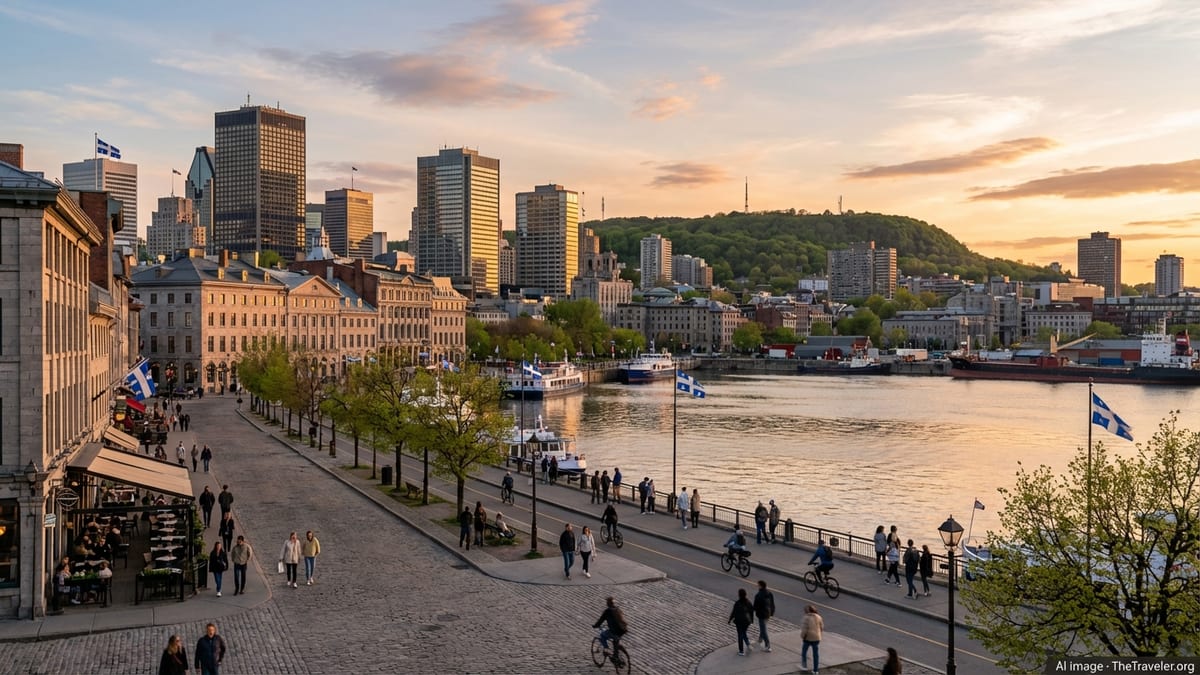
Montreal sits on an island in the St. Lawrence River, organized roughly around Mount Royal, the tree-covered hill at its heart. Locals often describe directions relative to the mountain and the river instead of north and south, but as a visitor you will mainly navigate by the Metro, compact neighborhoods, and a street grid that becomes intuitive after a day or two of walking.
The downtown core and historic Old Montreal form the city’s most-visited spine, with the business district, major museums, and the entertainment-filled Quartier des Spectacles clustered within a short walk. From there, a quick Metro ride or a 20- to 30-minute walk brings you to the Plateau, Mile End, Little Italy, and the Village, each with a distinct personality shaped by immigration waves, language, and evolving creative scenes.
Montreal is officially French-speaking, but English is widely understood in visitor-heavy areas, and service staff are used to switching languages with ease. You will see bilingual signage on public transport and at major attractions. A simple “Bonjour / Hi” is the classic local greeting; starting in French, even if you switch to English, is considered polite and sets a friendly tone for interactions.
The city experiences four dramatic seasons, from deep winter cold to hot, festival-filled summers. What you see and do will change significantly depending on when you visit, but the underlying rhythm is the same: Montrealers take their culture seriously, value public space, and are quick to claim streets, parks, and plazas for communal life whenever the weather allows.
Old Montreal and the Waterfront
Old Montreal is where most visitors begin, drawn by narrow cobblestone streets, 18th- and 19th-century stone facades, and the Gothic Revival towers of Notre-Dame Basilica. This is the city’s historic core, once its commercial and administrative hub, now carefully preserved yet decidedly modern in its dining, galleries, and boutique hotels. The area is compact and walkable, making it ideal for a first or second day when you are still getting your bearings.
Place d’Armes and Place Jacques-Cartier anchor the district, lined with grand former bank buildings, terrace cafés, and performers in warmer months. Inside Notre-Dame Basilica, expect richly carved wood, vibrant stained glass that tells the story of the city instead of biblical scenes, and a dramatic blue-and-gold interior that rewards a quiet pause even when the church is busy. Timed entry is increasingly common at peak periods, so planning ahead is wise.
Walk a few minutes south and you reach the Old Port and the revitalized waterfront, where former warehouses now host museums, markets, and family attractions. The observation wheel offers broad views of downtown and the river, especially striking at sunset when the skyline glows and the mountain fades into silhouette. In summer, the harborfront fills with open-air events, food stands, and festival infrastructure; in winter, you may find skating rinks, light installations, and temporary winter villages.
To the east, across from Old Montreal, Parc Jean-Drapeau spreads over two islands in the St. Lawrence. It is a major event site, hosting large music festivals, motorsport events, and seasonal programming, while also offering calmer days of cycling, river views, and beach access in warm weather. Combined with the Old Port, it underscores how closely the city’s cultural life is tied to the water that surrounds it.
Downtown, the Mountain, and Museum Row
Downtown Montreal is a dense mix of office towers, universities, shopping streets, cultural venues, and hotels, framed by the green slope of Mount Royal. Sainte-Catherine Street is the main commercial artery, with stretches that close to car traffic in summer to create pedestrian-friendly promenades and patios. The Quartier des Spectacles, just off Sainte-Catherine, is the beating cultural heart of downtown, with theatres, performance halls, and outdoor stages that host major festivals and free concerts throughout the year.
West of the core, the Golden Square Mile was once the preserve of wealthy industrialists, and their legacy lingers in stately mansions and refined institutions. The Montreal Museum of Fine Arts sits at its edge, with a broad collection that ranges from Canadian and Indigenous art to international modern and contemporary works. Nearby, the city’s design and fashion schools lend the area a youthful undercurrent that softens its traditional veneer.
Above it all, Mount Royal Park offers the most iconic panoramas of the skyline and river. Designed in the 19th century by Frederick Law Olmsted, the landscape of winding paths, lookouts, and forested slopes functions as Montreal’s lung and playground. In summer, locals picnic on the grassy fields and join informal drum circles, while runners and cyclists trace the loops up and around the hill. In winter, the same spaces transform into cross-country ski trails, snowshoe routes, and toboggan runs, making the mountain a year-round anchor for outdoor life.
Even on a short trip, planning at least half a day that combines downtown exploration with a walk or bus ride up to Mount Royal will give you a sense of how closely the city’s urban life and natural topography are woven together. This contrast between glass towers and leafy overlooks is one of Montreal’s defining visual signatures.
The Plateau, Mile End, and Everyday Montreal Life
North of downtown, the Plateau-Mont-Royal district and its northern neighbor Mile End are where many visitors fall in love with the city’s daily rhythms. Residential streets lined with triplexes and external staircases, colorful balconies, and mature trees create an instantly recognizable streetscape. Between them weave commercial avenues full of independent cafés, bistros, record shops, and design studios that cater as much to locals as to visitors.
Saint-Laurent Boulevard and Saint-Denis Street run roughly north-south through the Plateau, each with its own mood. Saint-Laurent feels eclectic and slightly gritty, with bars, music venues, and international eateries that reflect Montreal’s layered immigrant histories. It also acts as an open-air gallery, with large murals and street art created and refreshed during annual mural festivals. Saint-Denis, by contrast, leans more francophone and bohemian, with bookstores, local fashion, and sidewalk terraces that feel distinctly Parisian in summer.
Mile End, at the northern end of this area, has become shorthand for creative Montreal: game studios, artists’ spaces, independent publishers, and intimate music venues share the streets with long-running bagel bakeries and cafés packed with remote workers. It is the ideal neighborhood to wander without a fixed agenda. Choose a bakery or café as a starting point, then follow whichever block looks most appealing, detouring into parks or side streets when something catches your eye.
These central neighborhoods are also where you are likely to hear French and English in almost equal measure, often within the same conversation. This effortless bilingualism, combined with a strong emphasis on independent businesses, gives the Plateau and Mile End a human-scale vibrancy that many visitors end up seeking out daily, even if their hotel is elsewhere.
Beyond the Core: Little Italy, The Village, and Emerging Districts
Montreal’s personality shifts noticeably as you move away from the central spine. Little Italy, clustered around Saint-Laurent Boulevard and the Jean-Talon Market, reflects generations of Italian immigration that have left a deep imprint on the city’s food culture. Traditional cafés, neighborhood trattorias, and specialty grocers sit alongside newer, more experimental restaurants and wine bars that reinterpret classic recipes using Quebec ingredients.
Jean-Talon Market itself is one of North America’s larger open-air produce markets, especially lively from late spring through autumn when stalls overflow with berries, stone fruit, and vegetables from farms across Quebec. Even in colder months, sheltered sections host cheese shops, butchers, bakers, and spice vendors. Spending a morning here offers a clear window into local tastes and habits, from the varieties of apples and maple products to the prevalence of artisanal charcuterie and breads.
To the east of downtown, the Village unfurls along Sainte-Catherine Street and surrounding blocks, long established as the city’s main LGBTQ+ district. In warmer months, sections of Sainte-Catherine become pedestrian-only, with colorful public art, outdoor patios, and events that emphasize inclusion and nightlife. The area remains an important cultural and social hub, though its boundaries and character continue to evolve as new venues open and other districts grow more queer-friendly.
Further afield, neighborhoods such as Hochelaga-Maisonneuve and Verdun are increasingly part of visitors’ itineraries. Hochelaga-Maisonneuve combines early 20th-century working-class streets with major attractions like the Olympic Park, the Biodome, and the Botanical Garden. Verdun, once overlooked, now offers a lively main street, riverside parks, and easy Metro access, making it an appealing glimpse of everyday life beyond the most photographed corners of the city.
Montreal’s Cultural Calendar and Festivals
Montreal’s reputation as a festival city is well earned. From late spring through early autumn, the cultural calendar is dense with events that draw both international visitors and local crowds. Large outdoor stages in the Quartier des Spectacles, the waterfront, and Parc Jean-Drapeau host music, comedy, film, and digital arts programming, much of it paired with free public performances that spill into adjacent streets and plazas.
The summer music season brings multi-day events at Parc Jean-Drapeau, while downtown hosts jazz, classical, and contemporary concerts across both indoor halls and outdoor stages. Visual arts and design are celebrated through museum exhibitions and city-backed initiatives that highlight architecture, public art, and digital creativity. Street art festivals concentrate activity along major corridors such as Saint-Laurent Boulevard, where live mural painting and pop-up installations transform the urban landscape over a few packed days.
Autumn and early winter shift the focus toward film, theatre, and indoor arts. Francophone cinema festivals bring premieres and retrospectives to downtown screens, often accompanied by talks, masterclasses, and public discussions. Contemporary film festivals push formal and thematic boundaries, while long-running theatre companies and smaller experimental troupes launch new seasons that keep stages active well into the colder months.
Even in midwinter, the city counters the cold with festivals devoted to light, food, and outdoor activity. Illuminated installations brighten key arteries, restaurants collaborate on special menus, and skating rinks and winter markets turn plazas into gathering places. For visitors, it means that almost any time of year offers at least one major cultural event to anchor a trip, with smaller neighborhood happenings filling in the rest of the schedule.
Food, Drink, and Cafe Culture
Montreal’s food scene is rooted in classic dishes yet defined by constant reinvention. You will encounter familiar icons such as bagels, smoked meat sandwiches, and poutine, but they sit alongside a broad spectrum of contemporary bistros, international restaurants, and natural wine bars. Many chefs emphasize local and seasonal ingredients, drawing on Quebec’s agricultural regions for cheeses, game, produce, and maple products.
Bagels are a point of local pride: smaller, denser, and slightly sweeter than their New York counterparts, they are boiled in honey-infused water and baked in wood-fired ovens. Smoked meat, typically brisket cured with a distinctive spice blend and stacked high on rye bread, is another staple. Both are easy to find in central neighborhoods, where long-established institutions share the stage with newer spots that reinterpret these classics in more refined or playful ways.
Beyond these icons, the city excels at relaxed yet thoughtful dining. Neighborhood bistros and wine bars offer regularly changing menus that respond to what is in season, often served in understated spaces with open kitchens and lively bar seating. Tasting menus coexist with casual share-plate formats, and it is increasingly common to find plant-forward dishes integrated naturally into menus rather than presented as a separate category.
Café culture is deeply entrenched. From Mile End to Verdun, you will find independent coffee shops serving as de facto community living rooms, with laptop-toting regulars, shelves of local zines, and playlists that range from jazz to experimental electronica. Many double as bakeries or small lunch counters, offering pastries, sandwiches, and soups that make them convenient daytime stops between neighborhood explorations. For many visitors, these cafés become daily rituals and a lens on the city’s creative and social life.
Practical Tips for Visiting
Montreal’s public transport system makes it easy to explore without a car. The Metro is clean, frequent, and supplemented by a growing network of bus routes and dedicated bike lanes. Many visitors purchase multi-day transit passes to simplify travel between neighborhoods, especially when staying outside the most central districts. In warmer months, public bike-sharing systems provide a pleasant way to move along the river, connect parks, and link nearby neighborhoods at a leisurely pace.
The city is generally safe, with crime rates comparable to or lower than many North American urban centers. As always, standard precautions apply: keep valuables secure in crowded areas and be mindful at night around major bar districts where petty incidents can occur. Weather can be a more tangible challenge than safety. Winters are cold, with snow and ice common, so proper boots and layered clothing are essential. Summers can be hot and humid, especially during heat waves, making hydration and mid-afternoon breaks in shaded parks or air-conditioned spaces a wise habit.
Language is part of daily life but seldom a barrier to travel. While most people you interact with in hotels, restaurants, and cultural venues will speak English, learning a few French phrases is appreciated. Menus, museum information, and public communications are often bilingual, particularly in visitor-heavy zones. In more residential areas, you may encounter businesses where staff are more comfortable in French, but communication is usually possible with patience and good humor.
Finally, give yourself time to wander. Montreal rewards unscripted exploration as much as it does careful planning. Allow a free afternoon for simply following a street, drifting into parks, browsing small shops, or sitting at a café terrace to watch the city flow by. Those unscheduled hours often produce the strongest memories and the clearest sense of what makes Montreal distinct.
The Takeaway
Montreal is more than a collection of famous churches, festivals, and dishes. It is a layered bilingual metropolis where neighborhoods reveal themselves slowly, where public space and culture intertwine, and where residents seem determined to make the most of every season. Whether you stay close to Old Montreal and downtown or spend your days riding the Metro into lesser-known districts, you will find a city that feels both historic and current, comfortable and slightly offbeat.
Approach your visit as an invitation to participate rather than simply observe: listen to a street musician in the Plateau, join a crowd at an outdoor show in the Quartier des Spectacles, sample whatever is in season at the market, or linger on a park bench on Mount Royal as the skyline lights up. In doing so, you will experience Montreal not just as a destination, but as a living, evolving city that continues to balance its European heritage with a distinctly North American sense of openness and experimentation.
FAQ
Q1. How many days do I need to see Montreal properly?
Most visitors feel satisfied with three to four full days, which allows time for Old Montreal, Mount Royal, a couple of central neighborhoods, and at least one major museum or festival event.
Q2. Is Montreal a walkable city?
Yes, central areas such as Old Montreal, downtown, the Plateau, and Mile End are very walkable, and the Metro easily connects districts that are slightly farther apart.
Q3. Do I need to speak French to visit Montreal?
No. English is widely understood in visitor-facing settings, but learning basic French greetings and phrases is appreciated and can make interactions feel warmer.
Q4. What is the best time of year to visit?
Late spring through early autumn offers outdoor festivals and terraces, while winter appeals to those interested in snow, cold-weather activities, and illuminated events.
Q5. Which neighborhood is best for first-time visitors to stay in?
Downtown and the edges of the Plateau offer convenient access to public transport, major sights, and a wide range of restaurants, cafés, and cultural venues.
Q6. Is Montreal safe for solo travelers?
Yes, Montreal is generally considered safe for solo travelers, including at night in busy areas, provided you follow standard urban safety precautions.
Q7. How expensive is Montreal compared with other North American cities?
Costs are moderate: accommodation and dining can be more affordable than in some large U.S. cities, though prices rise during major festivals and peak summer weeks.
Q8. Can I get around using public transport only?
Yes, the Metro, buses, and bike-sharing systems cover most areas visitors want to see, making it easy to rely on public transport without renting a car.
Q9. Are there good options for vegetarian and vegan travelers?
Yes, many restaurants and cafés include vegetarian and vegan dishes on their menus, and some specialize entirely in plant-based cuisine, especially in central neighborhoods.
Q10. Do I need to book attractions and restaurants in advance?
Advance reservations are recommended for popular restaurants, guided tours, and major attractions during festivals or peak summer and holiday periods, while off-peak visits are more flexible.