

Omonia Square has long been one of Athens’ most talked-about places, a crossroads where metro lines, busy avenues and social currents all collide. Once a grand civic plaza, later a byword for urban decay, it is today a complicated, fast-changing pocket of the city: transport hub, working neighborhood, hotel zone and a front line in Athens’ ongoing efforts at urban renewal. For travelers, it can be both practical and fascinating, provided you arrive with realistic expectations and a clear sense of how to navigate it.
The Story of Omonia: From Grand Square to Gritty Crossroads
Omonoia Square sits at the northern edge of central Athens, where several major boulevards converge. In the 19th and early 20th centuries it was designed as a showpiece of the modern Greek capital, lined with neoclassical buildings and bustling cafés. Over time, however, commercial decline, shifting traffic patterns and a lack of cohesive planning gradually eroded its prestige, even as it remained a crucial transport and business node.
By the late 20th century Omonia had gained a tougher reputation. Economic crises, migration flows and insufficient social services concentrated visible poverty, drug use and sex work in and around the square. Many Athenians began warning visitors away, especially at night, even while thousands of people continued to live, work and commute through the area every day.
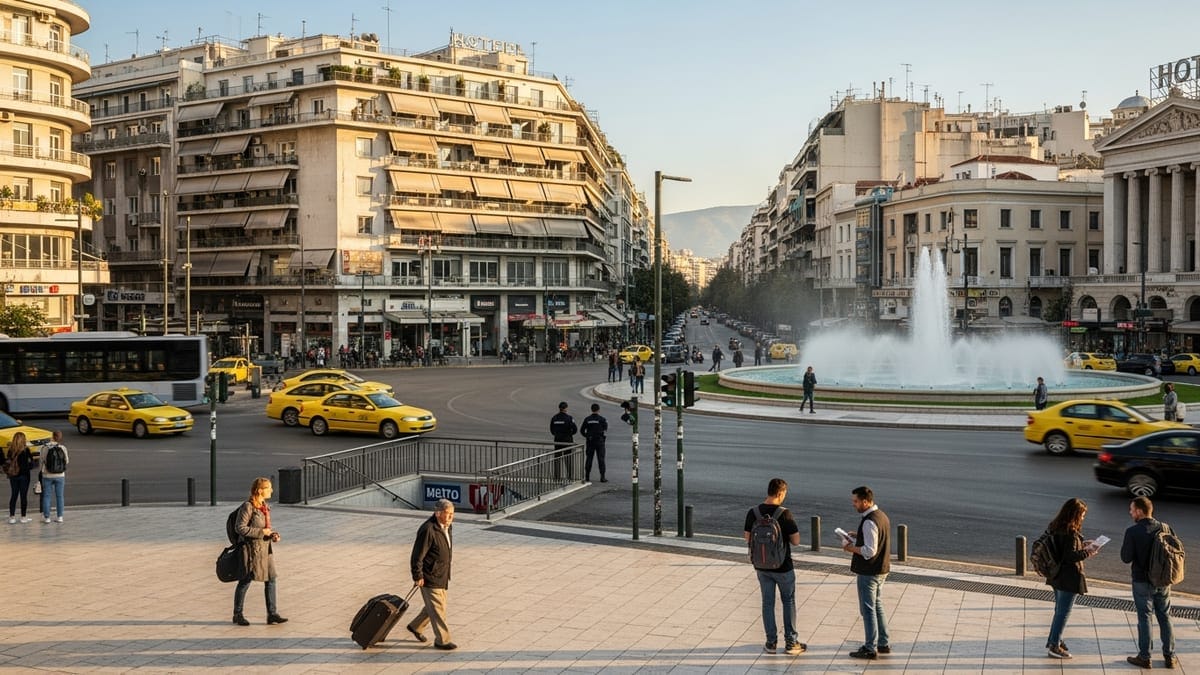
In the last several years the city has made repeated efforts to reimagine Omonoia. A major redesign completed in 2020 reintroduced a large circular fountain at its center, widened pavements and attempted to create more open public space. New hotels and international chains have moved in, alongside small cafés and fast-food outlets, giving parts of the square a more global, mainstream feel. Yet the transformation is incomplete; the result is a square that is cleaner and more functional than it was a decade ago, but that still reflects Athens’ social contrasts in a very direct way.
Understanding this layered history helps set expectations. You are not walking into a polished, postcard-perfect plaza like Syntagma or a charming historic district like Plaka. You are entering a busy, somewhat rough-edged downtown intersection that happens to sit on top of one of the city’s most important metro stations and within walking distance of major sights.
What Omonia Square Looks and Feels Like Today
Arriving at street level, most visitors’ first impression is movement. Omonoia is ringed by multi-lane traffic, hemmed in by mid-century concrete blocks, and threaded by pedestrian crossings that can feel chaotic at rush hour. The new fountain at the center, often lit in different colors at night, adds a welcome focal point and softens what would otherwise be an entirely hard, urban landscape.
During the day, the square is filled with commuters queuing for buses, office workers on coffee breaks, hotel guests heading to the metro and residents from the surrounding streets. You will see families, older locals, migrants from many countries, budget travelers and business people in suits using the same space. The atmosphere is not picturesque, but it is undeniably lively and urban. Traffic noise is constant, and there is nearly always a police presence, particularly around the metro entrances and main corners.
Look a little closer and you will also notice the less polished side. On some streets leading off the square you may see groups of people openly using or dealing drugs, especially to the west and southwest. Prostitution is present after dark on certain side streets. Buildings are heavily graffitied and some ground-floor spaces are shuttered or under renovation. This contrast between a refurbished central plaza and visibly struggling adjacent blocks is one of the defining features of Omonia today.
In the evening and at night, the energy changes but the square remains active. The fountain is illuminated, fast-food places and casual restaurants stay open late, and hotel bars light up. At the same time, the proportion of vulnerable people, rough sleepers and those involved in the informal economy becomes more visible. Many travelers report feeling generally safe on the main square and major avenues, but uncomfortable on certain narrow side streets where lighting is weaker and foot traffic thinner.
Staying Around Omonia: Pros, Cons and Who It Suits
Omonia has become a magnet for mid-range and budget hotels, from global brands to local independents. For many visitors, the appeal is practical. You are just one or two metro stops away from Syntagma, Monastiraki and the Acropolis area, or a 15–20 minute walk from some of the city’s main archaeological sites and museums. Room rates are often lower than in the more photogenic neighborhoods, and properties tend to offer modern interiors that contrast sharply with the streets outside.
The advantages are clear if you are an experienced city traveler who prioritizes connectivity and value over charm. Being based at Omonoia means quick access to the metro lines that run to Piraeus port, the airport connection via Monastiraki, and the major shopping streets of central Athens. Many hotels here are used by business travelers, airline crews and tour groups, which adds a layer of normality and constant foot traffic.
The trade-offs, however, are equally important. If you imagine stepping out of your hotel into a pretty square lingered over by café tables and street musicians, Omonia will disappoint. The immediate surroundings can feel grimy, noisy and at times confronting, especially for first-time visitors to Greece or those unused to big-city grittiness. Families with young children, travelers who feel anxious around visible drug use, or those seeking a romantic “old Athens” atmosphere may be happier basing themselves in Plaka, Syntagma, Kolonaki or Koukaki and visiting Omonia only in transit.
A balanced approach is to decide what matters most on this particular trip. If you have a tight budget, are comfortable in urban environments and value direct metro connections, staying near Omonoia can work well, particularly if you choose a hotel directly on the square or on one of the wide, well-lit main avenues. If safety, scenery and evening ambiance are top priorities, consider other neighborhoods and think of Omonia as a practical hub rather than a base.
Safety, Common Scams and How to Navigate Smartly
Athens overall is considered relatively safe by European capital standards, with low rates of violent crime in tourist areas. Omonoia, however, is widely cited by both locals and recent travel advisories as an area where petty crime and open drug use are more visible than elsewhere in the city. That does not mean you should avoid it entirely, but it does mean you should exercise more awareness and adjust your routines, particularly after dark.
Daytime on the main square and surrounding boulevards is generally busy and functional. Pickpocketing can be an issue on the metro platforms and in crowded trains, especially around ticket machines, escalators and doorways. Keep your phone and wallet in front-facing, zipped compartments and be wary of anyone jostling you or trying to create a distraction. On the surface streets, be cautious around people who insist on “helping” with tickets, directions or currency exchanges and then ask for money.
At night, it is wise to stick to main roads, avoid poorly lit side streets and move with purpose rather than lingering aimlessly. The most problematic zones, according to recent local guidance, are not the square itself but specific streets to the west and south, where clusters of drug use and street sex work are concentrated. You may also see groups of men gathered on certain corners or outside low-end bars. In most cases they are not interested in tourists, but it is prudent not to wander into these pockets out of curiosity, especially alone.
Standard big-city precautions go a long way: keep valuables out of sight, do not leave bags unattended on café chairs, avoid excessive alcohol if you plan to walk back late, and use licensed taxis or ride-hailing apps rather than informal offers of transport. If you feel uneasy at any point, step into a busy hotel lobby, brightly lit café or shop, or simply head back to the metro and move on to another neighborhood. Visible police patrols in the area are frequent, which many visitors find reassuring, though the heavy presence can also underscore that this is a district under close watch.
Transport Hub: Using Omonia to Explore Athens
Omonia’s greatest practical strength is its role as a transport node. The central metro station beneath the square connects Line 1, the green line that runs between Kifisia and Piraeus, with Line 2, the red line linking Anthoupoli and Elliniko. For travelers, this means quick access to both the port area and southern suburbs, as well as to central stations like Syntagma, Monastiraki and Akropoli with one simple change if needed.
The station itself is busy throughout the day, from early commuters to late-night workers. Platforms can feel crowded and somewhat worn compared with newer stations, but trains are frequent and signage is clear. Buying and validating tickets or topping up an Ath.ena transit card is straightforward via vending machines, though queues form at peak times. As in any large metro system, it pays to stand slightly aside when counting cash or using your phone, and to keep your bag closed and in front of you.
Above ground, the square is also a hub for buses and trolleybuses that radiate out to neighborhoods further north and west. If you plan to reach areas not well served by the metro, such as some residential districts or the long-distance bus terminals, Omonoia is often where you will transfer. Traffic around the square can be congested and crossings require attention; drivers may be impatient, and pedestrians often weave between vehicles in a way that surprises visitors used to stricter road enforcement.
For trips late at night or when you are carrying luggage, many travelers opt to use taxis or ride-hailing apps. It is easy to be picked up or dropped off on the avenues edging the square, and fares to the more popular neighborhoods of central Athens are generally modest given the short distances. If you are heading to or from the airport, you will usually change at Syntagma or Monastiraki when using the metro or airport buses, but Omonia serves as a reliable intermediate stop if you are staying nearby.
What There Is to See and Do In and Around Omonia
Omonia itself is not a major sightseeing destination in the way that the Acropolis or Plaka are, but its location places you within easy reach of several important attractions. Just a short walk to the northeast lies the National Archaeological Museum, widely regarded as the country’s finest collection of ancient Greek art and artifacts. Many visitors who base themselves near Omonia choose their hotel partly for this proximity, as it allows them to reach the museum on foot without relying on transport.
The commercial streets stretching south from Omonia toward Panepistimiou and Stadiou are lined with shops, offices, cafés and small eateries that cater mainly to locals. While they lack the charm of the historic districts, they offer an authentic glimpse of daily life in a busy European capital: students hurrying to classes, workers grabbing coffee from kiosks, street vendors selling snacks and newspapers, and small businesses clustered in aging buildings.
Within the square’s immediate perimeter you will find a mix of fast-food outlets, bakeries, coffee chains and more traditional Greek establishments. These can be useful if you are in transit or need a quick meal at odd hours, as many open early and close late. A handful of rooftop bars and hotel restaurants around Omonia offer panoramic views of the city, including glimpses of the Acropolis and Lycabettus Hill, especially striking at sunset or after dark.
Seasonally, Omonoia sometimes participates in broader city events, with festive lighting during the Christmas period and occasional public installations or promotional events sponsored by the municipality or private companies. These efforts aim to encourage Athenians and visitors alike to see the square as a shared civic space rather than merely a transit point, though the impact is still uneven and often overshadowed by the area’s more persistent challenges.
Everyday Practicalities: Food, Money, and Local Life
For travelers using Omonia as a base or regular transit point, the square’s biggest advantage is convenience. Supermarkets, small grocery stores, pharmacies and mobile phone shops are plentiful in the blocks surrounding the square. This makes it easy to stock up on water, snacks, local SIM cards or basic toiletries without going out of your way. ATMs and bank branches are scattered around the perimeter, though it is wise to use machines inside bank lobbies or larger stores where possible.
In terms of food, Omonia is strong on casual, filling options: gyros and souvlaki counters, bakeries serving pies and pastries, budget-friendly restaurants offering hearty Greek dishes and international fast-food chains. Quality varies but prices are generally lower than in heavily touristed districts. If you walk 10 to 15 minutes toward Monastiraki, Psyrri or Exarchia, you will find a denser concentration of bars, tavernas and more atmospheric restaurants for lingering evenings.
The demographic mix in and around Omonia is one of its most striking features. Long-established Greek residents live alongside migrants from the Middle East, Africa and Asia, as well as workers from elsewhere in Europe. This diversity feeds into the local businesses, from ethnic grocery stores and bakeries to hair salons and cafés that reflect various communities. For some visitors, this multicultural character is part of the area’s interest; for others, the language barriers and unfamiliar social rhythms can feel disorienting.
On a practical level, dress and behavior that blend in with a European city center are advisable: avoid flashing expensive jewelry or large cameras, keep bags closed and close to your body, and use cash or cards discreetly. Public drunkenness is less common than in some other European capitals, and rowdy behavior tends to stand out. Showing basic courtesy, such as greeting shop staff and being patient in busy cafés, can ease small interactions and make your time in and around the square feel more comfortable.
The Takeaway
Omonoia Square today is neither the elegant civic salon imagined in 19th-century plans nor the no-go zone its reputation suggests to some first-time visitors. It is, instead, a dense, imperfect, very real piece of contemporary Athens: a transport hub under constant surveillance, a working neighborhood with pockets of hardship, and a staging ground for urban renewal that remains very much a work in progress.
For travelers, the key is to approach Omonia with clear eyes and a plan. If you choose to stay nearby, you gain centrality, strong transport links and good value, balanced against visual grit and a higher likelihood of encountering the city’s social problems up close. If you prefer to lodge elsewhere, you will almost certainly still pass through the square or its metro station at some point, making it useful to know what to expect and how to move around sensibly.
In practical terms, treat Omonia like any major downtown crossroads in a large European city: stay on main streets, be aware of your belongings, avoid risky side streets at night and use the area primarily for what it excels at, which is getting you quickly from one part of Athens to another. Do that, and Omonia can slot smoothly into your itinerary, adding a dose of raw urban realism to your experience of a city better known for its ancient marbles and seaside sunsets.
FAQ
Q1. Is Omonia Square safe to visit during the day?
During daylight hours, Omonia Square is busy with commuters, workers and visitors, and many travelers pass through without incident, especially if they stay on the main square and larger avenues. The main concern is pickpocketing on the metro and around crowded crossings, so it is important to keep valuables secure and avoid getting distracted in tight crowds.
Q2. How risky is Omonia at night compared with other parts of Athens?
At night, Omonia has a rougher feel than areas like Plaka, Syntagma or Kolonaki, with more visible drug use, street sex work and groups of people lingering on certain side streets. Most visitors who stick to the main square and well-lit thoroughfares report feeling cautious rather than threatened, but it is not generally recommended as a place for leisurely late-night strolling, especially if you are alone or unfamiliar with big-city environments.
Q3. Should I book a hotel near Omonia or choose another neighborhood?
Booking near Omonoia makes sense if you prioritize budget, metro access and centrality over atmosphere, and if you are comfortable navigating a gritty, very urban area. If you value charm, scenic streets and a relaxed evening feel, you may be happier staying in Plaka, Monastiraki, Syntagma, Kolonaki or Koukaki and using Omonia mainly as a transit point.
Q4. What streets or areas around Omonia should I be especially cautious about?
The square itself and the major avenues are generally the safest routes, while several narrower streets to the west and south are known locally for higher concentrations of drug activity and prostitution. If you are unsure, avoid ducking into side alleys, follow the main roads toward Panepistimiou, Stadiou or the National Archaeological Museum, and use your hotel reception or a trusted local contact to confirm which streets they recommend avoiding after dark.
Q5. Is the Omonia metro station safe to use with luggage?
Thousands of people use Omonia station daily, including travelers with bags, and the vast majority do so without problems. The main risk is opportunistic theft on escalators, crowded platforms or train doors, so keep backpack straps in front of you, secure zippers, avoid leaving bags unattended, and be particularly alert when boarding or exiting trains.
Q6. How close is Omonia Square to the main sights of Athens?
Omonia is within a 15 to 20 minute walk of Monastiraki and the lower edge of the historic center, and the National Archaeological Museum is roughly 10 minutes on foot to the northeast. By metro, you can reach Syntagma, the Acropolis area, and other key stops within a few minutes and with at most one change, making Omonoia a convenient starting point despite its lack of scenic appeal.
Q7. What kind of food and services can I expect to find near Omonia?
The immediate area is rich in practical, everyday services rather than destination dining: supermarkets, pharmacies, mobile phone shops, budget clothing stores, bakeries and casual eateries serving gyros, souvlaki and simple Greek dishes. There are also international fast-food chains and a few hotel restaurants and rooftop bars, while more atmospheric tavernas and bars are a short walk away in neighborhoods like Psyrri, Exarchia and Monastiraki.
Q8. Is Omonia a good area for solo travelers, especially women?
Many solo travelers, including women, pass through or stay near Omonia without issues, but comfort levels vary. If you are used to big cities and keep to main streets, avoid late-night wandering and follow standard precautions with valuables, you are unlikely to encounter more than discomfort at the area’s grittier aspects. If you are a nervous or first-time solo traveler, you may feel more relaxed basing yourself in a calmer neighborhood and visiting Omonia mainly by day or in transit.
Q9. Are there ongoing improvements planned for Omonia Square?
The city has already renovated the square with a new fountain and broader pavements and continues to promote investment in surrounding buildings and public space. Urban renewal, however, is gradual, and social challenges such as addiction and homelessness are not solved by cosmetic changes alone, so visitors should expect a mix of upgrades and lingering issues rather than a fully transformed, polished plaza.
Q10. If I feel uncomfortable around Omonia, what is the best way to adjust my plans?
If the area feels more intense than you expected, you can easily pivot by spending more time in nearby districts like Plaka, Monastiraki, Syntagma or Kolonaki, which are all within a short metro ride or walk. Consider using Omonoia purely for its transport connections, arranging evenings and meals elsewhere, and, if necessary, moving to accommodation in a neighborhood whose atmosphere better matches the kind of Athens experience you are looking for.