

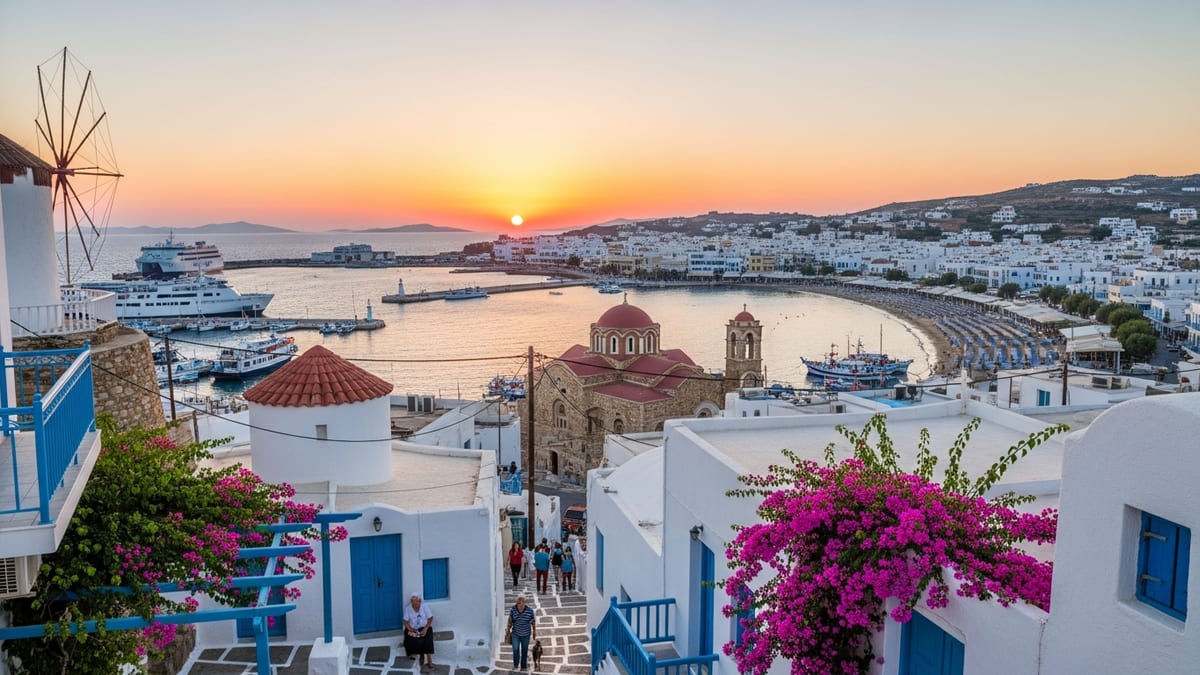
Parikia, the capital and main port of Paros, is often your first glimpse of the island: whitewashed houses clustered around a deep-blue bay, ferries gliding in and out, and a warren of alleys that glow soft pink at sunset.
For many travelers it used to be little more than a transit stop on the way to Naoussa or the beaches, but that is changing fast. Parikia today is a destination in its own right, blending centuries of history with a growing food and design scene, relaxed nightlife and easy access to some of Paros’s best shores.
Getting Oriented in Parikia
Parikia sits on the west coast of Paros, facing the sunset and serving as the island’s main maritime gateway. Almost all ferries from Piraeus, Rafina and other Cycladic islands arrive here, which makes Parikia a natural hub whether you are staying for a night or a week. The town fans out in a curve around the bay: the ferry port and waterfront promenade at its heart, the old town climbing gently inland behind, and beaches stretching away north and south.
The first area you encounter is the harborfront, lined with cafés, ticket offices, car rental agencies and small hotels. From here, pedestrian lanes lead straight into the historic core, where motor traffic is limited and you move on foot. To the north of the port, the seafront road continues toward Livadia Beach, Parikia’s main in-town stretch of sand, while to the south you follow the coastal road toward Parasporos and Agia Irini. Everything in central Parikia is compact: you can walk from the port to Livadia in about 10 to 15 minutes and from the harbor to the Venetian Castle in under 10.
Understanding this simple layout helps you choose where to stay and how to plan your days. If you want nightlife and an easy stroll back from dinner, look near the old town and waterfront. If swimming and quiet are priorities, consider the streets behind Livadia or the hotels a short drive to the south. Buses to other parts of Paros depart from stops near the port and the main square, making it straightforward to use Parikia as a base for exploring the rest of the island.
Essential Sights: History, Culture and Iconic Landmarks
For a town of modest size, Parikia holds an impressive concentration of history. The standout monument is Panagia Ekatontapiliani, often translated as the Church of a Hundred Doors, one of the oldest and most important Christian sites in the Aegean. Parts of the complex date back to the 4th century, with later Byzantine additions that give it its present basilica form. The interior is cool and dim, with marble columns and icons softened by candlelight, and the complex also houses a small ecclesiastical collection. Modest dress is expected, and photography rules can change, so watch for posted signs.
Climb from the harbor into the old town and you reach the Frankish or Venetian Castle, known locally as the Kastro. Built in the 13th century by Venetians using blocks from ancient temples, it is today a partial ruin woven into the surrounding neighborhood, with marble column drums and inscriptions embedded in its walls. The reward for the short uphill walk is a panoramic sweep over Parikia’s bay, particularly evocative in late afternoon when the fishing boats and ferries catch the light.
Just a few minutes’ walk from Ekatontapiliani is the Archaeological Museum of Paros, compact but well curated. Exhibits span from the Neolithic to the Roman period and include striking marble sculptures, funerary stelae and a fragment of the Parian Chronicle, a unique inscription that lists major events in Greek history. Because opening hours can shift season by season, especially outside July and August, it is wise to check times locally shortly after you arrive. Nearby, the Byzantine Museum displays icons and ecclesiastical artifacts related to the island’s religious life, many associated with Ekatontapiliani itself.
As you wander between these sights, keep an eye out for smaller landmarks that stitch Parikia’s story together: the preserved windmill at the harborfront, now functioning as a café, characteristic of Cycladic maritime towns; neoclassical mansions housing municipal offices that reflect Paros’s 19th century prosperity; and memorials such as the statue of Greek War of Independence heroine Manto Mavrogenous, who died here and is commemorated in the main square.
Exploring the Old Town and Waterfront
Behind the busy port road, Parikia’s old town is a maze of whitewashed alleys where daily life unfolds at a slower, more intimate scale. Narrow cobbles weave between cube-shaped houses with blue shutters, tiny chapels squeezed into corners, and cascades of bougainvillea that frame arched doorways. Unlike some Cycladic centers that feel overtaken by tourism, Parikia still has a lived-in character: elderly residents sit outside their doorsteps in the evenings, shopkeepers greet neighbors by name and children play late into the night in small squares.
Shopping here rewards a patient wander. Alongside predictable souvenir stands you find boutiques selling handmade leather sandals, linen clothing well suited to the island climate, ceramics inspired by Cycladic motifs and small galleries showcasing local painters and photographers. These streets are also where you will discover some of Parikia’s most atmospheric restaurants and wine bars, tucked into courtyards where vines stretch across pergolas and candlelight flickers against stone walls.
Down by the water, the waterfront promenade offers a different energy. Cafés and restaurants line the seafront with outdoor tables almost at the water’s edge. In the morning this is where locals lean over tiny cups of Greek coffee, reading newspapers or chatting under the shade of tamarisk trees. By late afternoon the promenade becomes a prime strolling route: visitors and residents alike walk from the port toward Livadia or in the opposite direction toward the harbor windmill, pausing to watch ferries maneuver or fishing boats unloading their catch.
Sunset is when the waterfront is at its most photogenic. The sun sinks almost directly opposite Parikia’s bay in summer, bathing the houses and castle in warm tones. Many travelers time their day around this daily spectacle, finding a table at a seafront bar or taking their drink to sit on the low wall near the windmill. On clear evenings the outline of neighboring islands is visible on the horizon, reminding you how central Parikia is to the wider Cycladic seascape.
Beaches in and Around Parikia
One of Parikia’s main advantages as a base is how close you are to swimmable, sandy beaches. You do not have to venture far to find clear water, and several options are accessible on foot, by short taxi rides or quick water-taxi hops in high season. This makes it easy to mix sightseeing and swims in the same day, or to squeeze in a dip before catching a ferry.
Livadia Beach begins only a short walk north from the harbor and curves around a sheltered bay. The sand is light and the water usually calm and shallow, making it suitable for families and for travelers who want to transition immediately from ferry to sea. Sunbeds and umbrellas are rented in front of cafés and tavernas, but there are also pockets of free sand where you can lay your own towel. Because of its convenience, Livadia can feel busy in July and August, yet it remains a friendly and functional choice for an easy beach day.
Across the bay, Krios and Marcello beaches offer a more classic beach experience while still being close to town. In summer, small boats often run from near the harbor to these shores, or you can drive around the bay. The water tends to be particularly clear and turquoise, with a mix of organized sections and quieter stretches. Beach bars play music and serve drinks and snacks, attracting younger crowds and groups, especially in the peak months, though mornings and shoulder-season days remain relatively tranquil.
To the south, Parasporos Beach and Agia Irini are within a short drive of Parikia. Parasporos is a broad bay with golden sand and a social vibe, popular with those who enjoy a livelier atmosphere and beach bars that carry the day into sunset. Agia Irini, often called Palm Beach for the line of palm trees along its shore, is smaller and more sheltered, with a somewhat tropical feel and good conditions for relaxed swimming and a bit of snorkeling along the rocks. Reaching these beaches typically requires either a rented scooter, car or taxi, though local buses usually run regular routes during summer.
Food, Drink and Nightlife
Parikia’s food scene has evolved beyond basic taverna fare, though you can still find all the Greek classics. On small backstreets and in vine-draped courtyards, chefs are reworking local ingredients such as chickpeas, capers, tomatoes and fresh Aegean fish into dishes that lean lighter and more contemporary without abandoning tradition. Restaurants in and around the old town favor seasonal produce, so menus often change through the summer, and it is common to see daily specials written on chalkboards.
Along the waterfront, rows of tavernas and ouzeris serve grilled octopus, whole fish, fried zucchini and meze plates, paired with local white wines or ouzo. These venues are particularly popular at sunset, when the combination of sea views and glow from the sky lends even simple meals a romantic air. Slightly inland, you will find courtyards that feel far removed from the bustle of the promenade, where you can linger over longer dinners in a quieter environment.
Parikia’s cafés play a central social role from morning to late night. Many double as all-day spaces where you can have a coffee while planning your day, return for a light lunch and then come back again for drinks. In recent years, specialty coffee bars and modern bakeries have joined the scene, offering espresso-based drinks, smoothies and pastries. For quick and affordable meals, gyros stands and bakeries selling cheese pies and spanakopita stay open into the night, ideal when you are returning from a beach or from exploring other parts of Paros.
At night, Parikia’s character shifts but rarely becomes overwhelming. Compared to more overt party islands, the vibe here is sociable rather than frantic. Bars scattered throughout the old town and along the waterfront play a mix of Greek and international music, offering cocktails, local beers and wines. Some stay open until the early hours in high summer, especially on weekends, and you will find a diverse mix of ages and nationalities. For those seeking louder clubs, Naoussa on the north coast remains the island’s main nightlife hub, accessible by taxi or late-running buses, but many travelers find that Parikia’s scale suits an evening of bar-hopping followed by an easy walk back to their accommodation.
Where to Stay and How Long to Spend
Parikia offers a wide range of accommodations, from simple rooms above tavernas to design-forward boutique hotels and family-run guesthouses tucked into quiet alleys. Around the harbor and in the streets leading to Ekatontapiliani you will find properties that are ideal for short stays or for travelers prioritizing convenience: you step off the ferry and are settled into your room within minutes, and you can reach buses, shops and restaurants on foot.
For more of a beach atmosphere while still remaining close to town, look at the area behind Livadia Beach, where low-rise hotels and studios often include balconies or small gardens and can be a little quieter than the harborfront. To the south of Parikia, a handful of higher-end hotels and suites lie within easy driving distance, giving you more space and sometimes sea views while keeping the town’s restaurants and ferry connections within reach. As Paros’s popularity has grown, new openings and renovations have become more frequent, so consider checking the most recent guest reviews when choosing where to stay.
In terms of how long to spend, Parikia can reward more time than many travelers allow. A single night will barely cover a quick stroll through the alleys and a sunset drink before moving on. Three nights is often the sweet spot for combining old town exploration, time on nearby beaches and a day trip to other parts of Paros or to Antiparos. A week based in Parikia works well if you prefer to unpack once and use the town’s central bus links and road network to explore the island at a deliberate pace while still having a familiar neighborhood to return to each evening.
Availability can be tight in late July and August, when Greek school holidays and European vacation schedules overlap. Booking well in advance is recommended for those months, particularly if you have specific property types or room categories in mind. Shoulder seasons from late May to June and September to early October often bring more reasonable rates, milder temperatures and quieter streets while most services, ferries and restaurants are still operating.
Practicalities: Getting There, Getting Around and Staying Safe
Parikia is one of the key ferry hubs in the Cyclades, with regular sailings from Piraeus and Rafina near Athens and from neighboring islands such as Naxos, Ios, Mykonos and Santorini. Both conventional ferries and high-speed vessels serve the route, and journey times from Piraeus can range from about three to five hours depending on the operator and number of stops. In summer, multiple departures per day are common, while in the shoulder seasons schedules thin out but still provide reasonable connections. Paros also has a small airport near Aliki in the south of the island, with domestic flights from Athens, and from there it is a short taxi or bus ride to Parikia.
Within Parikia, walking is the primary way to move around the old town and waterfront. The lanes are narrow and often stepped, unsuited to cars, which helps maintain the town’s character but can be challenging for those with mobility issues. The main bus station, near the port, offers routes to Naoussa, Aliki, Piso Livadi and other key points on the island. Services are generally frequent in high season and less so off-season, so picking up a current timetable when you arrive is useful. Taxis queue at the port, and car, scooter and bicycle rentals have offices along the seafront and near the main square.
Weather on Paros is typically Mediterranean, with hot, dry summers and mild winters. July and August see high temperatures and the meltemi wind, which can provide welcome cooling but occasionally leads to choppy seas and ferry delays. Spring and autumn usually combine pleasant warmth with clearer skies and fewer crowds. As climate patterns become less predictable, storms and heavy rains have occasionally affected the Cyclades outside the traditional rainy months, so it is wise to check forecasts during your stay, especially if you are planning boat trips or hikes.
Parikia is generally considered safe, with low levels of serious crime. Standard travel sense applies: watch your belongings in crowded areas around ferry arrivals and in busy bars, and use hotel safes for passports and valuables where available. Sunscreen, hats and hydration are essential in the peak summer heat, particularly when walking uphill to sites like the Kastro or Agios Konstantinos church. The local health clinic in Parikia can handle minor issues, and for more serious cases, transfers to larger facilities on other islands or the mainland are arranged as needed.
The Takeaway
Parikia is far more than a point of arrival. It condenses much of what draws travelers to the Cyclades into a walkable, lived-in town: early Christian and classical history, whitewashed architecture, alleyways full of color, a working harbor, and beaches close enough that a swim is never more than a short stroll or ride away. Stay a little longer and its subtler rhythms reveal themselves, from elderly residents exchanging news in shaded squares to fishermen laying out their nets along the quay.
Using Parikia as your base gives you both structure and freedom: structure in the form of reliable ferry and bus links, a broad range of accommodations and dining, and freedom to wander, to hop to nearby beaches, to take day trips and know that you will return each evening to a town that feels increasingly familiar. Whether you are island-hopping for a week or planning a longer Cycladic escape, building time in Parikia into your itinerary turns a transit point into a highlight.
FAQ
Q1. How do I get to Parikia from Athens?
Most travelers reach Parikia by ferry from Piraeus or Rafina, with journey times typically between three and five hours depending on the vessel and route. You can also fly from Athens to Paros airport and take a taxi or bus, which brings you to Parikia in around 15 to 20 minutes.
Q2. How many days should I spend in Parikia?
If you want more than a quick overnight stop, plan for at least three days to explore the old town, visit Ekatontapiliani and the museums, enjoy nearby beaches such as Livadia and Krios, and take a short excursion elsewhere on Paros or to Antiparos.
Q3. Is Parikia a good base for exploring the rest of Paros?
Yes, Parikia is one of the best bases on the island because most ferries arrive here and buses radiate out to Naoussa, Aliki, Piso Livadi and other villages. Car and scooter rentals are widely available, making it simple to day-trip while returning each evening to the same hotel.
Q4. What is the best time of year to visit Parikia?
Late May to June and September to early October often offer the best balance of warm weather, swimming-friendly seas and fewer crowds. July and August are the busiest and hottest months, with the widest choice of ferry connections and nightlife but also higher prices and fuller beaches.
Q5. Are the beaches in Parikia suitable for families?
Livadia Beach, a short walk from the port, is particularly family-friendly thanks to its shallow water, sand and easy access to cafés and facilities. Other nearby beaches such as Marcello and Krios also work well for families, though reaching them may require a short boat ride or drive.
Q6. Do I need a car to enjoy Parikia and nearby areas?
You do not need a car to enjoy Parikia itself, as the old town and main beach are walkable. However, renting a car or scooter for at least a day or two is helpful if you want to reach more distant beaches, hilltop villages and less frequented parts of the island on your own schedule.
Q7. Is Parikia expensive compared to other Greek islands?
Parikia generally offers better value than some of the most high-profile islands in the Aegean. Prices rise in peak season, but you can still find a range of accommodations and dining options, from budget-friendly rooms and gyros stands to more upscale boutique hotels and creative restaurants.
Q8. What should I wear when visiting Panagia Ekatontapiliani?
When entering Ekatontapiliani, aim for modest, respectful clothing: shoulders covered, shorts or skirts at least knee-length and no beachwear. Lightweight fabrics help you stay comfortable in the summer heat while still meeting these basic expectations.
Q9. Is Parikia suitable for travelers with limited mobility?
The waterfront promenade and some streets are relatively flat, but many alleys in the old town are narrow, uneven or stepped, which can be challenging. Choosing accommodation close to the harborfront and planning ahead for accessible routes will make a stay easier for those with mobility concerns.
Q10. Can I visit Antiparos on a day trip from Parikia?
Yes, Antiparos is an easy day trip. Buses or taxis take you from Parikia to the small port of Pounda in about 10 to 15 minutes, where frequent local ferries cross to Antiparos in a short hop. Many travelers spend the day there and return to dine and sleep back in Parikia.