

Tobermory, perched at the northern tip of Ontario’s Bruce Peninsula, feels like a small harbor town dropped into Caribbean-blue water. With the famous Grotto, limestone cliffs, glass-bottom boat tours over shipwrecks, and a laid-back marina village, it has become one of Canada’s most in-demand summer destinations.
This guide brings together up-to-date information on the Grotto, Tobermory’s harbors, and the best things to do, so you can plan a trip that is unforgettable, safe, and respectful of this fragile landscape.
Understanding Tobermory and the Bruce Peninsula
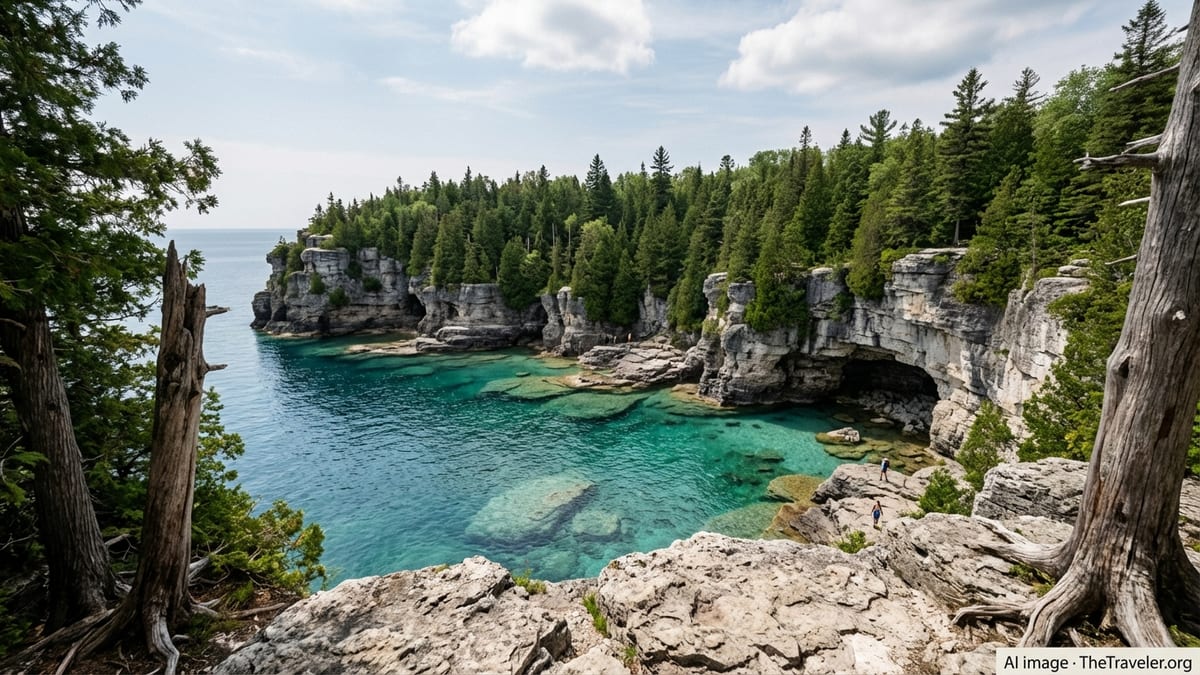
Tobermory sits where Georgian Bay meets Lake Huron, at the northern tip of the Bruce Peninsula in Ontario. The village is the gateway to both Bruce Peninsula National Park on land and Fathom Five National Marine Park offshore, a rare combination of protected cliffs, forest, and underwater shipwrecks. What draws many travelers first is the color of the water: a striking turquoise that looks almost tropical, contrasted against grey-white limestone and dense green forest.
The town itself is compact, centered around Little Tub Harbour with another picturesque basin, Big Tub Harbour, a short drive away. Wooden docks, fishing and tour boats, ice cream stands, and small inns give it a classic Canadian cottage-country feel. Yet in recent years Tobermory has surged in popularity, especially in summer and on long weekends, which has led to strict reservation systems for key sites and limited parking. Understanding this context is essential: a great visit here depends on planning ahead rather than showing up spontaneously.
Weather is another factor that shapes the Tobermory experience. Summers are warm but rarely excessively hot compared with southern Ontario, and the water remains chilly even in July and August. Spring and fall can be stunningly beautiful, with thinner crowds and vivid colors on the escarpment, but conditions are changeable and the water can be very cold. Many services scale back outside the core season, so check opening dates if you are planning an early spring or late autumn visit.
Because so much of the area is protected parkland, there is a strong focus on conservation and visitor safety. Trails can be rugged, cliffs are exposed, and shorelines are often uneven rock rather than sandy beach. Approaching Tobermory as a national park destination first and a beach town second will help you pack appropriately, choose realistic activities, and travel in a way that supports the long-term health of the place.
How to Plan Your Visit and When to Go
Peak season in Tobermory typically runs from mid June to mid September, aligning with school holidays and the warmest weather. During this time the Grotto, Flowerpot Island, and the main harbors can be extremely busy. Parking areas for the national park routinely fill early in the day, and for the Grotto you now need a confirmed parking reservation from roughly May 1 to October 31. If you are dreaming of a spontaneous beach day, this is not the destination for it in summer; advance planning is non-negotiable.
If your schedule is flexible, consider the shoulder seasons: late May to early June and mid September into October. You will likely encounter cooler temperatures and colder water, but the trails are often quieter, parking may be easier to reserve, and the forests along the escarpment glow with spring greens or fall color. Pack layers, a windproof jacket, and be prepared to adjust plans if a cold front, rain, or strong wind rolls through.
For most visitors from Toronto, the drive to Tobermory takes about four to five hours depending on traffic. Many travelers choose to stay at least two or three nights so they can schedule a Grotto visit, a day for boat tours or Flowerpot Island, and time to simply stroll the village and harbors without rushing. Day trips are technically possible but can feel compressed, especially once you account for timed parking and boat departure schedules.
Because demand is high, book accommodation, Grotto parking, and any major boat tours as early as you reasonably can, particularly for July, August, and long weekends. Give yourself some flexibility by avoiding back-to-back reservations with tight timing on the same day. A simple rule of thumb is to focus on one major anchor activity per day and fill in the rest with walks, shorter hikes, or relaxed time at the harbor.
The Grotto: Reservations, Access, and What to Expect
The Grotto is a natural sea cave carved into the Niagara Escarpment on the Georgian Bay shoreline inside Bruce Peninsula National Park. It is famous for its translucent blue water, stone arch, and dramatic cliffs. That popularity has led to one of the most managed visitor systems in the country. To access the Grotto in the main season you must reserve a timed parking permit for the Cyprus Lake area of Bruce Peninsula National Park. These permits are required from roughly May 1 to October 31 and give you a four-hour time slot to hike in, enjoy the shoreline, and return to your car.
Parking for the Grotto is at the Head of Trails area, accessed via Cyprus Lake Road off Highway 6, about 10 kilometers south of Tobermory. Reservations are handled through the national park’s central booking system, and in busy periods, time slots for popular days can sell out well in advance. When parking is fully booked, there is no other legal access to the Grotto: there are no drop-offs allowed once lots are full, walking along Cyprus Lake Road is prohibited for safety, and nearby first-come, first-served lots do not provide practical or permitted access to the Grotto shoreline itself.
Your four-hour window is usually enough time to walk to Indian Head Cove and the Grotto, swim if conditions are suitable for you, enjoy the views, and hike back. Plan to arrive at the start of your time slot so you are not rushed. The main Georgian Bay Trail from the Head of Trails parking area to the shoreline is roughly 1 kilometer and typically takes around 20 to 30 minutes each way at a moderate pace, though you should add time if you are hiking with young children or if the trail is wet.
Once you reach the shoreline, remember that access into the actual Grotto cave involves a steep, rocky scramble through a gap in the cliff. This descent is not suitable for everyone. The limestone can be slick, footing is uneven, and there is no formal staircase. Many visitors are content to admire the view from the clifftop and nearby rocks without climbing down. To keep the area safe for everyone, Parks Canada strongly discourages cliff jumping, and rescues are not uncommon when visitors ignore posted warnings. Good footwear, realistic judgment about your comfort with heights, and respect for the rules will go a long way toward ensuring your visit is memorable for the right reasons.
Hiking, Swimming, and Safety Around the Grotto
The hike to the Grotto and Indian Head Cove is part of a broader network of trails in Bruce Peninsula National Park. From the Head of Trails area you can follow well-signed routes that connect with sections of the long-distance Bruce Trail and loops around Cyprus Lake. Terrain varies from compact forest paths to exposed rock and tree roots, and the shoreline itself is almost entirely natural limestone ledges and boulders rather than sandy beach. Even in high summer, this is more a hiking and rocky-shore experience than a casual beach stroll.
If you plan to swim at Indian Head Cove or in the Grotto, be prepared for very cold water. Georgian Bay rarely warms up to typical lake-swimming temperatures, and sudden plunges can be a shock. Go slowly, stay close to shore if you are not an experienced cold-water swimmer, and avoid entering the water at all if waves are strong or if you feel uncertain. Lifejackets for weaker swimmers or children are a sensible precaution, and inflatable toys are not a substitute for proper flotation or supervision.
Footwear is key. Closed-toe shoes or hiking sandals with good grip will make the approach hike and shoreline walking far more comfortable and secure than flip-flops. The rock can be sharp in places, and puddles or spray make certain slabs slippery. Consider bringing a small daypack with water, snacks, a light jacket, sun protection, and a basic first-aid kit. There are some facilities near the Head of Trails parking area, but you should not rely on constant access to washrooms, shade, or drinking water once you are on the trail.
Above all, build extra time for moving carefully, taking photos, and simply enjoying the landscape rather than racing from viewpoint to viewpoint. The four-hour format is generous as long as you do not cut your arrival too close or underestimate how long it takes your group to hike and navigate rocky ground. Staying on marked paths, keeping off vegetation, and packing out all your garbage help protect a shoreline that is under intense pressure from visitor numbers every year.
Little Tub and Big Tub Harbors: The Heart of Tobermory
While the Grotto often dominates visitor wish lists, Tobermory’s harbors are where you will likely spend much of your time off the trail. Little Tub Harbour is the social and commercial center of the village, wrapped by a ring of inns, cottages, restaurants, and tour operators. Wooden docks host sailboats, tour vessels, and fishing boats, and in peak season the atmosphere is lively from morning until sunset, with people grabbing coffee to go on early cruises and couples lingering over dinner as the sky fades.
Many of the area’s signature experiences depart from Little Tub Harbour, including glass-bottom boat tours that glide over shallow shipwrecks and cruises to Flowerpot Island in Fathom Five National Marine Park. Even if you do not step on a boat, strolling the boardwalk, watching divers prepare their gear, and browsing small local shops gives a sense of how closely the community is tied to the water. On calm days the harbor reflects the masts and buildings in the still water, creating classic cottage-country scenes.
Big Tub Harbour, a short drive or a walk from Little Tub for those comfortable with a slightly longer stroll, has a quieter, more residential feel and is home to some of Tobermory’s best-known shipwreck viewing locations. The water here is incredibly clear, and from certain shoreline points you can sometimes see the outlines of historic wrecks just below the surface, especially on bright days without much wind. It is also the setting for the photogenic Big Tub Lighthouse, a small white structure that has become an unofficial icon of the town.
Both harbors are relatively small, and parking in their immediate vicinity can be tight in high season. Many travelers find it easier to park once near their accommodation and then walk between restaurants, docks, and shops. This not only reduces traffic on narrow local roads but also allows you to take in the details of the village, from log-style cottages to small gardens, that you might miss from a car window.
Boat Tours, Flowerpot Island, and Shipwrecks
One of the defining experiences in Tobermory is getting out on the water. Several tour operators based in the village run glass-bottom and open-deck boat trips that showcase the area’s maritime history and the rugged coastline of Fathom Five National Marine Park. A popular itinerary combines a short cruise past shallow shipwrecks with a drop-off on Flowerpot Island, allowing passengers to hike, picnic, and explore before returning on a later boat.
Flowerpot Island takes its name from two towering sea stacks along its shore that resemble massive stone flowerpots. Trails loop through forest and along the coast, passing viewpoints, the distinctive rock formations, and the island’s historic lighthouse area. Surfaces range from packed earth to rock and boardwalk, and while many families visit, you should still wear good walking shoes and carry water. The island has limited facilities, so plan to pack out everything you bring in and follow all signage about staying off fragile areas or closed sections of trail.
The region’s shipwrecks are another major draw, with more than a dozen preserved in the clear waters around Tobermory thanks to cold temperatures and the protection of the marine park. On glass-bottom tours, you can stand over panels in the deck and look down at wooden hulls, broken masts, and scattered timbers. For scuba divers and snorkelers, dedicated charters and guided trips offer closer looks at some wrecks where conditions and regulations permit. Even from the surface, however, the experience feels like peering into an underwater museum.
When booking boat tours, pay careful attention to departure times, return options, and weather policies. Summer storms, strong winds, or rough water can lead to schedule changes, and operators may adapt routes for safety. If your Grotto reservation and boat trip fall on the same day, allow more than enough time between them so you are not forced to rush between the harbor and the park. As with Grotto parking, tickets for peak dates can sell out, so reserve in advance whenever your plans are firm.
Other Outdoor Adventures Around Tobermory
Beyond the famous highlights, the wider Bruce Peninsula around Tobermory offers a range of quieter outdoor experiences. Trails branch from the national park visitor center and nearby access points, giving you the chance to walk sections of the Bruce Trail with views over Georgian Bay or through peaceful mixed forest. Some routes lead to lookouts atop the escarpment, where you can see the line of islands stretching into the bay and the stark transition from deep blue water to forested cliffs.
On calmer days, paddling is an appealing way to experience the shoreline. Kayak and canoe rentals may be available in season, allowing you to explore sheltered coves, islands near the main harbor, or sections of the coast under the guidance of local outfitters. Paddlers must be aware that the water is cold and conditions can change quickly, so staying close to shore, wearing a properly fitted lifejacket, and keeping an eye on forecasts are important safety measures.
For those interested in beaches with gentler entry, Singing Sands on the Lake Huron side of Bruce Peninsula National Park offers a different atmosphere from the rocky Georgian Bay coast. The sand flats here are shallow and can be warmer, especially on sunny days, making it a good option for families who want to wade and play at the water’s edge. Parking regulations can change seasonally, and lots may require permits or fill early during busy periods, so check current guidance before you go.
Cycling, birdwatching, and simple scenic drives down the peninsula round out the menu of activities. Even if you spend most of your time on foot, it is worth planning at least one sunset at a western-facing viewpoint, whether that is along the Lake Huron shore near Tobermory, at a roadside pull-off, or from the harbor itself as boats return for the evening.
Where to Stay, Eat, and Practical Tips
Tobermory’s lodging scene reflects its roots as a small harbor village: you will find motels, inns, cottages, bed-and-breakfasts, and seasonal campgrounds rather than large resort complexes. Many properties are family-run, and availability in July and August is tight, so it is wise to book months in advance for peak weekends. If you cannot secure a place right in Tobermory, consider neighboring communities along Highway 6 or elsewhere on the peninsula, accepting a slightly longer drive in exchange for more options.
Dining focuses on casual, hearty fare suited to active days outside. Expect fish and chips, burgers, local whitefish, pizza, and pub-style menus, along with ice cream stands and coffee shops near the waterfront. During the busiest weeks there can be waits at popular spots, especially around sunset when many people come off the water or trails at the same time. Building flexibility into your meal plans, eating a bit earlier or later, or keeping simple picnic supplies on hand can help you avoid lines and make the most of your time.
For everyday logistics, bring what you can from home or from larger centers on your route. There are small grocery stores, gas stations, and outfitters in and around Tobermory, but selection can be limited and prices reflect the remote location. Essential items such as sturdy shoes, weather-appropriate clothing, sun protection, insect repellent, and reusable water bottles are best packed before you arrive.
Finally, remember that cell coverage and data speeds can be inconsistent once you get closer to the tip of the peninsula. Download maps, reservation confirmations, and important details in advance, and do not rely on constant connectivity to navigate or pull up tickets. Keeping printed copies or screenshots of your Grotto parking permits, boat reservations, and accommodation confirmations is a simple way to reduce stress if your signal drops unexpectedly.
The Takeaway
Tobermory’s magic lies in the contrast between its small, unhurried harbor village and the dramatic landscapes that surround it. The Grotto’s luminous water, the sheer limestone cliffs of Georgian Bay, the preserved shipwrecks resting on the lakebed, and the quiet pine forests above the escarpment all combine to create an experience that feels both wild and accessible.
Because that experience is now shared by many visitors, successful trips revolve around preparation. Reserving Grotto parking in advance, booking boat tours and accommodation early, packing for rugged trails and cold water, and building extra time into each day will leave you freer to actually enjoy the views instead of worrying about logistics. Simple choices such as staying on marked paths, packing out your trash, and respecting safety warnings help ensure that the national parks and harbors remain as beautiful for future travelers as they are for you.
Whether you are hiking to the Grotto at sunrise, scanning the harbor for the outlines of shipwrecks below your boat, or watching the last light fall across Little Tub Harbour, Tobermory rewards those who approach it with patience and curiosity. Plan thoroughly, travel lightly, and let the cliffs, water, and winds of the Bruce Peninsula do the rest.
FAQ
Q1. Do I need a reservation to visit the Grotto in Tobermory?
Yes. From roughly May 1 to October 31, you must reserve a timed parking permit for the Cyprus Lake area of Bruce Peninsula National Park to access the Grotto.
Q2. How long is the hike to the Grotto and Indian Head Cove?
From the Head of Trails parking area, the Georgian Bay Trail is about 1 kilometer each way and typically takes 20 to 30 minutes at a moderate pace.
Q3. Is the climb down into the Grotto suitable for children?
The descent into the Grotto is a steep, rocky scramble without a formal staircase, so it is not recommended for very young children or anyone uncomfortable with heights or uneven footing.
Q4. Can I visit Tobermory and the Grotto as a day trip from Toronto?
It is possible but rushed. The drive takes roughly four to five hours each way, and you must fit your visit into a four-hour Grotto parking window, so an overnight stay is usually more enjoyable.
Q5. When is the best time of year to visit Tobermory?
July and August offer the warmest weather but also the largest crowds. Late May to June and September to early October can be quieter, with cooler temperatures and colder water.
Q6. Do boat tours to Flowerpot Island run in bad weather?
Tour operators may adjust routes or cancel departures if wind, waves, or storms make conditions unsafe. Always check directly with your operator on the day of your trip for the latest information.
Q7. Is the water warm enough for swimming at the Grotto?
The water in Georgian Bay stays cold even in mid summer. Many visitors still swim briefly, but you should enter slowly, stay close to shore, and be honest about your comfort level.
Q8. Can I see shipwrecks without scuba diving?
Yes. Glass-bottom boat tours from Tobermory allow you to look down at shallow wrecks, and in some spots around Big Tub Harbour you can see outlines of wrecks from the surface on clear, calm days.
Q9. Do I need a car to get around Tobermory?
A car is the most practical option for reaching Tobermory and accessing trailheads and beaches. Within the village, you can often walk between harbors, accommodations, and restaurants.
Q10. Are there alternatives if Grotto parking is sold out?
If Grotto time slots are full, you cannot legally access that shoreline at that time. Consider other park areas such as Cyprus Lake trails, Singing Sands, harbor walks, or boat tours instead.